Old Cassopolis · Part 2
The courthouse that became the Colonial
The white-columned Colonial Opera House on a card of 1913 had been the Cass County courthouse for more than half a century. It held the first county fair, temperance revivals and the courts, then was rolled across the village to become an opera house, a movie theater and finally the Gem.
By Michael Urbanski · Project Scroll · · 13 min read
This is part 2 of a series. Start with Part 1 ›

Cassopolis, Mich. A white frame building with tall columns, a pediment and a domed cupola. Across the front, in capitals: THE COLONIAL. The caption, written across the foot of the card, reads “Colonial Opera House, Cassopolis, Mich.” The card dates from 1913.
It looks like a small-town theater dressed up in its Sunday best. In fact it was the oldest public building in the village, and it had already lived one full life. For more than half a century the people of Cass County had gone through those doors to be tried, married, taxed and lectured. They had held their first county fair in it. Then the county built a stone courthouse, and the old one was put on rollers and moved across the village to begin again as a place of entertainment.
We read the contract for it in the county history of 1882, the account of its last days in the history of 1906, the trade directories that counted its seats, and a theater history that follows it to the wrecking crew. Here is the life of the building on the card, from the plans of 1839 to the last picture show.
Before the courthouse
DocumentedCass County held its first courts in borrowed rooms. The 1906 county history records that the first term of the circuit court was held at Ezra Beardsley’s house in Edwardsburg, and that Beardsley’s block house served both as a hotel and as the county’s first court house.
DocumentedWhen the county seat settled at Cassopolis, the county built a modest courthouse of its own. In October 1835, according to the 1882 history, the board of supervisors resolved to build a wooden court house of about 34 by 24 feet, at a cost of no more than $450, with desks for the judges and the bar. It stood on a lot on the west side of Broadway, not on the public square, and the carpenter Joseph Harper had the contract. That little building served the courts and the county’s business until 1841.
The Court House Company, 1839
DocumentedThe bargain that produced the building on the card was struck on 7 August 1839. The county commissioners contracted with five men who called themselves the Court House Company: Darius Shaw, Joseph Harper, Jacob Silver, Asa Kingsbury and A. H. Redfield. The price, according to the 1882 history, was $6,000, one third in cash and the rest in village lots that had been donated to the county for the county seat. The company gave a bond of $12,000.
DocumentedThe lots included the public square itself, with only the northeast quarter reserved for the building. The 1906 history puts it the same way: in 1839 the commissioners deeded the square and grounds to Asa Kingsbury and his associates, keeping only the right to build a court house on the northeast quarter.
ReadingIt was a frontier way of paying for a public building: the county traded land it had been given for a building it needed, and the builders took their profit in town lots. The arrangement would cause trouble for forty years.
DocumentedThe five were among the village’s leading men. Joseph Harper, the 1882 history says, was a carpenter who had come to Cassopolis in 1835; he built the first court house and then this one. A. H. Redfield had been the village’s first postmaster, appointed when the post office opened in 1831, according to the 1899 village directory. Asa Kingsbury kept a banking house on the square, the 1906 history records, and the 1882 history names him among the incorporators and first directors of the national bank organized at Cassopolis in November 1870.
ReadingIn other words, the men who built the court house were the same men who stood to gain most from a busy square around it: a merchant-banker, the postmaster and the village carpenter. The lots they took in payment were worth more with a county building at their center.
What the contract asked for
DocumentedThe specifications survive in the 1882 history, and they describe the building on the card. It was to be 54 feet long, 46 feet wide and 24 feet high from the sills to the eaves, built of wood on stone foundations, sided and shingled with pine and painted white. Inside there was to be a brick safe of about 16 by 17 feet with iron doors and shelving, a central hall twelve feet wide, two entrance doors, five rooms in the basement, and upstairs the courtroom and two jury rooms. The windows were to take 624 panes of glass, each ten by twelve inches. The builders had two years.
DocumentedThe 1906 history adds a homely detail: the plaster in the old court house was made of marl lime, dug from the county’s own lake beds.
DocumentedThe building was finished in 1841, and formally accepted by the county in 1842. Before it had floors it already had an audience: the 1882 history tells of the orator George Dawson speaking in the unfinished court house, roofed but not yet floored, while a Whig meeting in the Oak Grove drew off part of the crowd.
A building for everything
DocumentedFor half a century the court house was the village’s public hall. In February 1845, the 1882 history says, a temperance lecturer named Littlejohn was granted the use of it and filled it night after night for about two weeks. The Methodists held their services in the court house and the schoolhouses until 1846. Elections were held there.
DocumentedWhen the Cass County Agricultural Society held its first fair in the fall of 1851, the court house hall held the exhibits of fruit, vegetables and household goods, and Heman Redfield gave the fair address there.
DocumentedThe county soon built around it. A jail went up north of the court house, finished in the fall of 1852, and in 1860 a building for the county officers was put up on the northwest quarter of the square. The Court House Company protested that the square was theirs; the 1906 history records a decision of the state supreme court in 1880 that settled the ownership of the square, except for the ground under the court house.
DocumentedThe quarrel ran through the whole life of the building. When the county put up its jail on the court house corner, the 1906 history says, Kingsbury disputed the county’s right to the ground, and the county ended by buying the land from him.
DocumentedFrom 1882 it was also a museum. The Cass County Pioneer Society, organized at the court house in 1873, had kept its collection of relics in a member’s store. The board of supervisors had set apart a room in the court house for the society, and when C. W. Clisbee’s rental of it ran out, the secretary reported in 1882, “on the 17th day of May, we took possession of the room and removed the relics to that place,” promising show cases and labels as soon as they could be had.
ReadingThat room held, for a time, the collection that probably went later, at least in part, into the Pioneer Log Cabin Museum on Broadway. By the 1920s a museum collection, probably these relics, was in the lobby of the stone courthouse, and by the time the cabin opened as a museum in June 1924 it had moved into the cabin. Whether the relics were still in the room when the building was moved off the square in 1898–99, and where they went, is not recorded. The society and its museum are the subject of A museum before there was a museum.
DocumentedThe village walking tour sums up the building’s life: a Greek Revival court house that stood at the northeast corner of Broadway and State from 1841 to 1898 and served as the county courthouse the whole time.
Out of the square, 1898–1899
DocumentedBy the 1890s the county wanted stone. Ground was broken for the new courthouse in late July 1898 and the cornerstone was laid that October. The architects were Bowman & Rush of Grand Rapids, the contractors Biggerstaff & Atkins of Kalamazoo, and the stone came from the Bedford Quarry Company in southern Indiana. That building, at 110–120 North Broadway, still stands.
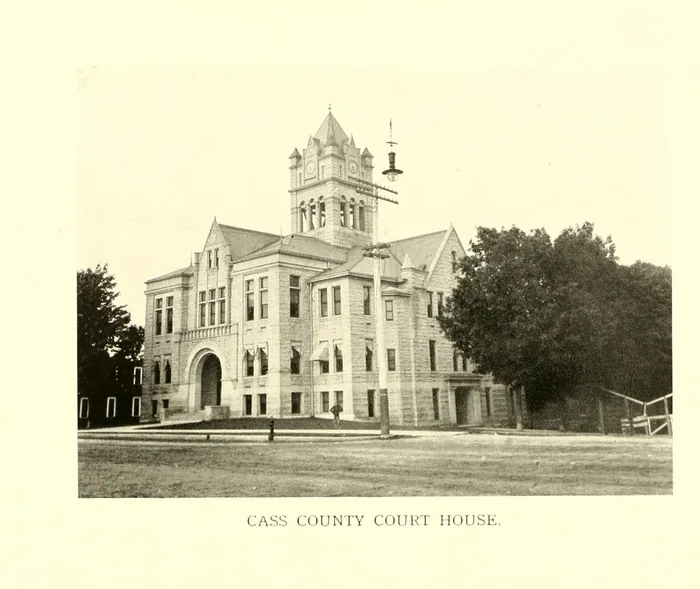
DocumentedThe building was older than it looks. It was the county’s second courthouse, a two-story frame building finished in 1841, and for more than half a century it stood on the northeast quarter of the public square. When the stone courthouse replaced it, it was sold and moved to the south side of State Street, west of Broadway. A theater history puts the move in 1899 and the new site at State and Disbrow streets; the village walking tour places it roughly across from today’s Bass Park.
DocumentedIn 1906 the county history found it there “used as a storage house.” The historian, L. H. Glover, looked at it with some feeling. Its classic lines and sturdy columns, he wrote, combined “the Greek temple with Colonial residences,” and suggested a building that had once done more important business; for more than fifty years the county’s official acts had been carried out under its roof.
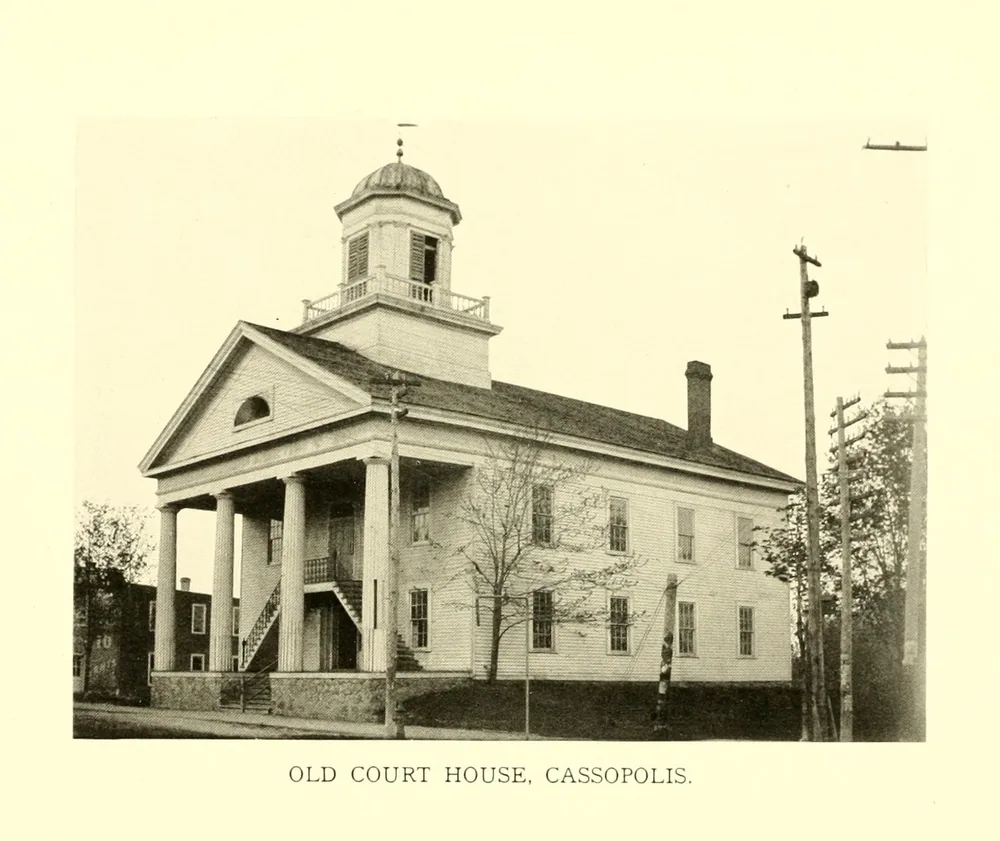
“The court house with which most of the old inhabitants of Cass county are familiar …”
The Colonial
DocumentedBy the time of the card it was a place of entertainment. A theater history says it opened as the Colonial Opera House in 1899, with 420 seats, and became the Colonial Theatre in 1909, when motion pictures were added to the bill.
DocumentedTraveling companies came to Cassopolis. The Billboard of 2 September 1911 printed the route of the Carlton Opera Company with a date at Cassopolis on the 7th, followed by La Porte, Indiana.
ReadingThe Billboard does not name the hall, but a touring opera company in a village of about fifteen hundred people would most likely have played its one opera house, the Colonial.
DocumentedThe Cassopolis column of the South Bend News-Times follows the hall from 1913. In November that year young people “attended the play, ‘Brewster’s Millions,’ at the opera house in Cassopolis.” In 1914 a revival meeting was planned “in the Colonial opera house,” and in 1915 the “Colonial opera house” had the Lyman Howe travel festival and a home-talent play. By 1916 the paper was calling it the Colonial theater, with films, the farmers’ institute and the school commencements.
DocumentedIn April 1917 the high school chorus gave a comic operetta at “the Colonial theater.” The Film Daily Year Book of 1927 lists the Colonial at Cassopolis with 476 seats.
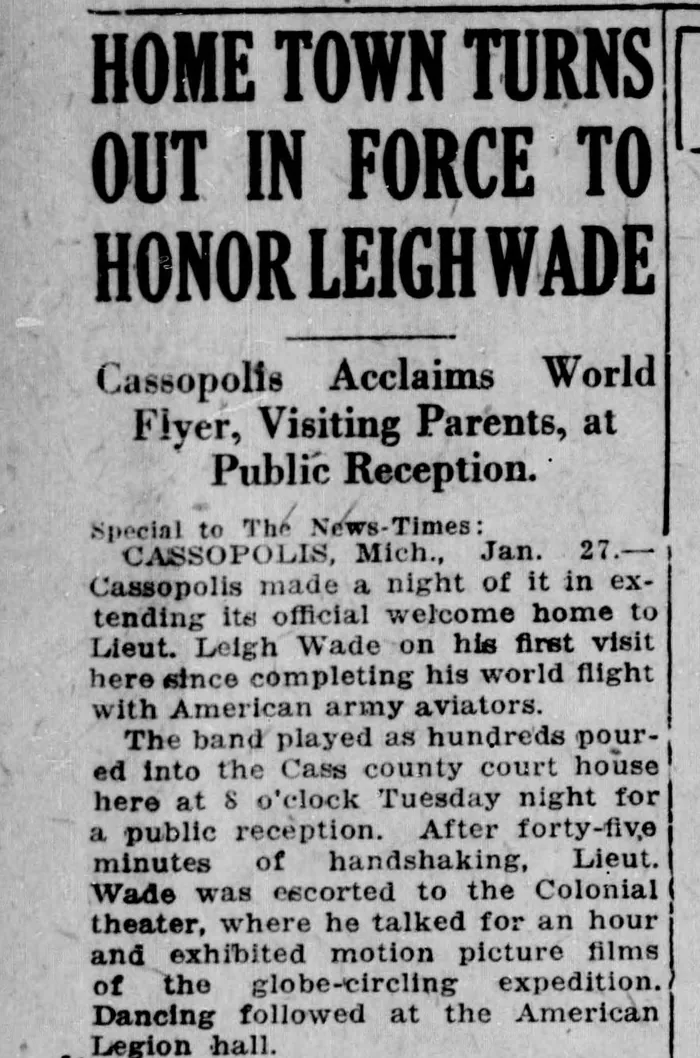
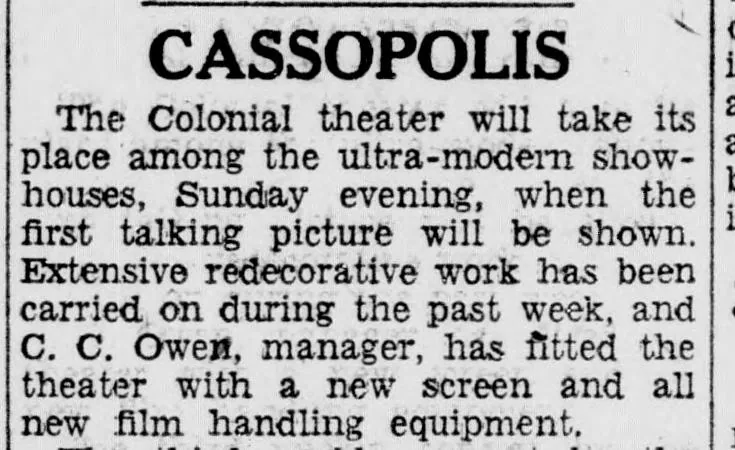
DocumentedIn June 1918 “the Colonial theater is closed,” with no shows for two weeks during a scarlet-fever quarantine. In January 1925 Lieutenant Leigh Wade, home from the first flight around the world, “talked for an hour and exhibited motion picture films” there. And in July 1929 “the first talking picture will be shown”: the manager, C. C. Owen, “has fitted the theater with a new screen and all new film handling equipment.”
The Gem, 1937–1960
DocumentedIt was remodeled in 1937 as the Gem Theatre, showed films until 1960, and was torn down in 1968. The theater history adds that the 1937 makeover was in the Streamline Modern style, that the house was equipped for CinemaScope in 1955, and that it closed in the summer of 1960. It gives the seating as 350 in one place and 420 in another.
ReadingSo the building on the card wore three faces in its life: the Greek Revival court house of 1841, the columned Colonial of the postcard, and finally a Streamline front with a marquee. Under all of them was the same timber frame the Court House Company had put up on the square, and by 1968 it was more than 125 years old.
Two points the record disputes
A theater history says it opened as the Colonial Opera House in 1899, with 420 seats, and became the Colonial Theatre in 1909. But the county history of 1906 calls it a storage house. In 1906 the historian wrote that its lines combined “the Greek temple with Colonial residences.” The earliest newspaper mention we have found of it as “the opera house” is from November 1913. If you have a program, a ticket or a diary entry that settles it, write to research@projectscroll.com.
ReadingOne way to square the two accounts: the building may have been used as a hall only now and then in its first years on State Street, and as storage in between, before it became a regular theater. The 1909 date for movies, and the name THE COLONIAL across the front in 1913, fit a building that came fully into its own as a theater after Glover saw it.
The 1839 specifications, as the 1882 history summarizes them, do not mention a cupola or columns.
A timeline
- 1835 First Cassopolis court house, about 34 by 24 feet, built by Joseph Harper on the west side of Broadway
- 1839 7 August: contract with the Court House Company for a new court house, $6,000
- 1841 The new court house finished on the northeast quarter of the square
- 1845 Temperance lectures fill the court house for two weeks
- 1851 The first county fair’s exhibits in the court house hall
- 1882 17 May: the Pioneer Society moves its museum of relics into a room of the court house
- 1898 Ground broken for the stone courthouse in late July; cornerstone in October
- 1899 The old court house moved to State Street; opens as the Colonial Opera House (theater history)
- 1906 Glover finds it “used as a storage house”
- 1909 Renamed the Colonial Theatre; films added
- 1913 The real-photo card; “the opera house” in the News-Times, November
- 1918 Closed two weeks for scarlet fever, June
- 1925 Leigh Wade, round-the-world flier, speaks and shows films, January
- 1927 Listed with 476 seats
- 1929 The first talking picture, July
- 1937 Remodeled as the Gem Theatre
- 1955 Equipped for CinemaScope
- 1960 Closes in the summer
- 1968 Torn down
If you go
ReadingThe old building is gone, but its two homes are public ground. The 1898 courthouse at 110–120 North Broadway stands on the old square, where the 1841 court house stood on the northeast quarter; walk south across State Street and west toward Disbrow Street to the site of the Colonial and the Gem, roughly across from Bass Park.
Sources
- L. H. Glover, A Twentieth Century History of Cass County, Michigan (Chicago, 1906): the old court house “now” on the south side of State Street, “used as a storage house.” Internet Archive.
- Cassopolis column, South Bend News-Times, 10 April 1917, p. 12 (the operetta at the Colonial theater). Hoosier State Chronicles.
- The Film Daily Film Year Book 1927 (Cassopolis: Colonial, 476 seats). Internet Archive.
- Gem Theatre, Cassopolis, MI. Cinema Treasures.
- Cassopolis Historic Walking Tour (the 1841 courthouse). Cass County Council on Aging with the Cass District Library Local History Branch.
- The Colonial Opera House, Cassopolis, Mich (real-photo postcard, 1913). David V. Tinder Collection of Michigan Photography, William L. Clements Library, University of Michigan.
- History of Cass County, Michigan (Chicago: Waterman, Watkins & Co., 1882): the first court house of 1835; the contract of 7 August 1839 and its specifications; uses of the court house; the agricultural society’s first fair. Internet Archive.
- The Billboard, 2 September 1911 (route of the Carlton Opera Company: Cassopolis, Mich., 7th). Internet Archive.
- Report of the secretary, ninth annual reunion of the Cass County Pioneer Society (1882): the court-house room, 17 May. Michigan Pioneer and Historical Collections, vol. 29. Internet Archive.
- Cassopolis column, South Bend News-Times: 28 November 1913, 12 November 1914, 5 November 1915, June 1918, 28 January 1925, 12 July 1929. Library of Congress, Chronicling America.
- South Bend News-Times, 28 January 1925, p. 11: “Home Town Turns Out in Force to Honor Leigh Wade.” Chronicling America, Library of Congress.
- South Bend News-Times, 12 July 1929, p. 20 (Cassopolis column: the first talking picture at the Colonial). Chronicling America, Library of Congress.
Numbers in the text point to this list; entries without a number are further sources we consulted. How we research › · The libraries behind all our stories ›
Stand where it stood: the village walk Do you know when it opened? Write to us See the old Cassopolis cards
Corrections (1)
First published 22 October 2026; last updated 25 October 2026. Like all our pages, it is expanded from time to time with new records, pictures and features. Factual corrections are listed here, with their dates.
- The date of the relics’ move into the log cabin is not recorded; the collection was probably, not certainly, the Pioneer Society’s.
About this research
Research and reporting Michael Urbanski Project Scroll
- Sources
- Every fact on this page is drawn from the sources listed above, and each can be checked where it is held.
- Corrections
- Errors are corrected on the page, and each correction is noted there.
- Contact
- To report an error or share a record that adds to the story, write to research@projectscroll.com.
- Method
- How we research ›
© 2026 Michael Urbanski and Project Scroll. All rights reserved. The text, original maps, charts and illustrations may not be reproduced without permission; brief quotations with credit and a link back are welcome. Material from other sources belongs to its holders and is credited where it appears; public-domain material is marked as such.


