
E Clampus Vitus · Part 1
A lodge of E Clampus Vitus, in Cassopolis, in 1846
One account, printed in two county histories, records a lodge of the “Ancient and Honorable Order of Eclampsus Vitus” at Cassopolis, Michigan, in the spring of 1846: four charter members named, a ball of over two hundred badges, and the earliest lodge of the order yet found with its members named. Newspapers of the same year show the order already at work across the state line in Indiana. Here is the whole record, and what it does and does not prove.
By Michael Urbanski · Project Scroll · First published · Updated · 56 min read

New finding 12 new findings in this story. See what’s new ›
Cassopolis, Mich. Picture a winter night in the county seat of a frontier county not yet twenty years old. The frame tavern on the square is lit up. Inside, more than two hundred people are wearing the badges of a secret society that came to town only that spring, with a name few of them could have spelled the same way twice: the “Ancient and Honorable Order of Eclampsus Vitus.” It is the winter of 1846–47, and the lodge’s four founders are young men, none of them past twenty-five. Within a year the lodge will be gone, leaving only a few lines in two county histories.
The order was E Clampus Vitus. No one knows what its name means, not even its own members; and what happens at its initiation, they have kept to themselves ever since. This is the story of the earliest lodge of the order yet found with its members named: six years before the order is first heard of in California, and eighty-five years before Carl Wheat revived it in San Francisco, here it is in Michigan.
In 1875 the first history of Cass County, Michigan, printed a short account of “the first Secret Society, of which there is any record” in the county: a lodge of the “Ancient and Honorable Order of the Eclampsus Vitus,” instituted at Cassopolis in the spring of 1846. Seven years later a second county history printed it again. Neither book was written for the order now known as E Clampus Vitus, and so far as we can find, no historian of that order has ever cited either one.
New, 2 November 2026: Lafayette, Indiana, where members met in “the Tent Room” in February 1848, is now on the trail map and the chart of how long each lodge waited to be written down; and the Indiana House’s joke of 1847 gets its due in Exhibit C.
- 4charter members, named
- 200“over two hundred badges” at the ball
- 3Beall sisters who married into the lodge
- 29years before anyone wrote it down
The case in brief
What the record shows
- A lodge at Cassopolis, spring 1846, with four charter members named, a ball of “over two hundred badges” at the Union Hotel, a collapse in 1847 and a revival in 1860 (Rogers, 1875; Mathews, 1882).
- A family affair. Three of the four founders married sisters of one family, the Bealls.
- The order alive in Indiana in 1846: a lodge at Connersville by February, Tent No. 43 at Indianapolis by July, and a “Jackson Lodge” at Centreville that came before the legislature for a charter.
- The legislature’s answer was a joke at the order’s expense, printed in the official House Journal of January 1847.
A word to the Brethren
If you wear the red shirt, you know the story: Ephraim Bee and his commission, Joel Henry Zumwalt carrying the ritual to Hangtown, the lodge at Mokelumne Hill by 1851, and Carl Wheat bringing the order back to life in San Francisco, over lunch at the Clift Hotel in December 1931. You also know the line in the order’s own 1966 history, that by 1849 “the East and Middle West were dotted with Clamper Lodges,” not one of them named.
This page names one. It comes with a hall, a ball and four charter members, in the spring of 1846. And the newspapers of that year, just over the state line in Indiana, show the order alive and growing: a lodge at Connersville, a Tent No. 43 at Indianapolis meeting “in full regalia,” and a bill before the legislature to charter a lodge at Centreville. Credo quia absurdum, the motto runs: I believe because it is absurd. Here you will not need to. Every statement below is marked Documented (the record says so) or Reading (our interpretation of it), and every source is listed at the foot of the page.
Who’s who
- Dr. Evan J. Bonine 1821–1892 · charter member
- Quaker-born physician from Richmond, Indiana, who learned medicine at Centreville and married there in 1844; practicing at Cassopolis at twenty-four. Went overland to California in 1849 and came back in 1851. Later surgeon of the 2nd Michigan Infantry, state legislator, and mayor and postmaster of Niles.
- Laban Harter 1826–1888 · charter member
- Born at Eaton, Ohio. He married Emily Beall at Cassopolis in 1847, went to California with Bonine, and became a merchant at Niles.
- Jordan P. Osborn 1823–by 1906 · charter member
- Of Cassopolis, a harness-maker there from 1844; son-in-law of Eber Root, the innkeeper of the Union Hotel; later a village trustee and, in 1875 and 1876, President of the Village. Still keeping his harness shop on North Broadway in 1899; “the late J. P. Osborn” by 1906 (Glover).
- Dr. Leander Osborn 1825–1901 · charter member
- Jordan’s nephew. He began to read medicine under Bonine in 1847 and became the doctor at Vandalia.
- The Beall sisters Evaline, Emily P. and Helen M.
- Daughters of Nathaniel Beall, a farmer near Centreville, Indiana, and Sarah Talbot, who were married at Centreville in 1826; their mother was a niece of Dr. Bonine’s mother, also Sarah Talbot. They married Bonine, Harter and Leander Osborn.
- Dr. John Prichet 1803–1884 · the teacher
- Physician of Centreville, Indiana, in whose office Bonine read medicine for three and a half years; the husband of Emily Talbot, a sister of Mrs. Bonine’s mother. He went overland to California in 1849 by the Truckee route, worked the camps near Yuba City and Sacramento, and came home by Panama in 1851; his journals are at the Indiana State Library. The trail west ›
- James M. Shepard 1842–1927 · the storyteller
- Cassopolis dentist from 1868, later owner of the Cassopolis Vigilant and state senator. He was three years old in 1846, so his account of about 1875 is not his own memory; he helped with the county history of 1882.
- Eber Root the innkeeper
- Licensed to keep a tavern at Cassopolis on 24 January 1832. His frame tavern still bore the name “Union Hotel” in 1882, and a history of 1899 names it as the Union Hotel where the Masons met in 1852. His second house, the Cassopolis Hotel (Glover calls it the Cassopolis House) on the east side of the square, burned in 1859; it had a ball-room of its own, where the Odd Fellows were instituted on 18 February 1847. So the record names two hotels that season, and by our reading the ball was at the one called the Union. His daughter Isabella married the charter member Jordan P. Osborn. He retired to a farm “early in the fifties” and died on 19 June 1862 (Mathews).
- Howard S. Rogers and Alfred Mathews the historians
- Authors of the county histories of 1875 and 1882 that printed Shepard’s account.
- Ephraim Bee 1802–1888 · the founder, by legend
- Innkeeper and blacksmith of West Union, in what is now West Virginia, from whom the order traces its descent.
- Joel Henry Zumwalt 1831–1906 · the man who carried it west
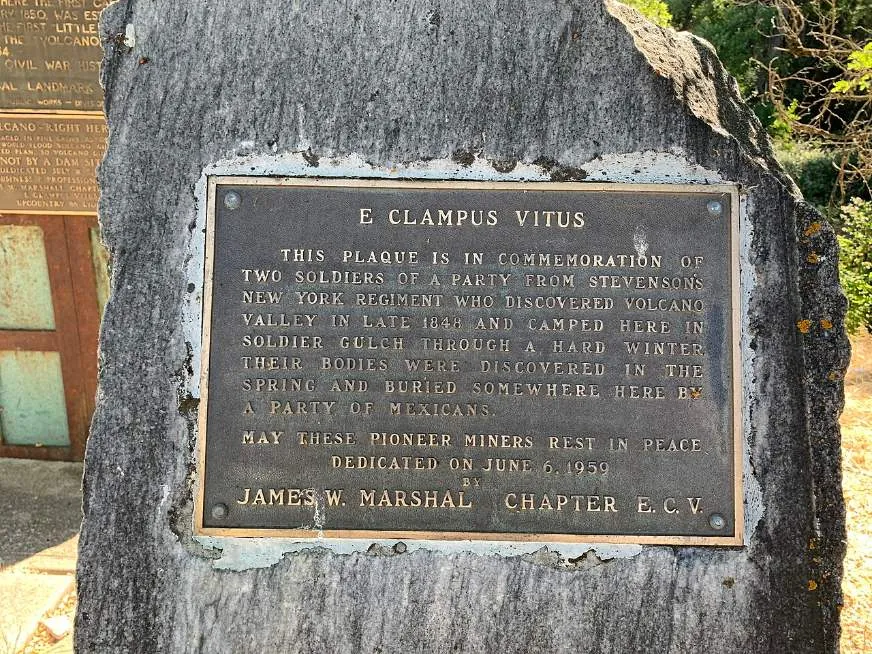
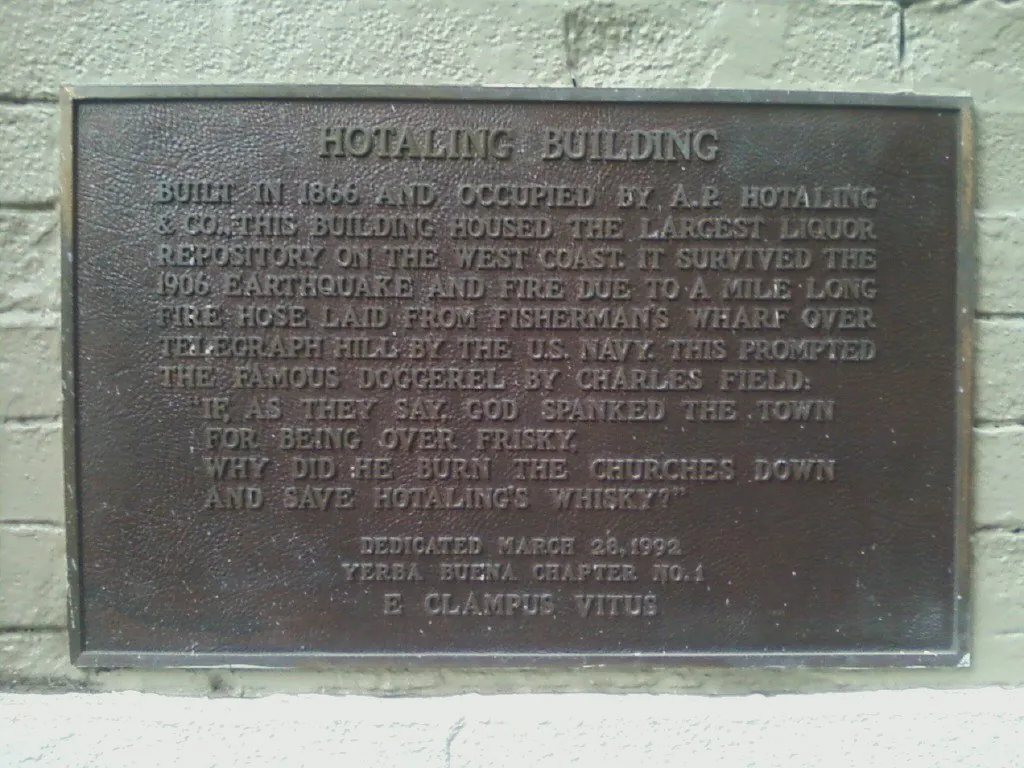
- Said by the order to have brought the ritual to Hangtown in 1849 and to have founded the lodge at Mokelumne Hill by 1851. The order long called him Joseph; its Grand Council set the name right with a granite plaque at his grave in Mokelumne Hill, dedicated on 20 May 2021.
- Carl I. Wheat the reviver
- Revived the order in San Francisco in 1931 and, by the order’s historian, chose the spelling “Clampus,” which was already in print by 1852.
Exhibit A: the page that started it
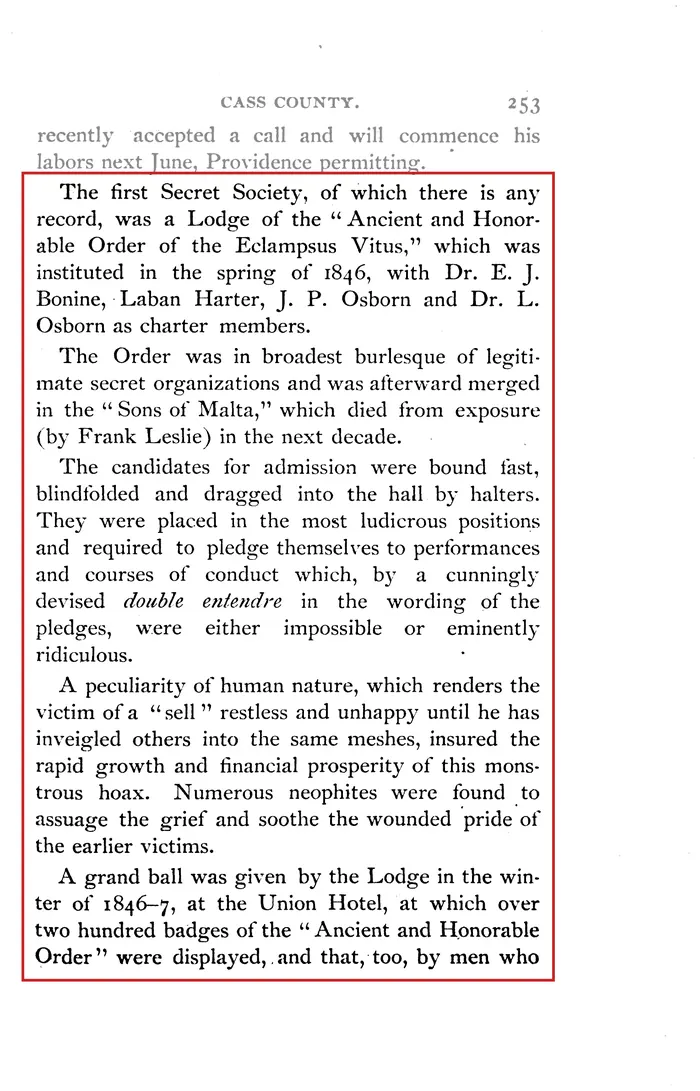
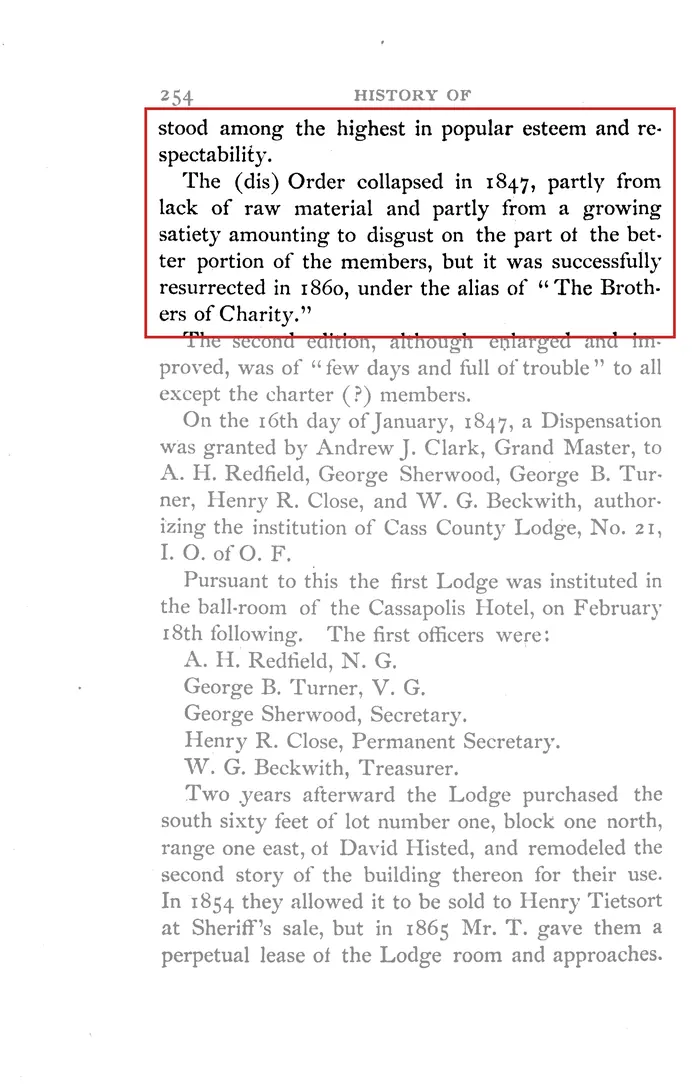
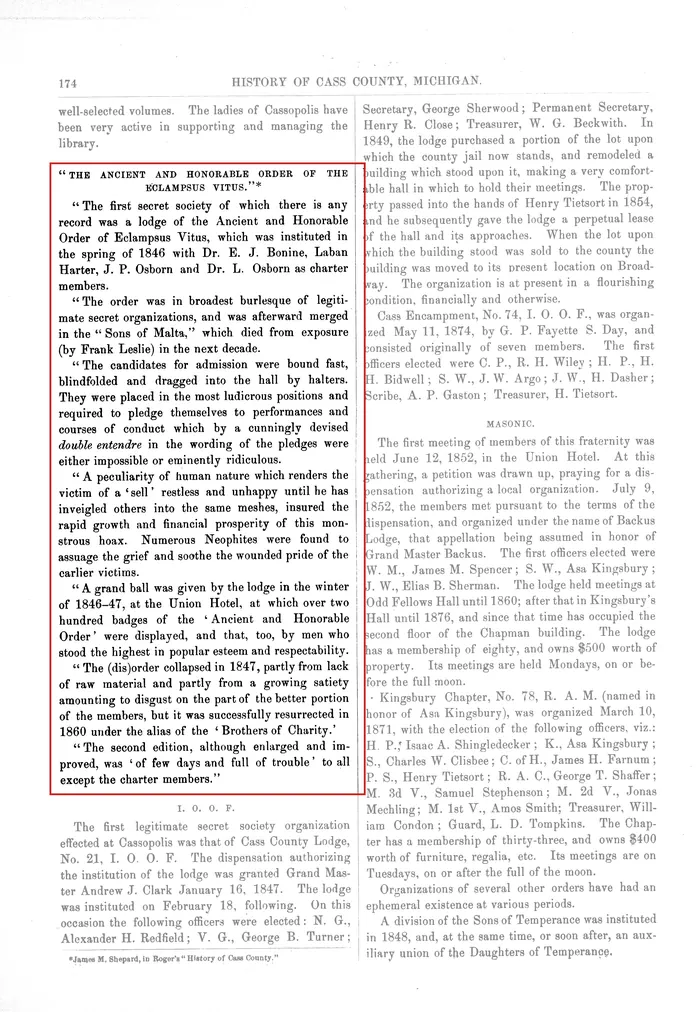
This is the passage as Alfred Mathews printed it in 1882, page 174, under the heading “The Ancient and Honorable Order of the Eclampsus Vitus.” A footnote credits it to “James M. Shepard, in Roger’s [sic] ‘History of Cass County.’” It is reproduced in full; the page photographs are below.
“The first secret society of which there is any record was a lodge of the Ancient and Honorable Order of Eclampsus Vitus, which was instituted in the spring of 1846 with Dr. E. J. Bonine, Laban Harter, J. P. Osborn and Dr. L. Osborn as charter members.
“The order was in broadest burlesque of legitimate secret organizations, and was afterward merged in the ‘Sons of Malta,’ which died from exposure (by Frank Leslie) in the next decade.
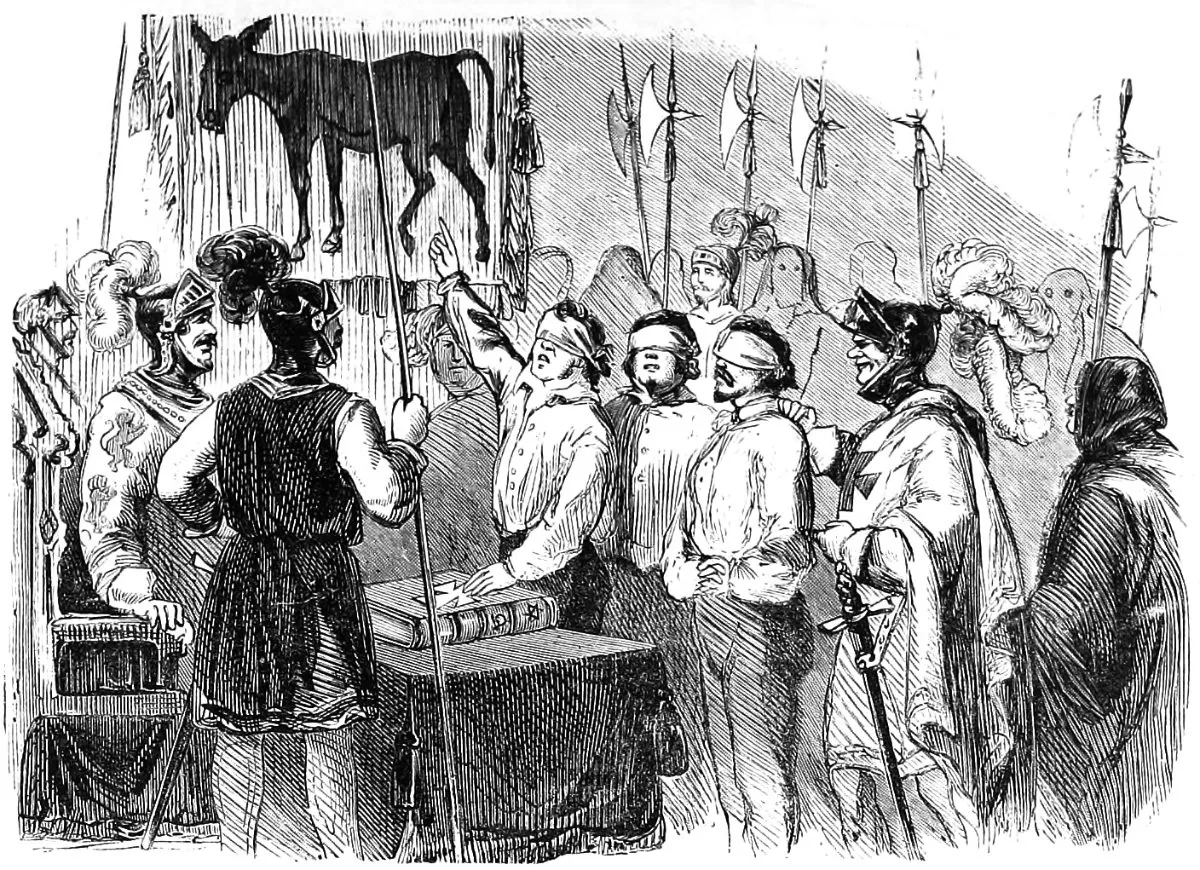
“The candidates for admission were bound fast, blindfolded and dragged into the hall by halters. They were placed in the most ludicrous positions and required to pledge themselves to performances and courses of conduct which by a cunningly devised double entendre in the wording of the pledges were either impossible or eminently ridiculous.
“A peculiarity of human nature which renders the victim of a ‘sell’ restless and unhappy until he has inveigled others into the same meshes, insured the rapid growth and financial prosperity of this monstrous hoax. Numerous Neophites [sic] were found to assuage the grief and soothe the wounded pride of the earlier victims.
“A grand ball was given by the lodge in the winter of 1846–47, at the Union Hotel, at which over two hundred badges of the ‘Ancient and Honorable Order’ were displayed, and that, too, by men who stood the highest in popular esteem and respectability.
“The (dis)order collapsed in 1847, partly from lack of raw material and partly from a growing satiety amounting to disgust on the part of the better portion of the members, but it was successfully resurrected in 1860 under the alias of the ‘Brothers of Charity.’
“The second edition, although enlarged and improved, was of ‘few days and full of trouble’ to all except the charter members.”
The original, in Howard S. Rogers’s History of Cass County, from 1825 to 1875 (Cassopolis, 1875), pages 253 and 254, differs in small ways that matter. Rogers prints the order’s name as “the ‘Ancient and Honorable Order of the Eclampsus Vitus,’” the respectable men as those who “stood among the highest,” and the last line as “to all except the charter (?) members.” The question mark is in the 1875 text; Mathews dropped it. The phrase “of few days, and full of trouble” is from the Book of Job (14:1), an old funeral text.

The storyteller: who wrote it
Mathews names the author: James M. Shepard. He did not see the lodge. Shepard was a small child in 1846. He was born at North Brookfield, Massachusetts, on 24 November 1842, and died at Cassopolis on 13 August 1927, by the Library of Michigan’s record of the legislature. The Cass County books of 1882, 1893 and 1906 give the year of his birth as 1840; Michigan Biographies of 1924 and the death notice in the American Foreign Service Journal, which gives his age as 84, agree on 1842, and so does Wesleyan University’s alumni record of 191178, which gives his full name, James Melville Shepard, a student of the class of 1864 who left in his junior year. He came to Cassopolis only on 3 September 1868, as the village dentist; he joined the Cassopolis Vigilant in 1876 and became its sole proprietor in 1878, and was elected to the Michigan Senate in 1878 (Glover, 1906, pp. 556–558). Later, from 1897 to 1916, he was American consul at Hamilton, Ontario. When he wrote, in about 1875, all four of the founders were still living in or near the county. The account is a written record of local memory, set down about thirty years after the events, and it should be read as that, not as a minute book.
Exhibit B: the newspapers of 1846
New findingShepard wrote his account about thirty years after the fact. The newspapers of 1846 did not wait. Just over the state line, in Indiana, the order was in print that very year, and its first notice uses the very spelling of the Cassopolis account.
Indiana American, Brookville · 27 February 1846
From a letter written at Connersville: it says that “both of these learned expositors of news,” two editors, are “naturally qualified members of the ‘Eclampsus Vitus’ society, an order of which, we have in our town.”
Indiana State Sentinel, Indianapolis · 15 and 16 July 1846
“The members of Tent No. 43 of the order of Eclampees Vitus are notified to meet in their Hall on Thursday Evening, July 16, at early candle lighting, attired in full regalia. A general attendance is requested. By order.”
Indiana House of Representatives · winter of 1846–47
Mr. Julian of Wayne County brought in a bill “to incorporate the ancient order of E-clam-peis Vitus” (Indiana State Sentinel, 7 January 1847); the Richmond Palladium of 5 January says it was for a lodge “at Centreville.” On 6 January the committee on corporations recommended its “indefinite postponement,” and the bill was laid on the table; the Sentinel reported it on 14 January.
Quotations are from the newspapers’ scanned pages at Hoosier State Chronicles. The scans are worn and their machine-read text is garbled in places (where the Sentinel’s type reads “Eclampees,” the machine-read text gives “Eclumpees”), so we quote them as closely as the pages allow.
ReadingSo when the Cassopolis lodge was “instituted” in the spring of 1846, the order was already a going concern in Indiana: a lodge at Connersville by February, a “Tent No. 43” at Indianapolis by July, and a lodge at Centreville that wanted a charter from the state. That last detail is worth a smile: Shepard put a question mark after the Cassopolis “charter,” and the Centreville brethren actually asked the legislature for one. Exhibit C tells how that went.
New findingThe Centreville connection. The road from Centreville to Cassopolis runs straight through the founders’ family. The Beall sisters were born at Centreville, where their father, Nathaniel Beall, farmed 160 acres until he died there in January 1845. Dr. Bonine read medicine at Centreville for three and a half years under Dr. John Prichet (Michigan Legislative Biography; Pricket in Cope), and Dr. Prichet had married the girls’ aunt, Emily Talbot. Bonine married the eldest sister, Evaline, at Centreville on 8 August 1844, and brought her to Cassopolis. Her sister Emily married Laban Harter in September 1847; a younger sister, Helen, married Dr. Leander Osborn in 1854 (Cope, Genealogy of the Sharpless Family, 1887).
Exhibit C: the Jackson Lodge and the Indiana House
New findingThe official Journal of the House of Representatives of Indiana for 1846–47 gives the Centreville lodge its name. On leave granted, Mr. Julian, one of the four members for Wayne County (the Journal lists them as William S. Addleman, Jacob B. Julian, Solomon Meredith and Robert Gordon), brought in House bill No. 242, “An act to incorporate Jackson Lodge of the ancient order of Eclampses Vitus, of Centreville, Indiana.” It was read twice and sent to the committee on corporations.
New findingThe days, from the Journal itself. The Journal dates every sitting, and its headings fix the bill’s short life. Mr. Julian brought it in on the afternoon of Wednesday, 30 December 1846 (page 259); on the afternoon of 31 December it was read a second time and sent to the committee on corporations (page 272); and the committee’s joke was read to the House on Wednesday, 6 January 1847 (page 345). The 14 January sometimes given is only the date the Indiana State Sentinel printed the news. So the Centreville brethren’s charter lived for a week, from the last days of 1846 to Epiphany, which any Clamper will agree was about as long as it deserved.

DocumentedThe committee’s report, printed in full in the Journal, is one of the funniest pages a state legislature ever published:
“The committee on corporations, to which was referred bill of the House No. 242, entitled ‘An act to incorporate the Jackson Lodge of the ancient order of Eclampses Vitus, of Centreville, Indiana,’ have had the same under consideration, and are not able to ascertain from the bill itself what objects are to be attained by the proposed corporation; but if they are correctly informed from other sources, the bill is for the benefit of a species of animals with which the country is now abundantly supplied, and of which it is not desirable either to increase the number or improve the breed. They therefore recommend that it be indefinitely postponed.”
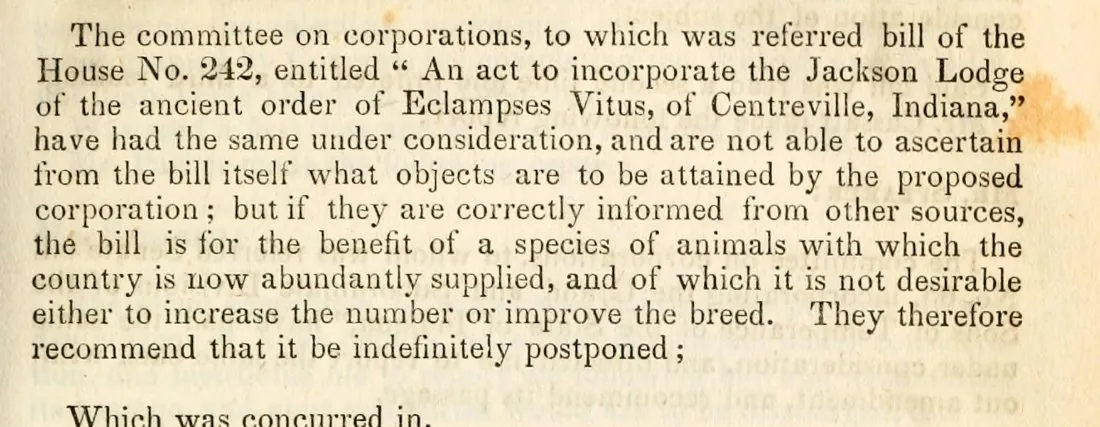
ReadingThe House concurred, and the bill was laid on the table. The committee never names the animal, and it did not need to: the same session had before it a bill “for the improvement of the breed of horses and mules” in Blackford County, and within a fortnight of the report its title had grown to “horses, jack-asses, and mules.” The joke is that the brethren were asses, and the Clampers of any age will recognise the kind of compliment it is. It was the first joke at the order’s expense that served it well: the committee’s laugh is the reason the Jackson Lodge survives in the state’s official record at all. That winter the legislature also had before it the Senate’s bill No. 65, “to incorporate the grand and subordinate divisions of the Sons of Temperance”: the earnest order and its burlesque, before one legislature in one session.
DocumentedWe have searched the Indiana House and Senate journals and the session laws from 1842 to 1853 for the order under any of its spellings. This is the only bill.
Exhibit D: the four founders
DocumentedDr. Evan J. Bonine. Born at Richmond, Wayne County, Indiana, on 10 September 1821, of Quaker family: a son of Isaac and Sarah (Talbot) Bonine, which made him a younger brother of James E. Bonine, whose farm at Vandalia is the subject of The Bonine House at Vandalia; read medicine at Centreville, Indiana, and graduated from the Ohio Medical College at Cincinnati in 1843; married Evaline (Eveline) Beall at Centreville on 8 August 1844 and practiced at Cassopolis. His mother and his wife’s mother were both named Sarah Talbot, aunt and niece (see below). He was twenty-four in the spring of 1846. In 1849 he went overland to California with his brother-in-law Laban Harter, and returned in 1851 to settle at Vandalia, a few miles from Cassopolis, as its physician and postmaster. In politics he went from Whig to Free-Soiler and was among those who formed the Republican Party. He was surgeon of the 2nd Michigan Infantry in the Civil War, and later Surgeon-in-Chief of the 3rd Division, 9th Army Corps. He sat in the Michigan House for Cass County (1853) and Berrien County (1865–68, 1873) and in the Senate (1869–70), and was mayor and postmaster of Niles, where he died in December 1892. (Michigan Legislative Biography; Portrait and Biographical Record of Berrien and Cass Counties, 1893, quoting the Niles Daily Star.)
New findingTwo Sarah Talbots. Read the Sharpless genealogy entry by entry and the lodge’s family knot pulls tighter. Dr. Bonine’s mother, Sarah Talbot, born near Winchester, Virginia, in 1791, was a daughter of Jacob and Susanna (Sharples) Talbot, who had married at Middletown Meeting in Pennsylvania in 1770. Her elder brother Samuel, a millwright, carpenter and architect, brought his family from Wythe County, Virginia, to Centreville, Indiana, in 1822, and his daughter, another Sarah, born in 1804, became Mrs. Nathaniel Beall: the mother of the three sisters. So the two mothers were aunt and niece, and both were Sarah Talbot. When Evan Bonine married Evaline Beall in 1844 he married his first cousin’s daughter, and when Laban Harter and Leander Osborn married her sisters, they married into the doctor’s own mother’s family. The Bonines and the Talbots had come north together: “Upon the marriage of Isaac Bonine and Sarah Talbot, both families removed from Tennessee, on account of slavery, to Wayne Co., Indiana,” and the Bonines came on to Cass County in 1842. In the very year of the lodge the family was there in strength: the doctor’s uncle John Talbot died “about 1846, at Isaac Bonine’s, Cass Co., Mich.” And the gold that drew Bonine, Harter and Dr. Prichet west in 1849 kept one of the Talbots: the sisters’ uncle Martin Sharpless Talbot, a merchant, died in California in 1853, unmarried. (Cope, 1887, pp. 275, 413–416, 734–736, 749.)
DocumentedLaban Harter. Of the four he was the least known, and he is now the best placed. He was born at Eaton, Preble County, Ohio, on 28 April 1826, a son of Joseph Harter and Mary Howell (Cope, 1887), so he was nineteen or twenty in the spring of 1846. He married Emily P. Beall at Cassopolis on 5 September 1847, when she was fifteen, and became a merchant at Niles. He died on 10 July 1888 and is buried at Silverbrook Cemetery, Niles, beside his wife Emily P. Harter (1832–1910) (Friends of Silverbrook Cemetery, grave records, lot City 21). Their only daughter, Martha, was “born on a farm near Niles Nov. 10, 1848” (Niles Daily Sun, 26 October 1914), so the young couple were settled near Niles before he went west with Bonine in 1849. Two later records place him in the town: an “L. Harter, Treasurer,” of the Niles Horse-Thief Association, organized in May 1853 (Ellis and Johnson, 1880), and “the old Loban [sic] Harter residence” at Niles, where Bonine’s son Dr. Fred N. Bonine was born on 21 October 1863 (Niles Daily Star, 23 August 1941).
DocumentedJ. P. Osborn: Jordan P. Osborn. Born 6 August 1823, a son of the Quaker minister Charles Osborn; named by Mathews as “Jordan P., who is a resident of Cassopolis,” and later a village trustee and, in 1875 and again in 1876, President of the Village of Cassopolis (Mathews, 1882). He was twenty-two in the spring of 1846. His elder brother Parker B. Osborn, born 1821, kept a harness shop at Cassopolis but removed to Wilmington, Ohio; the charter’s initials, J. P., point to Jordan.
New findingThe innkeeper’s son-in-law. Mathews gives two more facts about Jordan Osborn that place him at the heart of the story. “Harness was first manufactured and sold by P. B. Osborn as early as 1843. J. P. Osborn, his brother, went into business with him in 1844, and since 1847 has carried on the business alone”: so Jordan was keeping shop in the village the spring the lodge was instituted. And in his sketch of Eber Root, the innkeeper of the Union Hotel, Mathews lists Root’s children: “Isabella (Mrs. J. P. Osborn), Mary (Worthington) and Jane (wife of L. D. Smith)” (p. 178). The Root family’s genealogy had already recorded the marriage in 1870: Eber Root’s daughter “Isabel, m. Jordan Osborn of Cassopolis” (no. 1432). One charter member was the hotel-keeper’s son-in-law. Jordan’s sister, Mathews adds, was “Mrs. James B. Bonine, of Penn”: one more thread between the Osborns and the Bonines. ReadingWhen Rogers printed the story in 1875, Jordan Osborn was President of the Village, living in it, and married into the family of the house where the ball was held. Of everyone alive that year, he is the likeliest to have told Shepard.
DocumentedDr. L. Osborn: Dr. Leander Osborn, of Vandalia. Born 27 December 1825, a son of Josiah Osborn and grandson of Charles Osborn (Mathews, 1882). He began reading medicine with Dr. Bonine in 1847 and was afterward his partner for two years. He married Helen M. Beall of Centreville on 12 November 1854 (Mathews, 1882), and was “a successful physician at Vandalia” (Portrait and Biographical Record, 1893, biography of his brother Jefferson Osborn). He was twenty in the spring of 1846 and not yet a doctor: the title in the 1875 account is the one he held when it was written.
New findingThree sisters. When their brother Nathaniel Beall of Niles died in September 1898, his obituary listed among his survivors “Mesdames E.J. Bonine and Laban Harter,” of Niles, and, a few lines on, “Mrs. Osborne, of Vandalia” (Niles Daily Star, 12 September 1898, reprinted in the Niles Weekly Mirror, 14 September 1898). Bonine married Evaline Beall at Centreville in 1844, Harter married Emily at Cassopolis in 1847, and Leander Osborn married Helen in 1854. Three of the lodge’s four charter members married sisters of one family. ReadingSo the lodge was very nearly a family affair: a young doctor, two men who were or would become his brothers-in-law, and Jordan Osborn, the uncle of one of them. Of the three who married Beall sisters, only Bonine was married in 1846; Harter and Leander Osborn married into the family afterward, so the lodge may have helped make the family, as much as the family made the lodge. Two of the four, Bonine and Harter, would be in California within three years.
farmer near Centreville, Indiana; m. Sarah Talbot there, 11 January 1826; d. 1845
- Evaline Beallb. 1826 · m. Centreville, 8 Aug 1844Dr. Evan J. Bonine
- Emily P. Beallb. 1832 · m. Cassopolis, 5 Sep 1847Laban Harter
- Helen M. Beallb. 1834 · m. Calvin, Mich., 12 Nov 1854Dr. Leander Osborn
The sisters’ mother, Sarah (Talbot) Beall, was a niece of Dr. Bonine’s mother, Sarah (Talbot) Bonine: so the doctor married his first cousin’s daughter. The fourth, Jordan P. Osborn, was Leander’s uncle: both descend from Charles Osborn. Sources: Cope, Genealogy of the Sharpless Family (1887); Mathews (1882); obituary of Nathaniel Beall, 1898.
DocumentedThe Osborns and the Bonines. The lodge was not the only tie between the two families. Sarah S. Osborn, a daughter of Charles and Hannah Osborn, came to Cass County with her parents in 1843 and married James B. Bonine at Porter, Cass County, on 3 September 1848. He was a son of Hannah (East) Bonine and a farmer of a hundred acres at Vandalia, not the James E. Bonine of the Vandalia house (Cope, 1887). She died at Vandalia on 13 October 1885, an overseer of the Vandalia Monthly Meeting (The Christian Worker and Gospel Expositor, 5 November 1885). As Charles Osborn’s daughter she was an aunt of the charter member Leander Osborn.
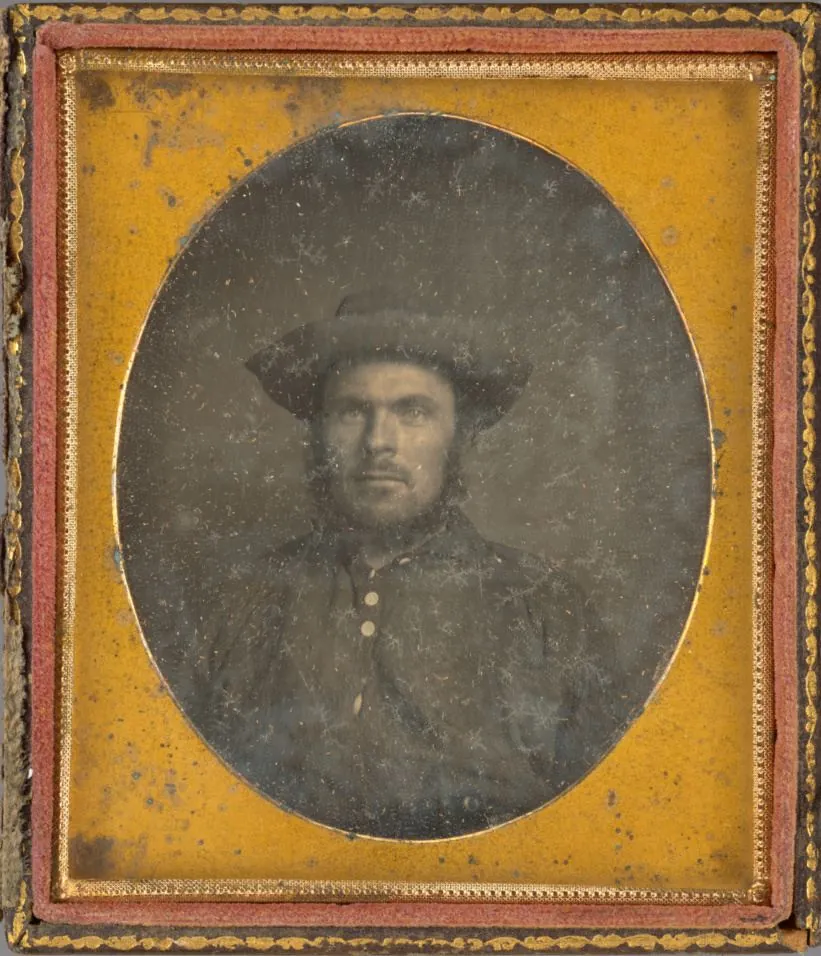
Bonine and Harter went overland to California in 1849, and Bonine came home in 1851: the very years the order took root in the diggings. These are the diggings as the daguerreotypists saw them then.
- Spring 1849: Cassopolis to Independence, Missouri, the jumping-off place of the California road.
- Across the plains by Fort Kearny and Fort Laramie. The usual landmarks of the road.
- Over South Pass to Fort Hall. Fort Hall is on the route Townley gives for the “Dr. Bonine” diary (The Trail West, 1988).
- Down the Humboldt and over the Sierra by the Truckee to the diggings near Sacramento and Yuba City, where Dr. Prichet spent the next two years. Townley; the Prichet journals, Indiana State Library L130.
- 1851: home again. Bonine came back to Michigan; Harter settled at Niles as a merchant. Niles Daily Star, 29 December 1892, in the Portrait and Biographical Record (1893).
State outlines: U.S. Census Bureau, via us-atlas. Stops placed by their coordinates.
New findingThe trail west. A bibliography of the overland trails lists a diary kept by “Dr. Bonine” in 1849, on the road from Independence by Fort Hall and the Truckee River, and gives its home as the Fort St. Joseph Museum at Niles (John M. Townley, The Trail West, 1988). Bonine had learned his medicine in “the office of Dr. J. Prichet, of Centerville, Ind.,” for three and a half years (Mathews, 1882, p. 97), and Prichet was family: he had married Emily Talbot, a sister of Mrs. Bonine’s mother (Cope, 1887, p. 735, where the name is spelled Pricket). Prichet too “went over the plains to California, 1849” (Cope). His first journal opens at Centreville on 26 March 1849 (Indiana State Library, L130, box 1, folder 7) and goes by steamboat down the Ohio and up the Missouri to Independence, then overland by the Truckee route; he spent the next two years in the mining camps near Yuba City and Sacramento before sailing home by way of Panama. His three journals are at the Indiana State Library (collection L130).
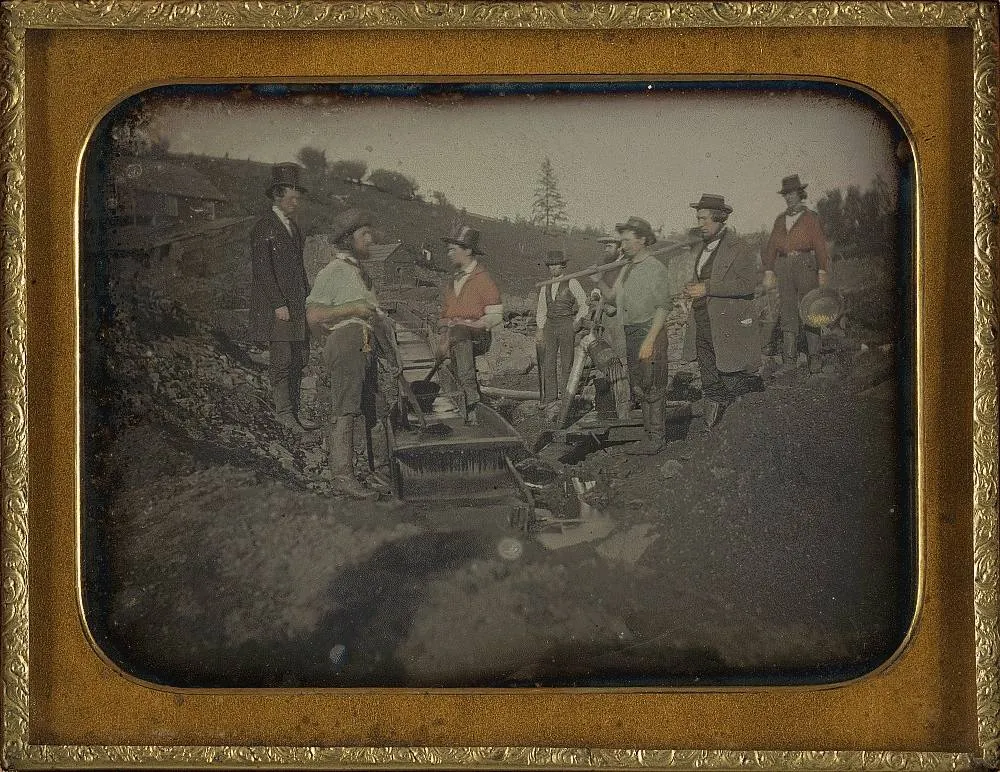
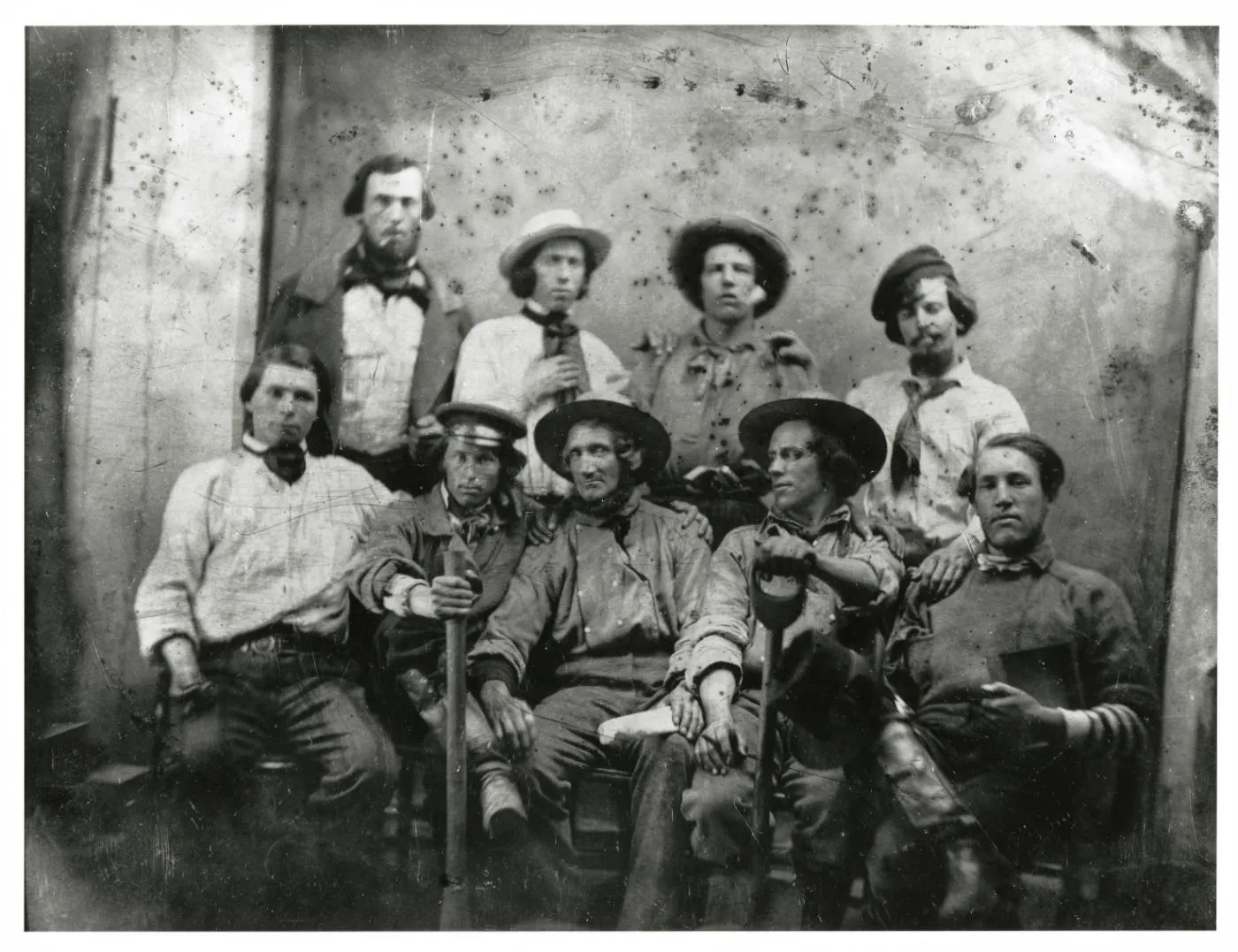
Exhibit E: the room
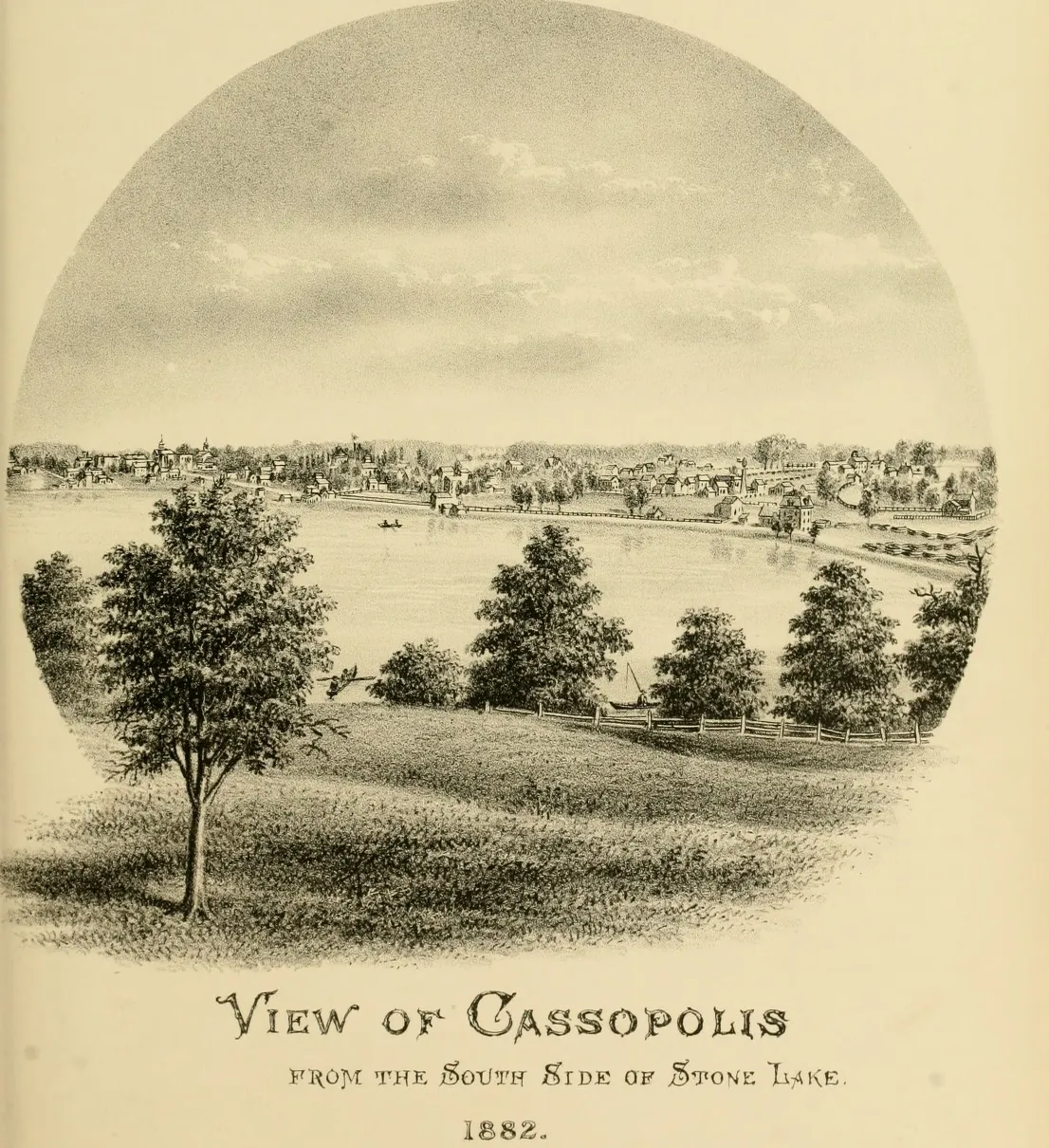
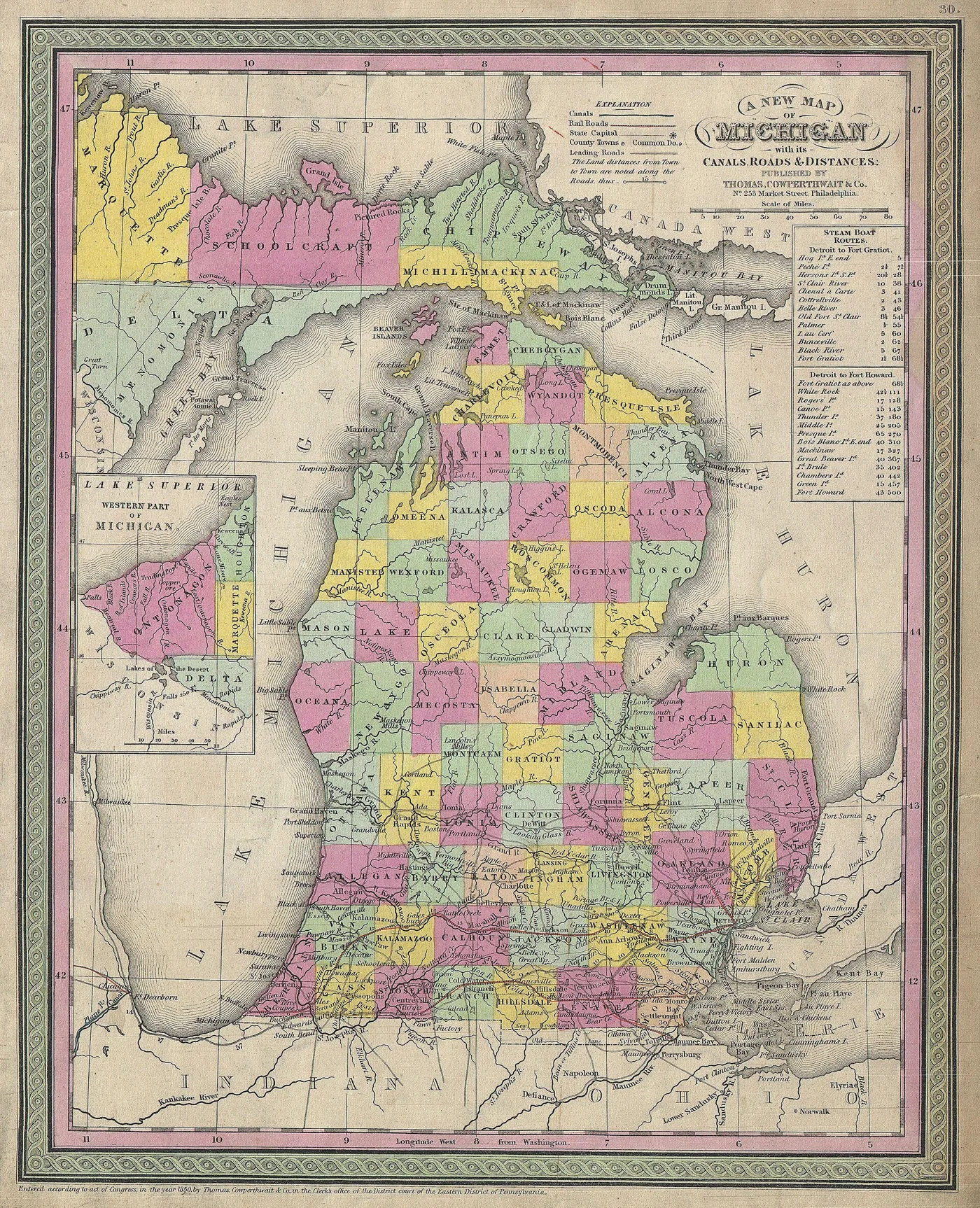
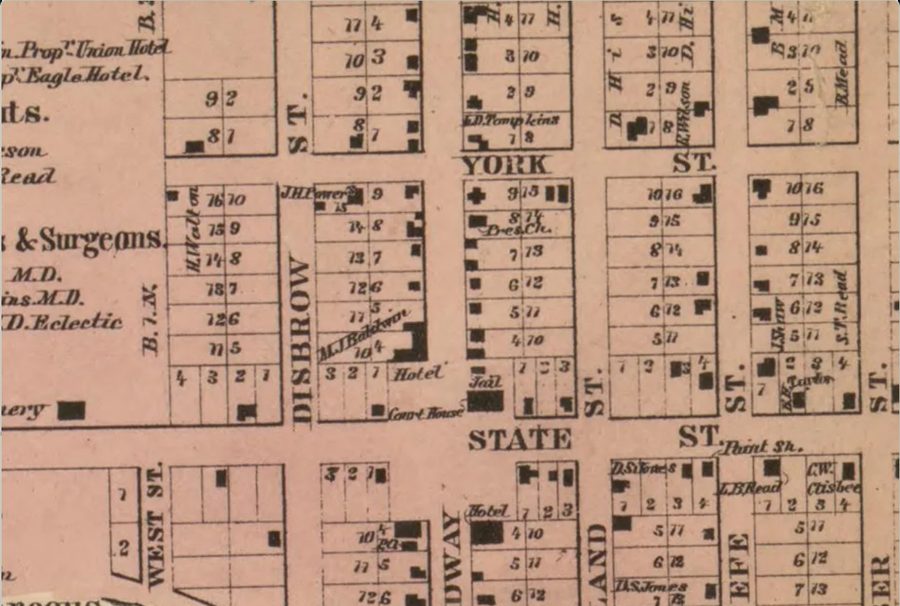
DocumentedThe Union Hotel was the frame tavern built by Eber Root, one of the first two men licensed to keep a tavern in Cassopolis, on 24 January 1832 (Rogers, 1875). It stood on the west side of Broadway at the public square (Glover, 1906). The 1860 wall map of Cass, Van Buren and Berrien counties prints one word on that block: HOTEL. Five years after the ball, on 12 June 1852, the Masons of Cassopolis held their first meeting “in the Union Hotel” (Mathews, 1882, p. 174): the kind of order the burlesque was made to mock, organizing under the same roof. The corner is still there; the hotel is not, and there is no marker. What became of the building is the subject of Case 2.
Did you know? The square the lodge danced beside was chosen with a stick. In the fall of 1831 two young men, Elias B. Sherman and Alexander H. Redfield, walked over from Edwardsburg, stopped at Abram Tietsort’s cabin on the lake and climbed “the beautiful elevation, now the public square.” Redfield cut a hickory pole with his pocket knife, measured it with his hands to about a rod, paced forty rods from the section corner to the top of the hill, and planted the pole there. The county seat was soon fixed on that spot. A brush fire later burned all but a stub; Redfield kept it thirty-seven years, had it made into a cane and gave it to the village in 1868 (his letter, in Mathews, 1882, p. 156). By the winter of the ball he was selling drugs and books on the same square (Mathews, 1882, p. 169).
Walk the town of 1846 in 3D › The Union Hotel and the court house of 1841 rebuilt from the county histories, with the stores, shops, churches and school of the time placed from the record and the fire maps, each marked with how we know; Redfield’s pole stands as a ghost at the centre of the square. Or see the hotel lit for the ball, winter 1846–47.
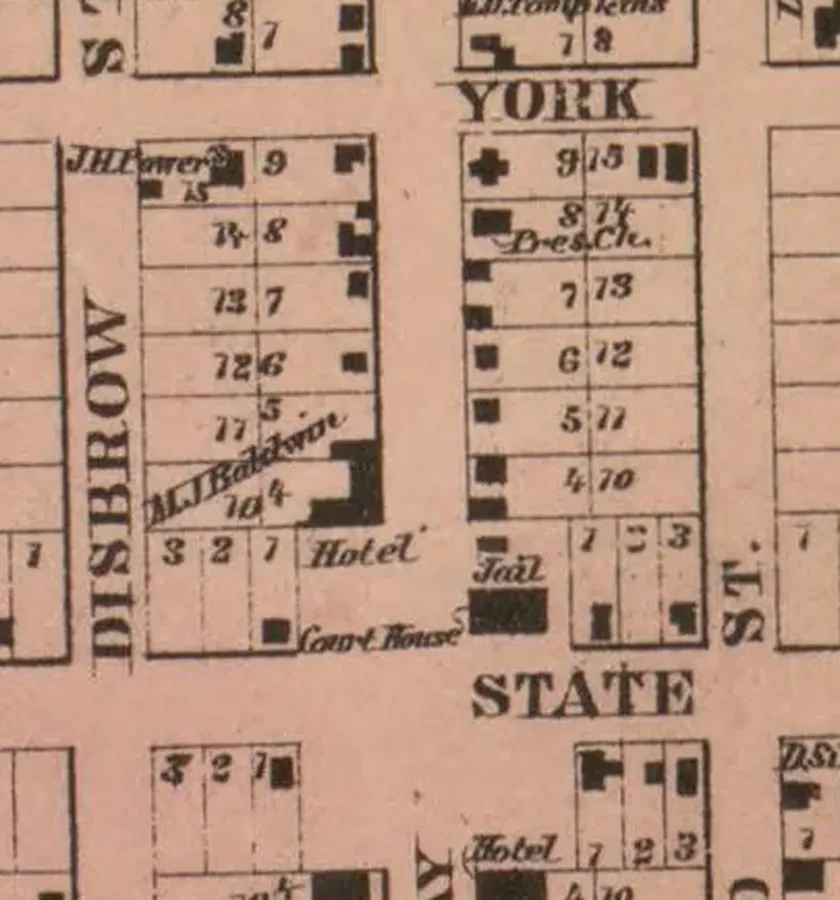
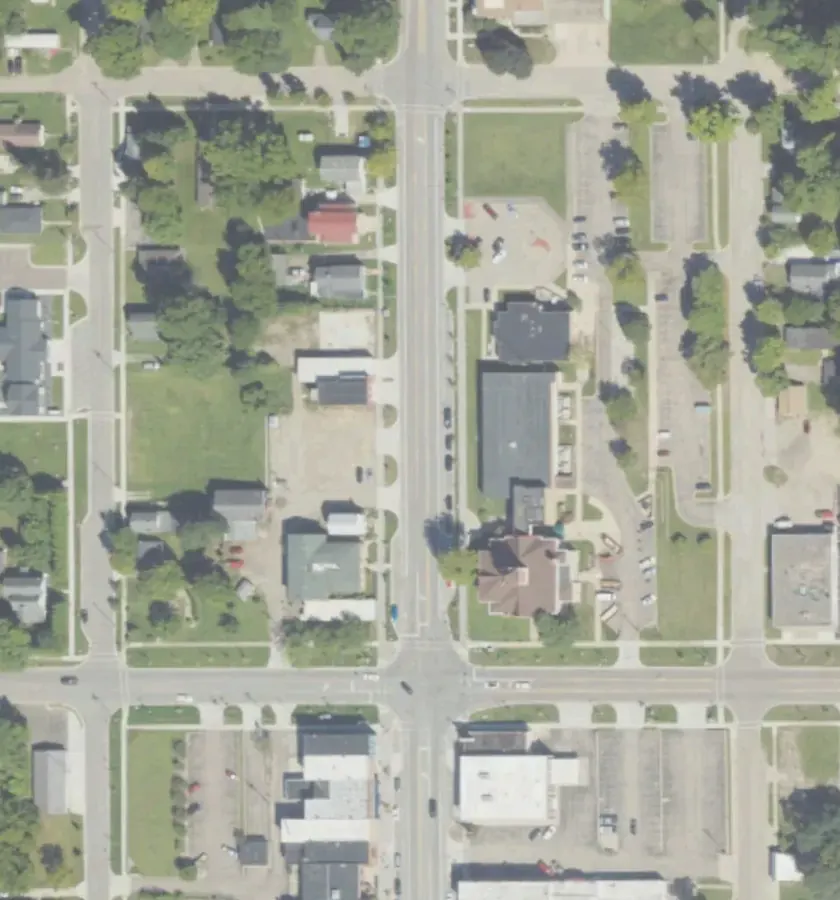
The Union Hotel’s corner, then and now. Drag the line. On the left, Broadway and State Street on the town plan of the 1860 wall map, with “Hotel” on the block on the west side of Broadway at the square; on the right, the same ground from the air today. North is up. The two are laid together as on our then-and-now map of Cassopolis: fitted at nineteen street corners that keep their 1860 names, the old corners land on average within about five yards of the new. 1860: Geil, Harley & Siverd, Map of the Counties of Cass, Van Buren and Berrien, Michigan (1860), Library of Congress, public domain. Today: aerial photograph, USDA National Agriculture Imagery Program, public domain.
DocumentedTwo hotels, two names. That same winter the village had a second hotel with a ball-room: the Odd Fellows were instituted on 18 February 1847 “in the ball-room of the Cassapolis Hotel” (Rogers, 1875, p. 254), “a frame building standing on the lot now occupied by the Baptist church which was burnt down in 1859” (Glover, in Norton’s Directory, 1899, pp. 237–238). That is Root’s second hotel (Mathews, p. 170). The Union Hotel was the other house: “the building afterwards turned into the planing mill” (Norton, 1899, p. 238), “on the west side of Broadway … built by Eber Root” (Glover, 1906, p. 146). The name is in print by December 1859, in M. J. Baldwin’s advertisement in the Cass County Republican: “UNION HOTEL. M. J. BALDWIN, PROPRIETOR, CASSAPOLIS.” ReadingWe believe the ball was held in Root’s first tavern, the Union Hotel; that the house bore that name as early as 1846–47 is our reading, since the earliest record of the name written at the time is the advertisement of 1859.
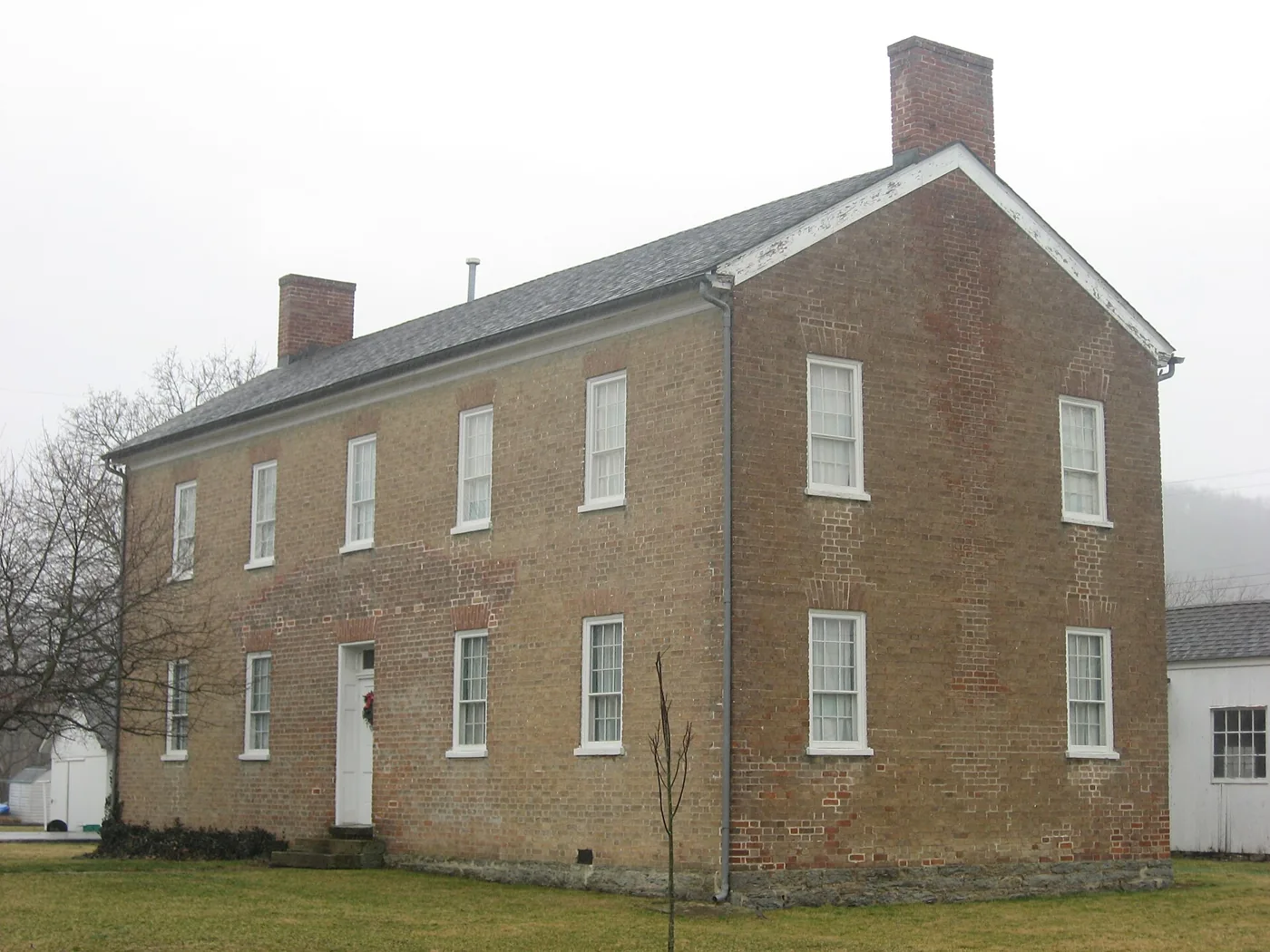
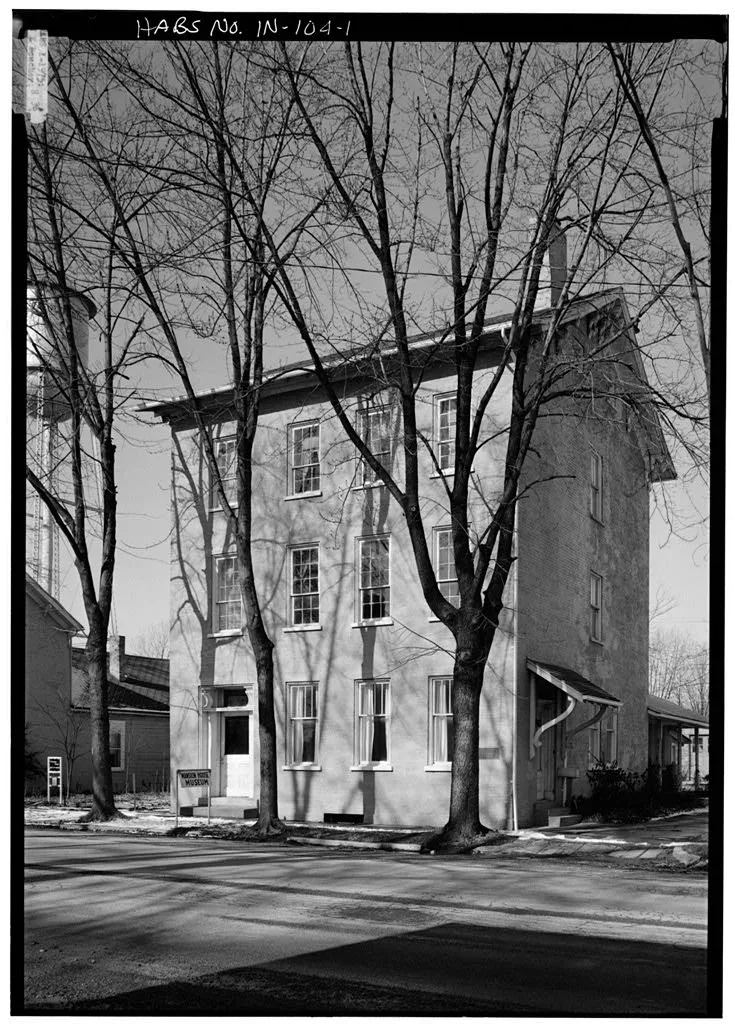
New findingThe hotel in 1882. Mathews tells what became of it, four pages before the lodge: “Mr. Root erected a frame building where the Cass House now stands.” And: “Root’s hotel is at present the planing-mill of Matthew Lindsey, and still bears in faded letters the name, ‘Union Hotel.’ It was moved away from its original site in 1867, when the Cass House was built by M. J. Baldwin” (Mathews, 1882, p. 170). So the ballroom’s building outlived its corner by at least fifteen years, working as a mill with its old name fading on the boards. Its later story is told in Case 2: The hotel that walked away.
Exhibit F: what became of the lodge
Did you know? When the Cassopolis lodge came back to life in 1860, it took a new name: “The Brothers of Charity.” The county history says it was afterward merged into the Sons of Malta, another burlesque order of the day.
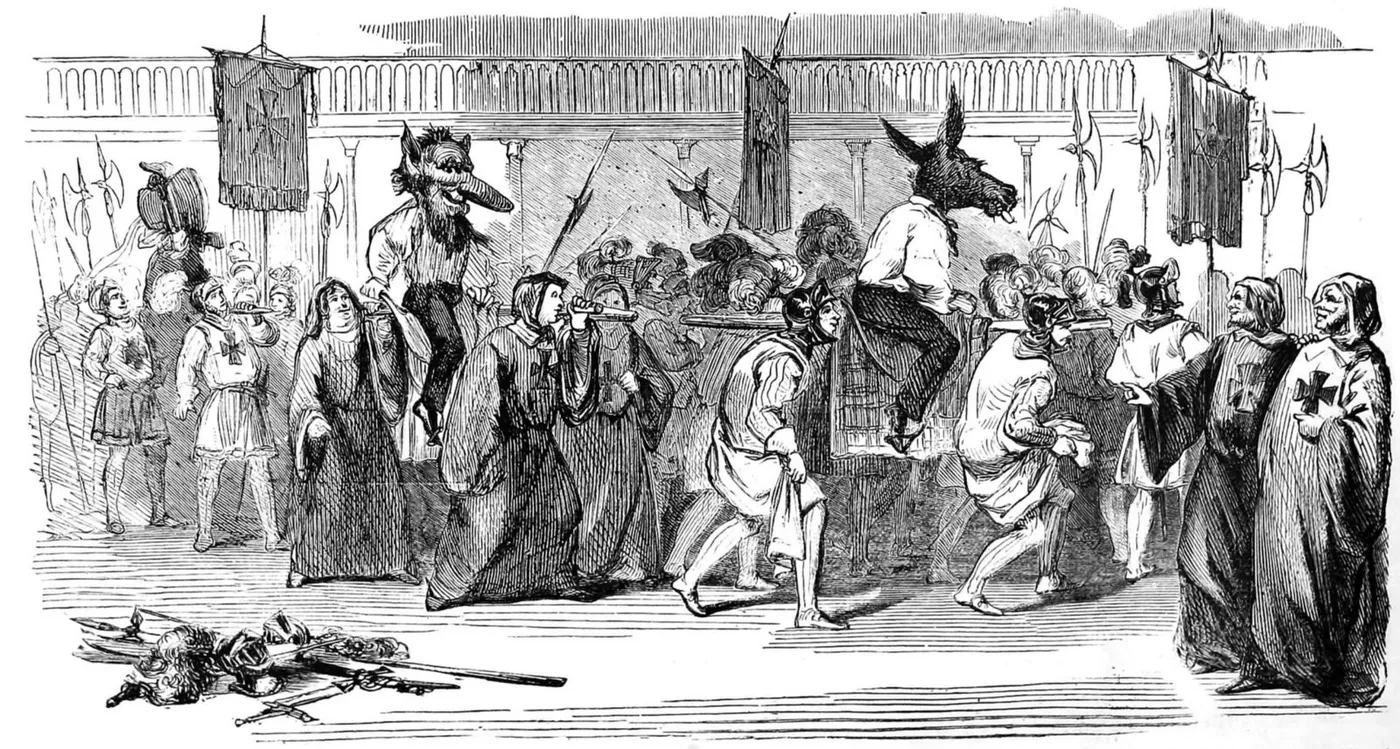
DocumentedBy the account’s own words, the lodge collapsed in 1847 and was “resurrected in 1860 under the alias of the ‘Brothers of Charity,’” and the order “was afterward merged in the ‘Sons of Malta,’ which died from exposure (by Frank Leslie) in the next decade.”
ReadingThat merger needs care. No lodge of the Sons of Malta is dated before 1854 (a New Orleans lodge, November 1854), so the lodge of 1846, gone by 1847, cannot have merged into it. The revival of 1860 could have, but only just. The Sons of Malta had reached Michigan by 1859, when a lodge was organized at Grand Rapids “largely for the cultivation of whatever was comic, droll or ridiculous” (Baxter, 1891). Then, in the first weeks of 1860, the order was exposed in print: the “Council of Ten” in Frank Leslie’s Illustrated Newspaper of 11 February 1860, a “Grand Exposure” in Vanity Fair of 25 February, and Thomas Williams’s pamphlet The Sons of Malta Exposed (New York, 1860). Shepard’s “died from exposure” is a pun on exactly that. A Cassopolis revival of 1860 could have joined the Sons of Malta only in that narrow window. The record shows no lodge of the Sons of Malta at Cassopolis or Niles, and no other burlesque “Brothers of Charity.”
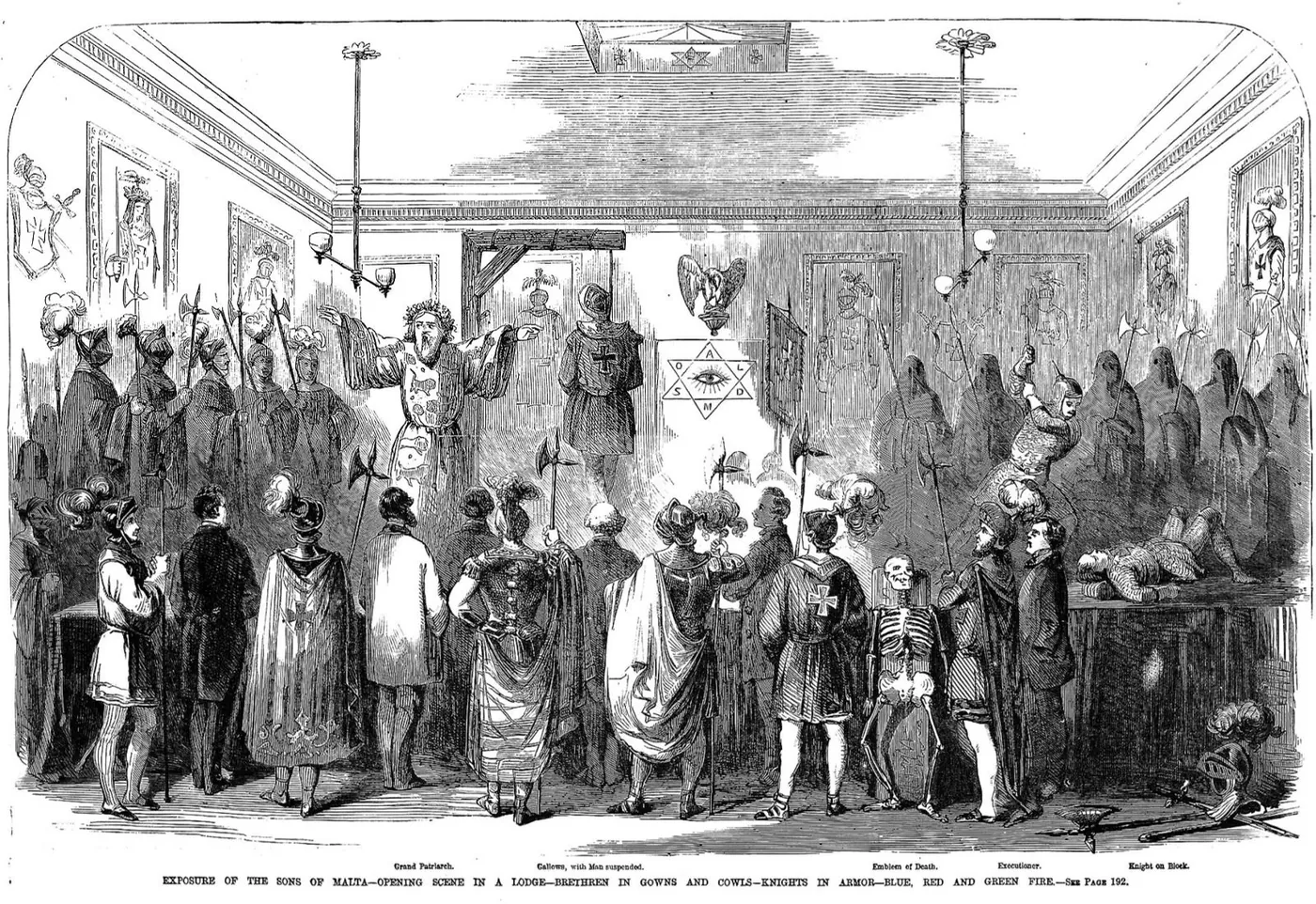
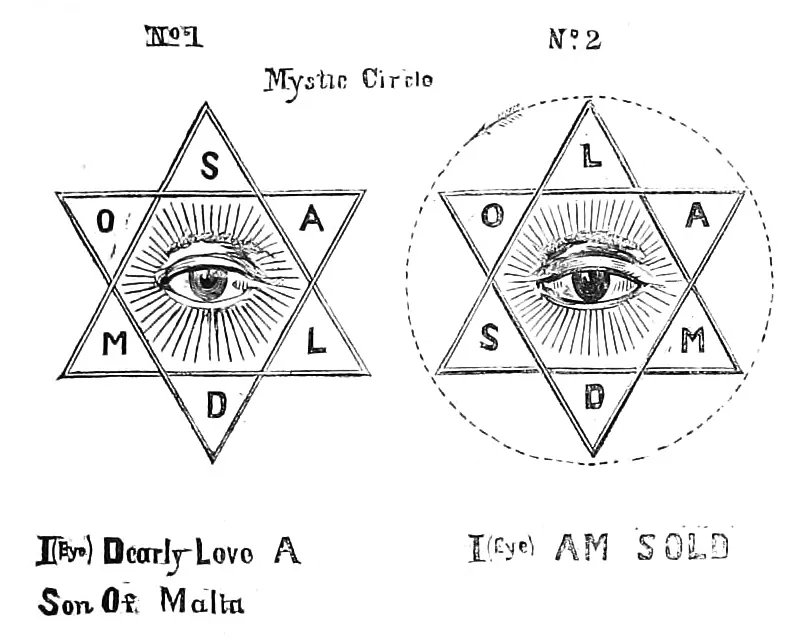
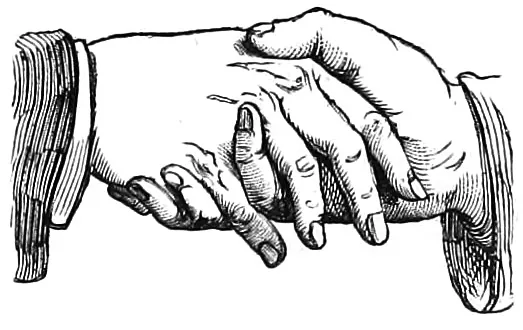
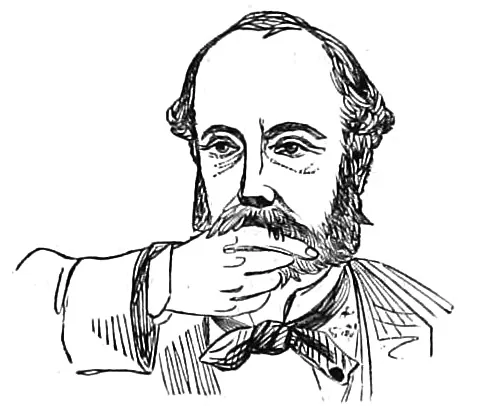
Leslie’s artist spared nothing: hooded brethren, knights in armour, a skeleton, a gallows and, at the centre, the candidate. In later numbers came the initiation itself, and the signs and grips that were supposed to be secret.
The wider trail: where it fits in the order’s history
E Clampus Vitus is known today as the historical society of the old West, the “Clampers” whose plaques mark forgotten places across California and beyond. Here is its history as the order and its historians tell it, with what the newspapers now add; where the records and the tradition part company, we say so.
- Written down that year
- Remembered in print later
- Legend, no record of the date
- The road from Centreville to Cassopolis
State outlines: U.S. Census Bureau, via us-atlas. Today’s state lines; in 1846 West Union was in Virginia.
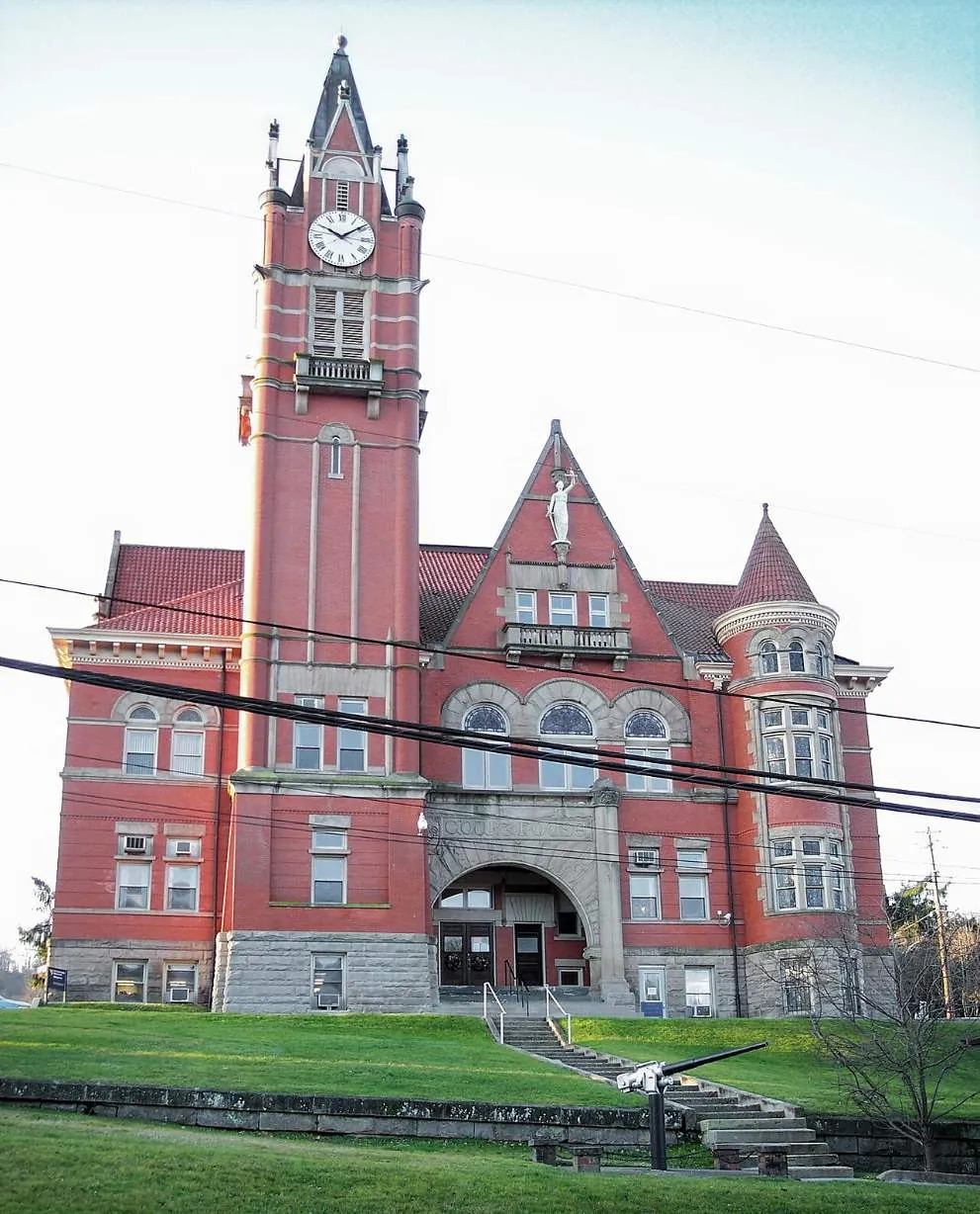
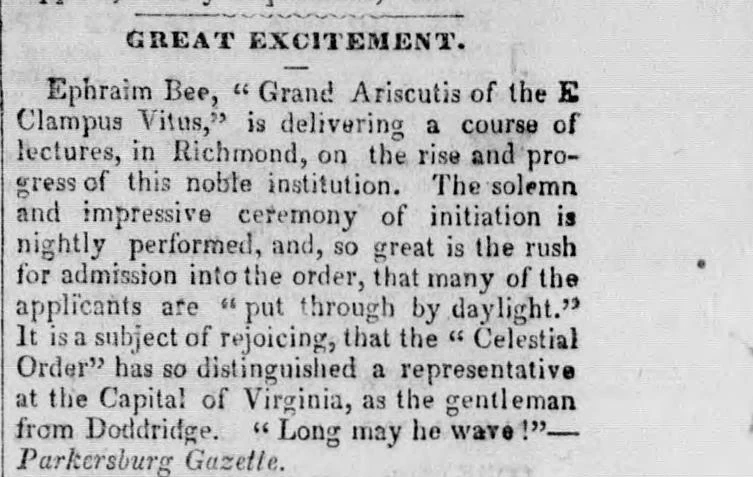
DocumentedThe founding legend. The order traces itself to Ephraim Bee (1802–1888), innkeeper and blacksmith of West Union, in what is now West Virginia. The marker at West Union, put up in 2003, says that by legend Bee received his commission “around 1845.” No document from those years has been produced to date it. Jennifer Wilt of the Doddridge County Heritage Guild, working from the county’s court books and the period press, writes that “shortly after 1850” Bee proclaimed himself Grand Hototote, and that she has found newspaper references to the order “as early as 1853.” An 1896 account in the Parkersburg State Journal has its writer meeting Bee in the fall of 1847, and finding, when they met again “some years afterward,” that Bee “had concocted the celebrated secret order” in the meantime. The earliest records of Bee in the order written at the time are from Clarksburg, in 1855 and 1856, where a paper names him “the Gwand Iwiseutis of the Eclampus Vitus”; the earliest of him at work is from February 1858, when the Parkersburg Gazette reported him lecturing at Richmond, Virginia, as “Grand Ariscutis,” while initiations were “nightly performed.” Part 2 tells the whole story.
DocumentedThe eastern lodges. The order’s historian Dr. Albert Shumate, in a talk of 25 June 1991, wrote: “There is documentation of lodges in Bedford Pennsylvania, (1847); Metropolis, Illinois (1849); and Bowling Green, Missouri (1849).” He gave no sources, but all three can now be traced to print, and all three were first gathered in an ECV pamphlet, Credo quia absurdum (Placerville, 1949).
DocumentedMore early records. The Alexandria Gazette of 13 March 1852 reported “the new order introduced recently into Virginia, called the ‘E. Clampus Vitas,’” and claimed to expose it as “dog Latin” for “squeezing the life out of you.” The earliest California notice yet found is a call to “THE MEMBERS of the E. C. V.” in the San Joaquin Republican at Stockton, 14 April 1852. And by 1 February 1867 the Wheeling Intelligencer could call Ephraim Bee “the recognized American head” of the order, with the story of Caleb Cushing, in print since March 1860, attached. All eighty-nine places are in the complete record, among them a standing lodge notice at Bardstown, Kentucky, in October 1852.
DocumentedBedford, 1847. Judge William M. Hall’s Reminiscences and Sketches (Harrisburg, 1890) gives a whole chapter to “The Ancient and Venerable Order of Ecclampsis Vitis.” Part 2 lets you follow Judge Hall’s burlesque initiation of 1847, step by step.
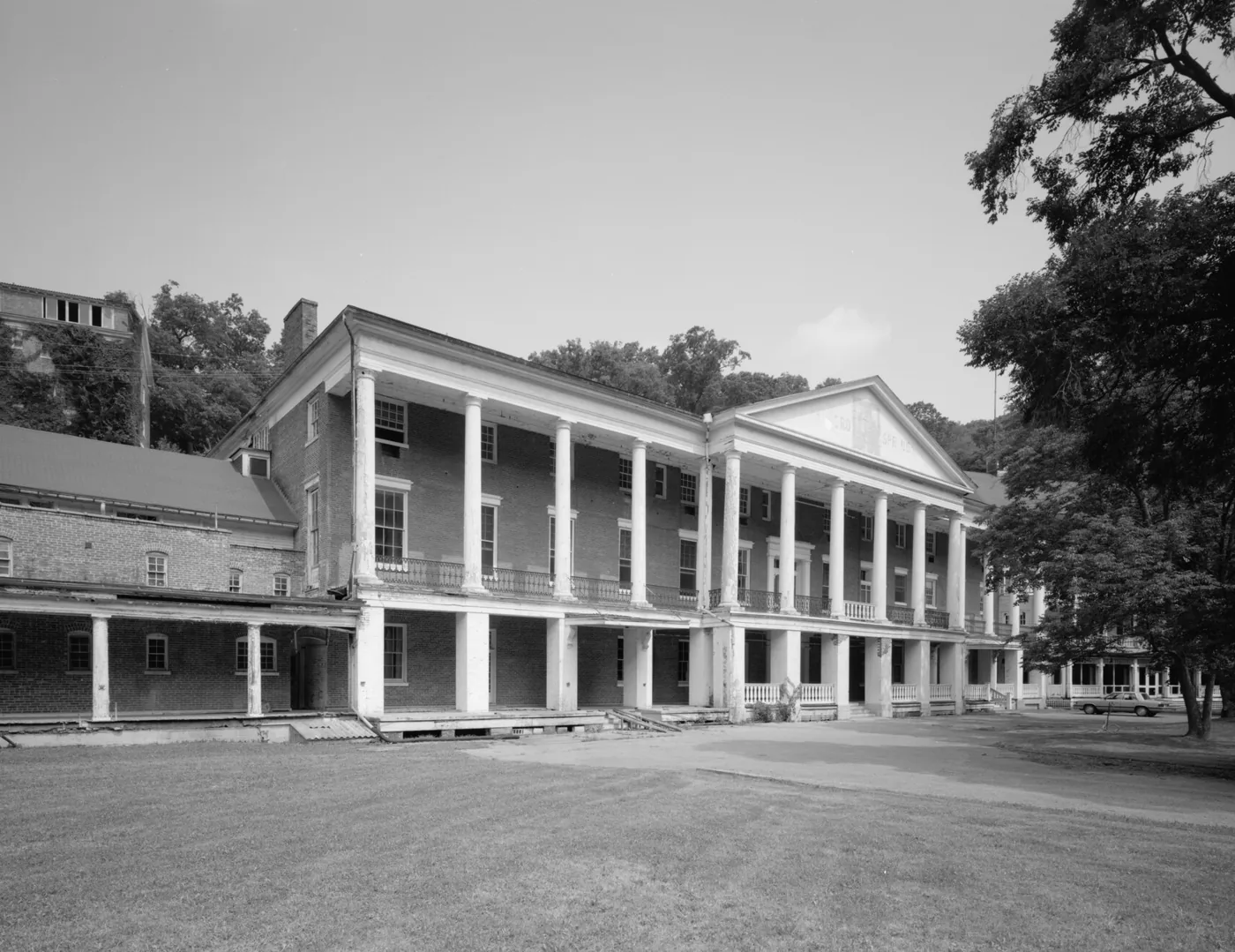
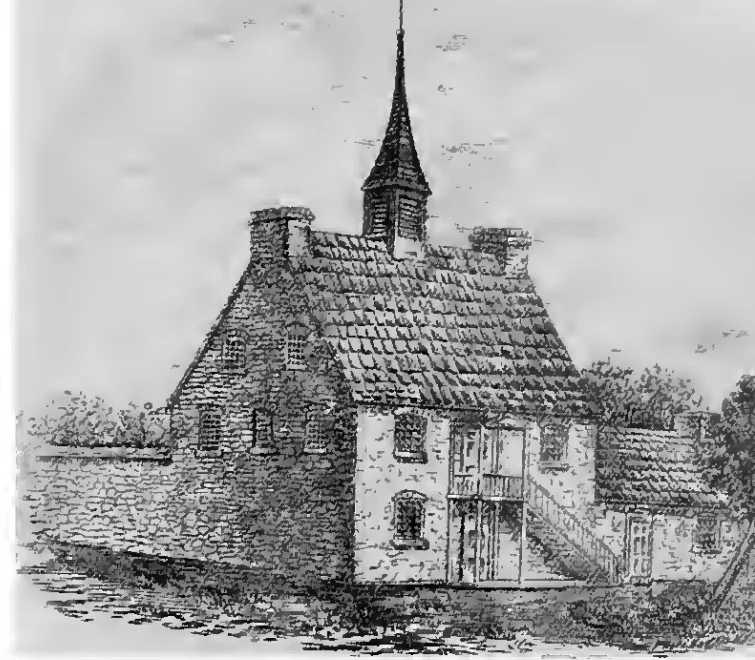
DocumentedMetropolis, 1849. The Huntington Library’s manuscript was described in the Oakland Tribune of 9 January 1938: “a manuscript book of the ‘Ancient & Honorable Order of E Clampus Vitus, Division No. 53,’ of Metropolis City, Illinois, dated 1849,” whose “roster indicates that several of the members had joined theretofore in Missouri, Alabama, Georgia, and other Southern States” (as clipped in Jim Cirner’s album “ECV ® Back in the Day” #3). Credo quia absurdum repeated those words in 1949. In between, in 1941, G. Ezra Dane, one of the men who revived the order, cited it in Ghost Town as a “Division No. 110” record book “for 1849, loaned to us by Miss Nellie Smith of Stockton, and now in the Henry E. Huntington Library.” The two accounts number the division differently, 53 and 110; both put it in 1849.
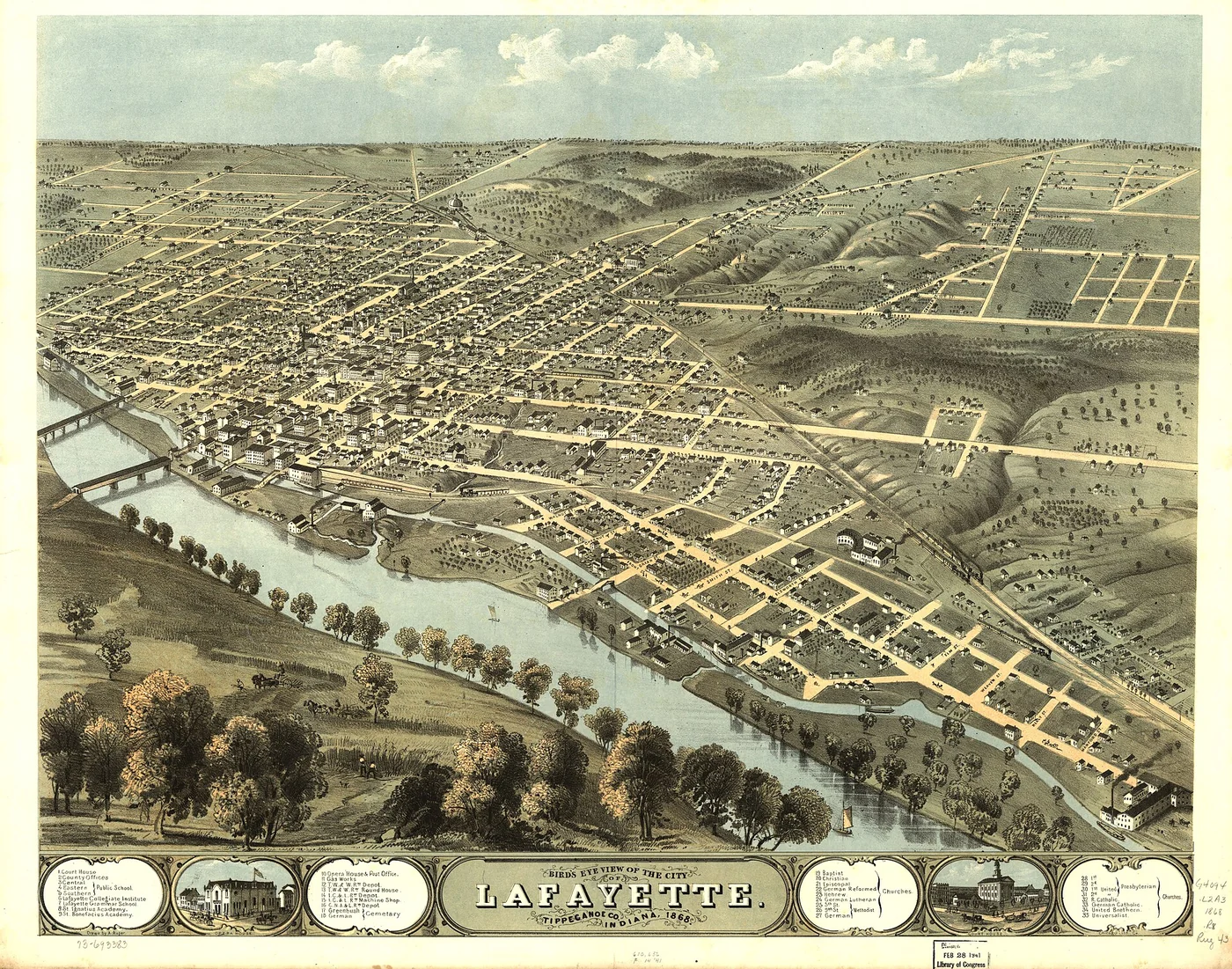
New findingLafayette, 1848. Two years on, and before word of the gold had reached the East, the order was still meeting in Indiana. The Lafayette Weekly Courier of 4 February 1848 carried a notice: “E Clampsus Vitus. The members of the Order of E Clampsus Vitus, will meet on Monday Evening, Feb. 7th, at the Tent Room, No. 15, over the Courier Office. By order of the R. J.” A “Tent Room,” like Tent No. 43 at Indianapolis, upstairs from the newspaper, and an officer known only by his initials. In 1870 a Lafayette paper could still report that “the order of E Clampsus Vitus flourishes in Vincennes.” Both are known from clippings in Jim Cirner’s album “ECV ® Back in the Day” #3.
DocumentedBowling Green, 1849. Not a lodge at all. The source, a Calaveras Prospect article of 30 May 1896 reprinted in Credo, says the first ritual brought to California “was printed in the office of the Bowling Green Journal in Pike County, Missouri,” where in 1849 Zumwalt “and one W. C. Wright went into the Journal office and each bought a ritual.”
ReadingSet side by side, the eastern record and Cassopolis tell one story. The order travelled with “drummers” and young professional men. Its officers in Bedford bore the titles of the Sons of Temperance, the great teetotal brotherhood founded in 1842, worthy patriarch and grand scribe; in Indiana it met in “Tents,” and Metropolis kept a “Division” book. It was, as Hall put it, “a burlesque on all secret societies,” and its punchline everywhere was the same animal: two mules in Bedford, the unnamed animal of the Indiana committee report. In Michigan the burlesque came first: the Cassopolis lodge was instituted in the spring of 1846, and the state’s first division of the Sons of Temperance opened only on 5 September 1846, at Jackson; Niles had a division of its own before the Grand Division of Michigan was instituted at Jackson on 6 April 1847 (Ellis, 1848).
DocumentedCalifornia. The order’s own 1966 history, Then and Now, says it “is generally accepted” that Zumwalt, whom it calls Joe, brought the ritual to Hangtown (Placerville) in 1849, where a lodge “didn’t last,” and that he “did establish the first lodge of ECV by 1851” at Mokelumne Hill. His name was Joel Henry Zumwalt (24 September 1831 – 22 January 1906). The order long knew him as Joseph, and its Grand Council corrected the name with a granite plaque at his grave in Mokelumne Hill, dedicated on 20 May 2021 (our thanks to Jim Cirner, who was at the dedication, for the correction and his photograph of the plaque, shown in part 2). Shumate dates the Hangtown attempt to 1850. Then and Now dates its best-loved story, the initiation of Steamboat Jake, to 1852; the earliest source, Harry Wells’s History of Siskiyou County (1881), sets it at Yreka in 1856.
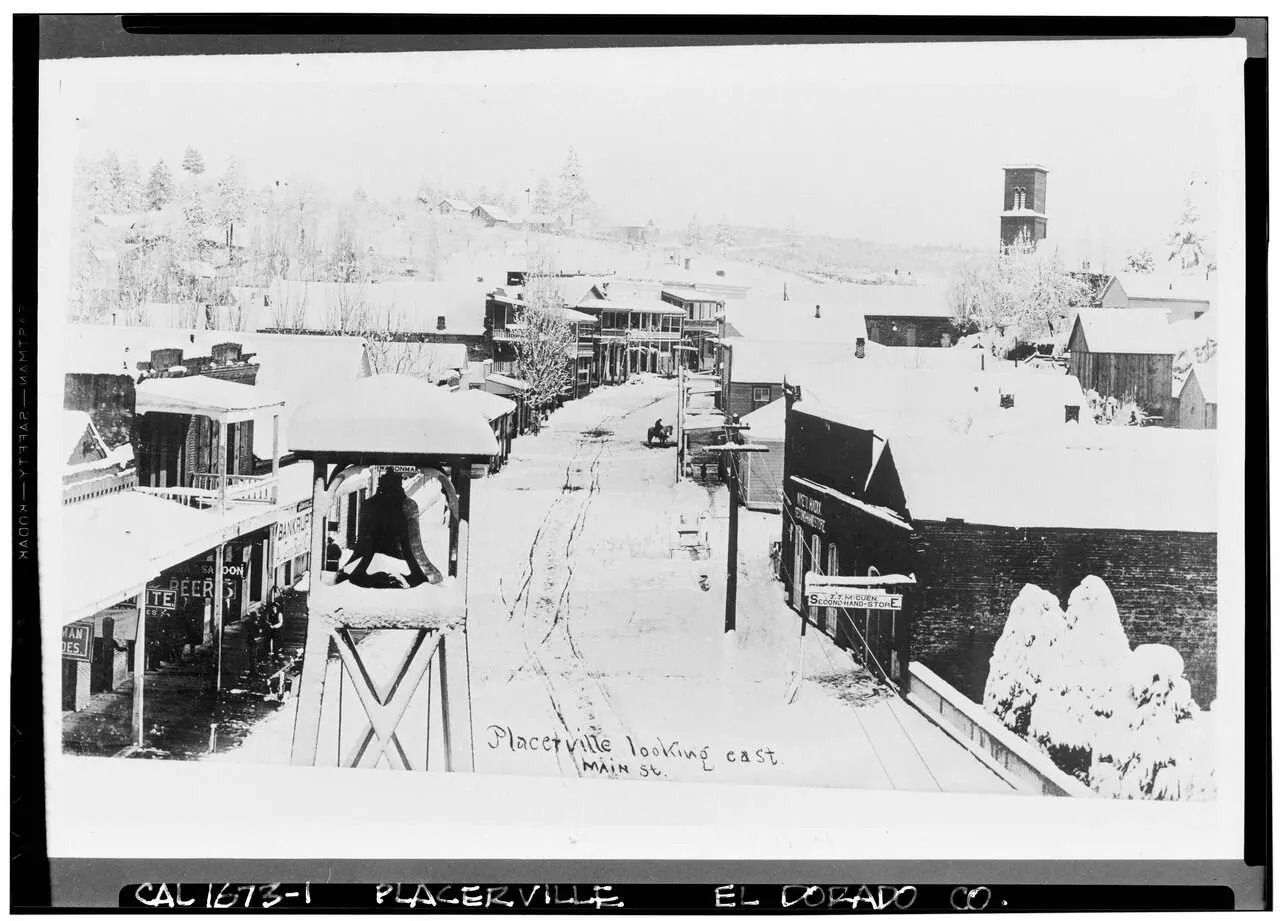
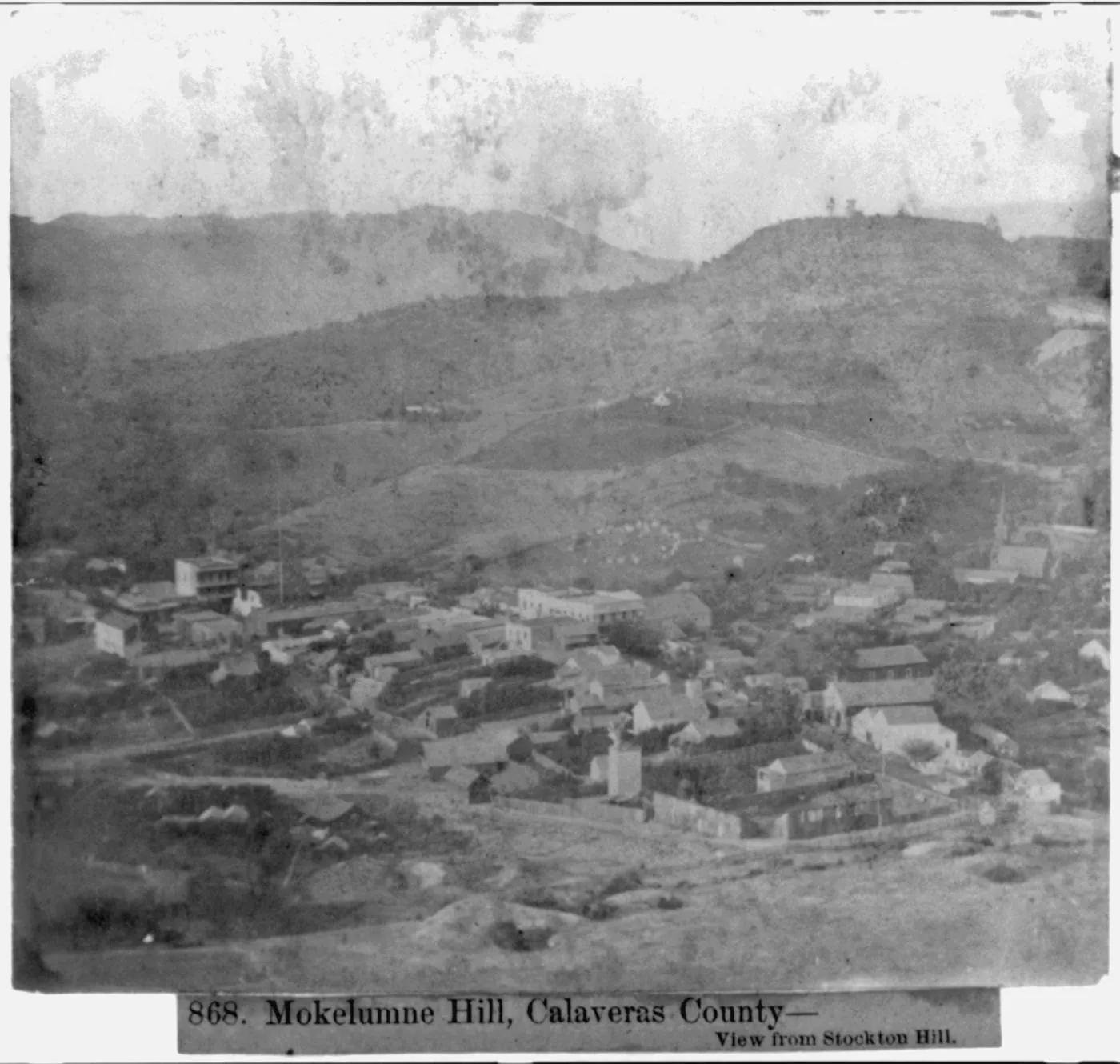
DocumentedThe gap the order’s own history leaves. Then and Now says that travelling salesmen were taken into the order, “with or without authority from Bee,” and that by 1849 “the East and Middle West were dotted with Clamper Lodges.” It names none. Its closing postscript hopes that “some day someone will attempt to research and compile a complete list of the number and location of the lodges formed during this earlier period.”
New findingRogers names one, and the Indiana papers of 1846 name more: Connersville, Tent No. 43 at Indianapolis, Centreville. Cassopolis, spring 1846, is the earliest lodge of the order yet found with its members’ names written down, and the first known in Michigan. With the Indiana lodges it makes the first lines of the list the order asked for in 1966, and proves that the order was alive in the Middle West three years before the gold rush carried it to California.
- The lodge meets
- First written record
The Clampers today
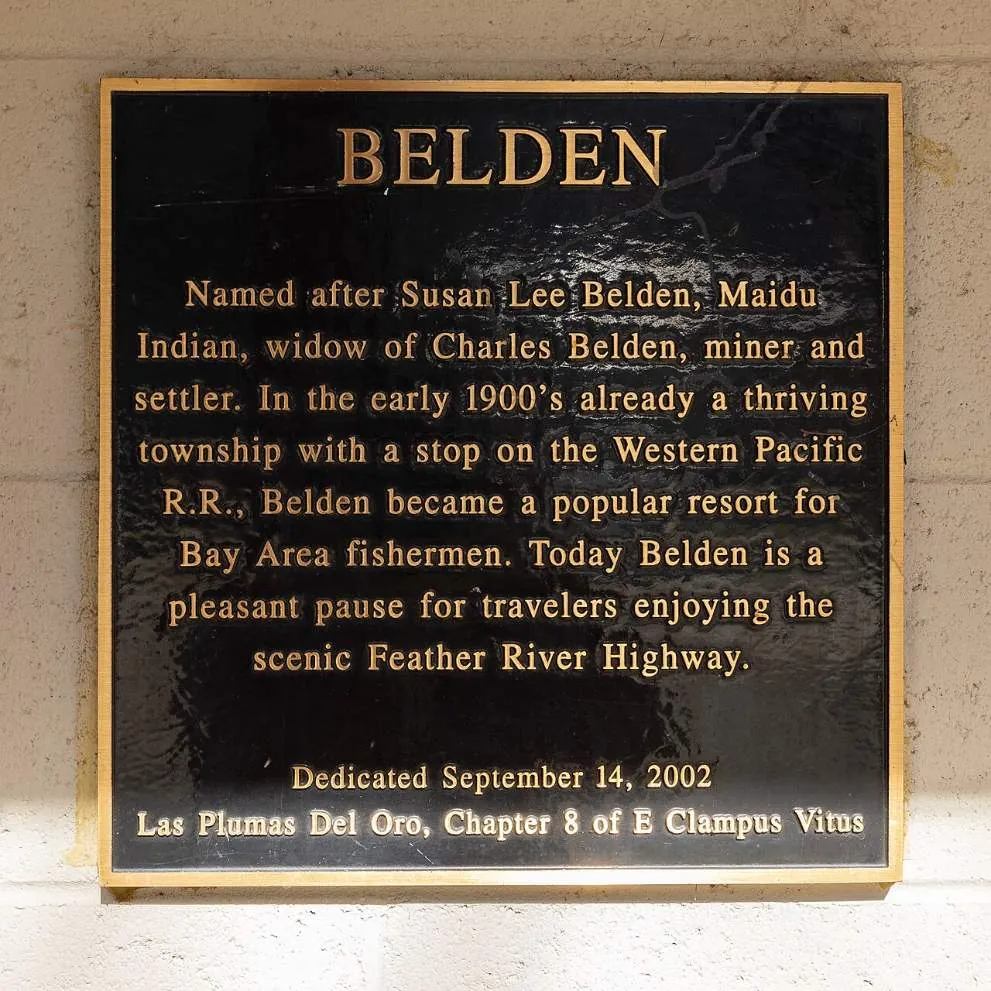
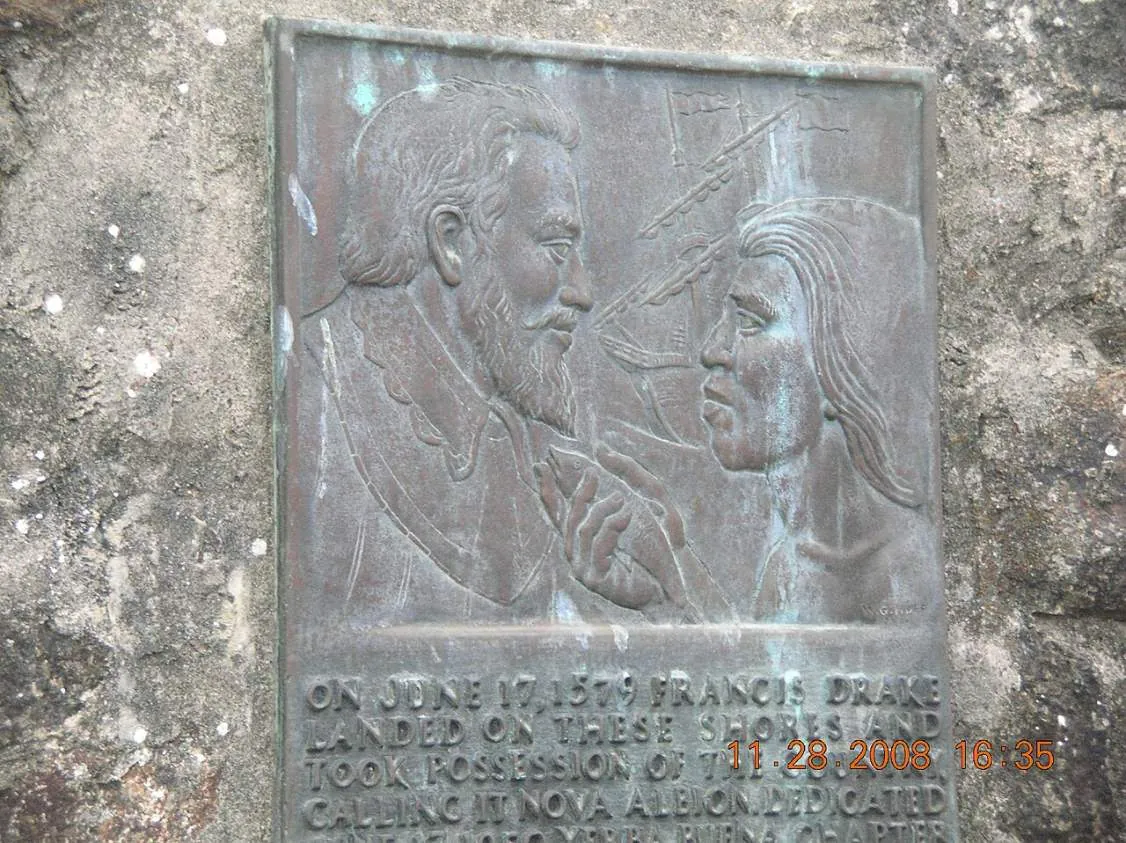
The order Carl Wheat revived in 1931 is best known now for its plaques: close to nineteen hundred of them, in bronze and stone, on forgotten places across California and the West. Some of them are pictured here.
A Clamper’s glossary
For readers who have never been a Poor Blind Candidate, and for Clampers who will enjoy checking our work.
Blow the Hewgag, in 3D › The great tin horn on its trestle at the top of a mining-camp street at dusk. Hold to blow: the longer the blast, the farther it carries, and the town wakes up.
- Tent
- What the order called a local lodge in Indiana in 1846: “Tent No. 43” at Indianapolis. At Lafayette in 1848 the members were called to meet in “the Tent Room, No. 15.”
- Clamper
- A member of E Clampus Vitus.
- Poor Blind Candidate
- A man not yet initiated. The order’s 1966 history speaks of “a Poor Blind Candidate” led to his initiation.
- Noble Grand Humbug
- “The presiding officer” of a chapter (Then and Now, 1966), in a role held for one year. The officers of its Grand Council are styled Sublime: the Sublime Grand Noble Recorder, for one, keeps track of the order’s copyrights and registered trademarks (Jim Cirner, 2026).
- Hewgag
- “The great tin horn” of the order, which “sounded a horrendous blast” (Then and Now).
- Credo quia absurdum
- The order’s motto: “I believe because it is absurd.”
- Wearing the tin
- Today’s Clampers pin on tin badges with their red shirts. What the “over two hundred badges” of the Cassopolis ball were made of is not recorded; at Bedford in 1847 the regalia was a muslin sash with a star cut from loaf-sugar paper.
The spelling
Both Michigan histories spell the name “Eclampsus,” with an S. The order’s historian writes that Carl Wheat chose the present spelling, “Clampus,” in 1931, when the order was revived in San Francisco. Chose it from the old order’s own variety, we would say: Wheat standardised the spelling, he did not coin it. The Michigan books are not misspelling the name; they spell it as the Connersville letter of 1846 did, one of the many spellings of the 1840s, before anyone tried to settle it. The printed history of “Clampus” is told under “The spelling” in part 2.
A timeline
- 24 Jan 1832 Eber Root licensed to keep a tavern at Cassopolis; he builds the frame house that becomes the Union Hotel.
- c. 1845 The order’s legend: Ephraim Bee’s commission. (Undated in any surviving record.)
- Feb 1846 A lodge of the “Eclampsus Vitus” at Connersville, Indiana (Indiana American, 27 Feb).
- Spring 1846 The Cassopolis lodge is instituted: Bonine, Harter, J. P. Osborn and L. Osborn.
- 16 Jul 1846 Tent No. 43 of the order meets at Indianapolis “in full regalia” (Indiana State Sentinel, 15 and 16 Jul).
- Winter 1846–47 The grand ball at the Union Hotel: “over two hundred badges.”
- 30 Dec 1846 – 6 Jan 1847 House bill No. 242, to incorporate “Jackson Lodge” of the order at Centreville, Indiana, is brought in on 30 December, read a second time on 31 December, reported on with a joke on 6 January and tabled.
- 1847 The lodge collapses. Bedford, Pennsylvania: the earliest dated eastern lodge. Leander Osborn begins reading medicine with Bonine.
- 1847 (fall) A writer meets Bee at West Union (as told in 1896).
- 4 Feb 1848 The members of the order are called to “the Tent Room, No. 15,” over the newspaper office at Lafayette, Indiana (Lafayette Weekly Courier).
- 1849 Bonine and Harter go overland to California; a “Dr. Bonine” diary of the road by Fort Hall and the Truckee is recorded at Niles (Townley). Bonine’s teacher, Dr. John Prichet of Centreville, crosses the same year. Metropolis and Bowling Green lodges. Hangtown attempt (1966 history).
- 1850 Hangtown attempt (Shumate). “Shortly after 1850”: Bee proclaims himself Grand Hototote (Wilt).
- 1851 Mokelumne Hill: by the order’s tradition (first printed 1896), the first lasting lodge in California; on record by March 1853. Bonine returns to Michigan.
- Mar 1852 The order “introduced recently into Virginia” (Alexandria Gazette, 13 Mar).
- 14 Apr 1852 The earliest California notice yet found: the E. C. V. at Stockton (San Joaquin Republican).
- 12 Jun 1852 The Masons’ first meeting at Cassopolis, in the Union Hotel.
- 1853 Earliest newspaper references to Bee’s order in what is now West Virginia (Wilt).
- 1854 Earliest dated lodge of the Sons of Malta.
- Apr 1855 A Clarksburg paper names Ephraim Bee “the Gwand Iwiseutis of the Eclampus Vitus,” the earliest record of him in the order that can be read today.
- Feb 1858 Bee initiating at Richmond, Virginia, as “Grand Ariscutis.”
- 1860 The Cassopolis lodge revived as “The Brothers of Charity.” Frank Leslie exposes the Sons of Malta.
- Mar 1860 A Richmond report has the order brought to America by Caleb Cushing, minister to China.
- Jan 1866 Bee welcomed at Wheeling, where he had founded “a branch order” two years before.
- Feb 1867 Bee initiating candidates at Wheeling’s McLure House, “the recognized American head” of the order.
- 1867 The Union Hotel is moved off its corner for the Cass House; by 1882 it is a planing mill.
- 1868 James M. Shepard comes to Cassopolis.
- 1875 Rogers prints Shepard’s account. Jordan P. Osborn, a charter member, is President of the Village (and again in 1876).
- 1882 Mathews prints it again, naming Shepard.
- Oct 1915 The order revived at Marysville as a boosters’ club; lodges follow from Oroville to Quincy, numbered up to No. 8.
- Jan 1920 “Very Deadibus Aroundaboutibus”: the Colusa Daily Sun writes the revival’s epitaph; Quincy revives its lodge the same week.
- Dec 1931 The order revived again, in San Francisco: Carl Wheat calls a lunch at the Clift Hotel for 18 December (part 2). Wheat standardises the spelling “Clampus,” in print since at least 1852.
- 1966 Then and Now asks for a list of the early lodges.
Questions people ask
Was there really a lodge of E Clampus Vitus in Cassopolis, Michigan?
One account says so, and it is detailed. James M. Shepard wrote it for Howard S. Rogers’s History of Cass County (1875), and it was reprinted in the county history of 1882: a lodge of the “Ancient and Honorable Order of Eclampsus Vitus,” instituted at Cassopolis in the spring of 1846, with four charter members named.
Who founded the Cassopolis lodge?
Dr. Evan J. Bonine, Laban Harter, Jordan P. Osborn and Dr. Leander Osborn. Three of the four married sisters of one family, the Bealls of Centreville, Indiana.
What happened at the Union Hotel?
In the winter of 1846–47 the lodge gave a grand ball at the Union Hotel, where “over two hundred badges” of the order were displayed, by men who stood among the most respected in the county. You can see the village as it may have looked that night, in 3D.
Is Cassopolis the oldest lodge of E Clampus Vitus?
It is the earliest lodge of the order yet found with its members named. A lodge at Connersville, Indiana, is on record a little earlier, in February 1846, but no one there is named.
What became of the Cassopolis lodge?
It collapsed in 1847, came back to life in 1860 as “The Brothers of Charity,” and is said to have merged afterward into the Sons of Malta, another burlesque order of the day.
Is Project Scroll part of E Clampus Vitus?
No. Project Scroll is independent research. It is not affiliated with, sponsored by or endorsed by E Clampus Vitus, Inc. or any of its chapters, and it does not speak for the order.
What we are not saying
- Not that the order was founded at Cassopolis. The account says a lodge of the order was “instituted” there. Rogers uses the same word a page later for the Odd Fellows lodge instituted at Cassopolis in February 1847 under a dispensation from a Grand Master: a local lodge of an order that already existed.
- Not that the evidence is like for like. The Cassopolis account is local memory written down about thirty years later by a man who was not there. Wilt’s dates come from contemporary court books and newspapers. Ours is a claim about the surviving record, not about what may have happened unrecorded.
- Not that Cassopolis was the first lodge. It was not, so far as the newspapers show: there was a lodge at Connersville, Indiana, by February 1846, and a “Tent No. 43” at Indianapolis by July. Our claim is narrower and, we think, still remarkable: Cassopolis is the earliest lodge of the order yet found with its members’ names on record, and the first known in Michigan.
- Not that Bonine or Harter carried the order west. The dates line up; no document connects them to any California lodge.
The picture album
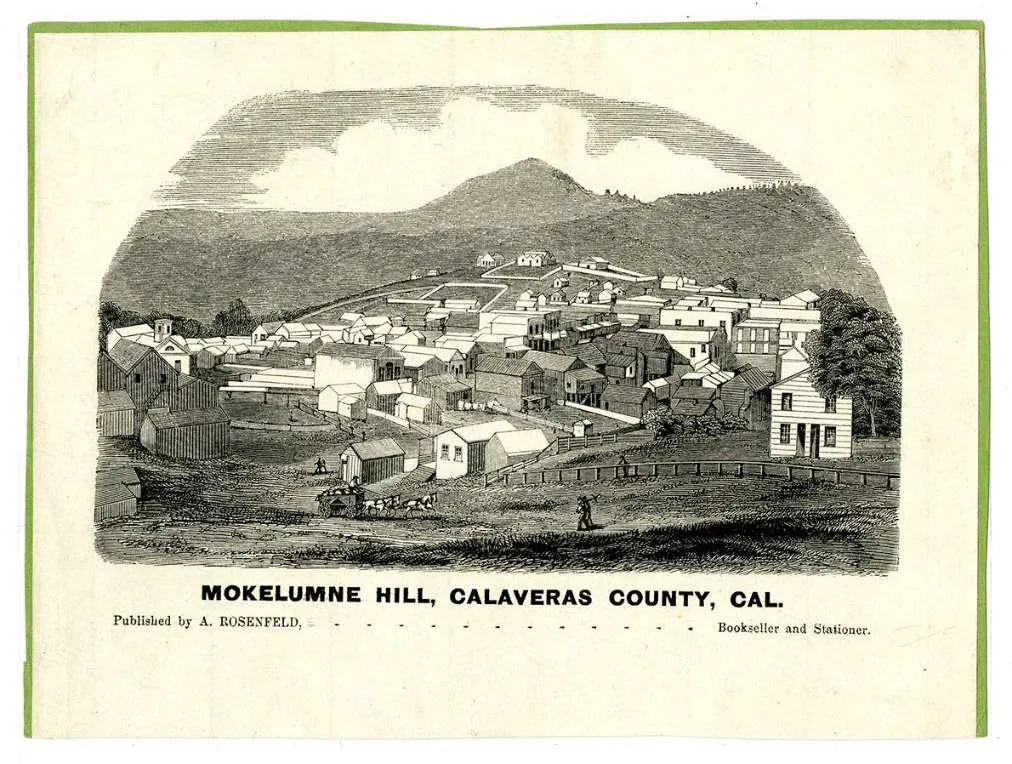
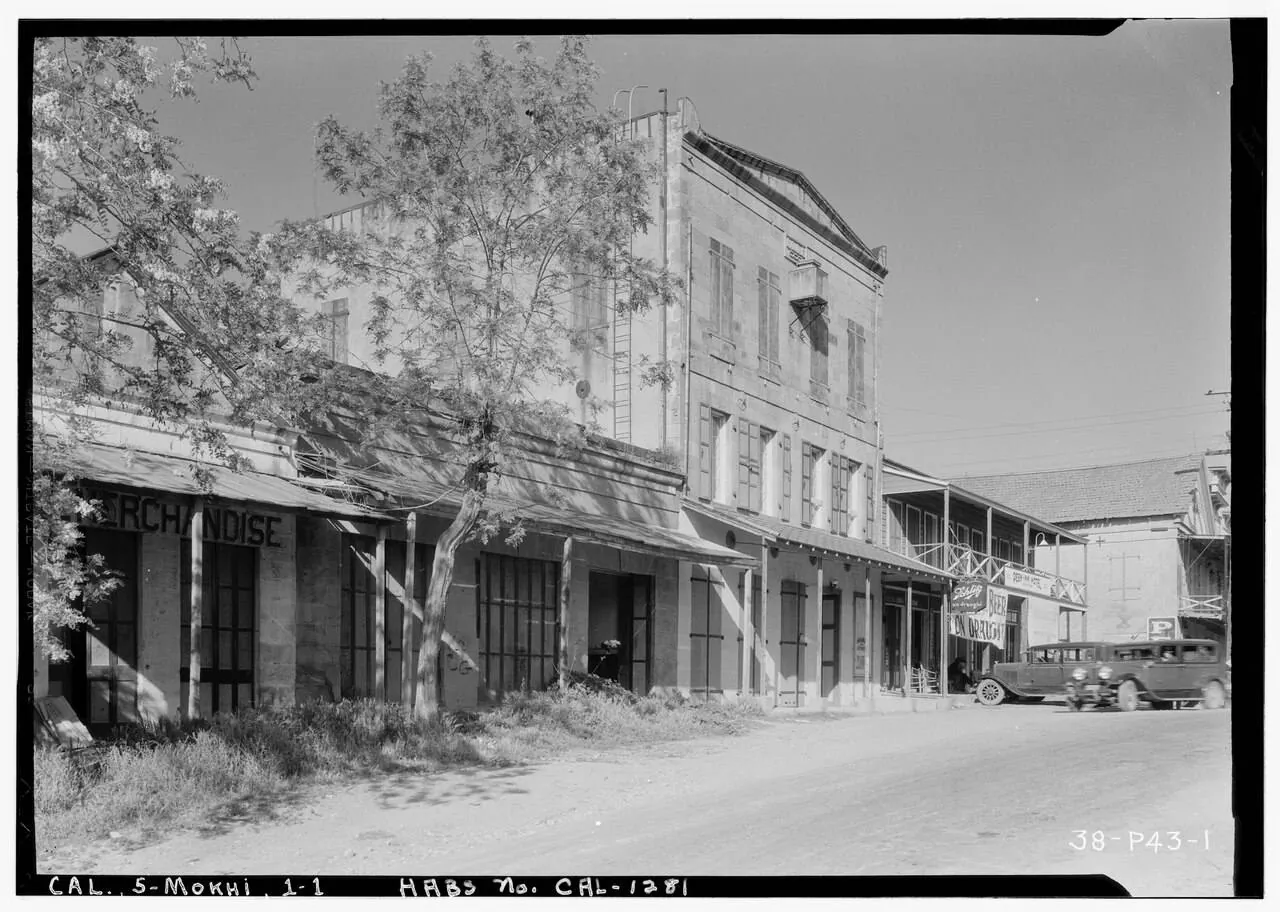
The historical pictures on this page in one place. The Sons of Malta engravings, the gold-rush daguerreotypes and the Historic American Buildings Survey photographs are in the public domain; the modern photographs of Clamper plaques are shared by their makers under the Creative Commons licences named in each caption. Press any picture to see it full size.
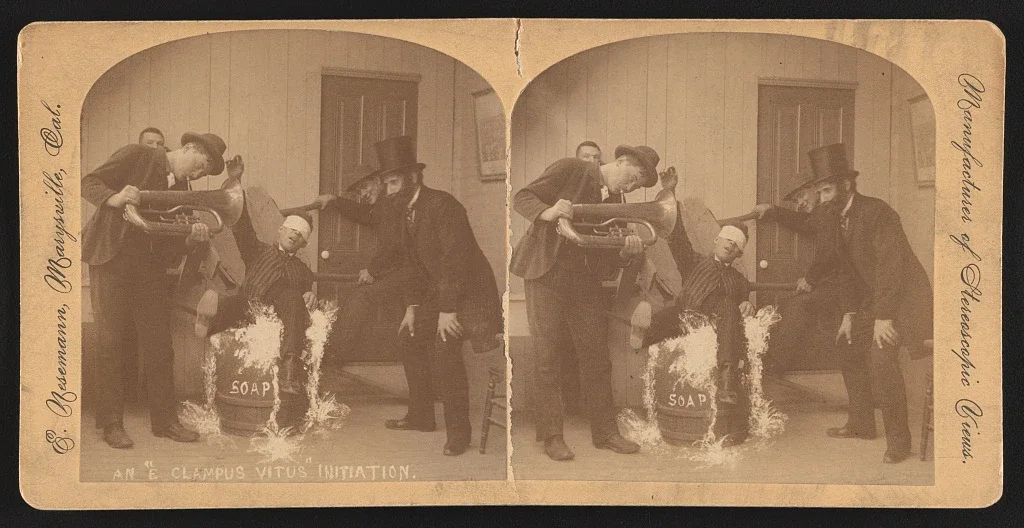
Pictures we know of but cannot show here. Ephraim Bee, drawn from life in 1846 by Joseph H. Diss Debar, is in his sketchbook at the West Virginia & Regional History Center, West Virginia University; the Center requires written permission to publish it, and no openly licensed copy exists. The order’s own photographs, from the revival of the 1930s on, are in its papers at the Holt-Atherton Special Collections, University of the Pacific, and at the Huntington Library, and none is online with open rights. The oldest Clamper photograph we can show is the Library of Congress stereograph of 1890 above. No picture of the Cassopolis lodge, its hall or its four founders is known.
The case file: what we asked, and what we found
The questions this page set out to answer, and what the record showed.
1 answered
Answered
Answered A charter that lived a week
When did the Indiana House deal with the Jackson Lodge?
- What we know
- In one week. The House Journal’s own day headings put the bill’s first reading on the afternoon of 30 December 1846, its second reading on the afternoon of 31 December, and the committee’s report on Wednesday, 6 January 1847. The 14 January date printed elsewhere is the Sentinel’s, not the House’s.

The pages
Read them yourself. Both books are free online, and the passage is short. The page photographs follow; the full books are linked under Sources.
Index of names
The people in the story, with the sections where they appear. The other part has its own index: Part 2.
- Beall sisters (Evaline, Emily P., Helen M.) The case in brief · Who’s who · Exhibit B: the newspapers of 1846 · Exhibit D: the four founders · Questions people ask
- Bee, Ephraim The case in brief · Who’s who · The wider trail: where it fits in the order’s history · A timeline · The picture album
- Bonine, Dr. Evan J. Who’s who · Exhibit A: the page that started it · Exhibit B: the newspapers of 1846 · Exhibit D: the four founders · A timeline · Questions people ask · What we are not saying · Last call at the Union Hotel
- Bonine, James E. Exhibit D: the four founders
- Cirner, Jim The wider trail: where it fits in the order’s history · A Clamper’s glossary
- Cushing, Caleb The wider trail: where it fits in the order’s history · A timeline
- Dane, G. Ezra The wider trail: where it fits in the order’s history
- Ehrenbacher, Jacob (“Steamboat Jake”) The wider trail: where it fits in the order’s history
- Hall, Judge (Bedford) The wider trail: where it fits in the order’s history
- Harter, Laban Who’s who · Exhibit A: the page that started it · Exhibit B: the newspapers of 1846 · Exhibit D: the four founders · A timeline · Questions people ask · What we are not saying · Last call at the Union Hotel
- Mathews, Alfred The case in brief · Who’s who · Exhibit A: the page that started it · The storyteller: who wrote it · Exhibit D: the four founders · Exhibit E: the room · A timeline
- Osborn, Dr. Leander Who’s who · Exhibit A: the page that started it · Exhibit B: the newspapers of 1846 · Exhibit D: the four founders · A timeline · Questions people ask · Last call at the Union Hotel
- Osborn, Jordan P. Who’s who · Exhibit A: the page that started it · Exhibit D: the four founders · A timeline · Questions people ask · Last call at the Union Hotel
- Prichet, Dr. John Who’s who · Exhibit B: the newspapers of 1846 · Exhibit D: the four founders · A timeline
- Rogers, Howard S. The case in brief · Who’s who · Exhibit A: the page that started it · Exhibit D: the four founders · Exhibit E: the room · The wider trail: where it fits in the order’s history · A timeline · Questions people ask · What we are not saying
- Root, Eber Who’s who · Exhibit D: the four founders · Exhibit E: the room · A timeline
- Shepard, James M. Who’s who · Exhibit A: the page that started it · The storyteller: who wrote it · Exhibit B: the newspapers of 1846 · Exhibit D: the four founders · Exhibit F: what became of the lodge · A timeline · Questions people ask
- Shumate, Albert The wider trail: where it fits in the order’s history · A timeline
- Townley, John M. Exhibit D: the four founders · A timeline
- Wheat, Carl I. The case in brief · Who’s who · The Clampers today · The spelling · A timeline · Last call at the Union Hotel
- Wilt, Jennifer The wider trail: where it fits in the order’s history · A timeline · What we are not saying
- Zumwalt, Joel Henry The case in brief · Who’s who · The wider trail: where it fits in the order’s history
Last call at the Union Hotel

So picture the square once more. The ball is over and the badges are put away. Within a year the lodge has collapsed. By 1849 Bonine and Harter are on the overland trail to California; Bonine is back in 1851, to doctor, to soldier and to serve as mayor of Niles, and Harter keeps a store there. Leander Osborn becomes the doctor at Vandalia. Jordan Osborn stays in Cassopolis, making harness, and in 1875 and 1876 he is President of the Village. In 1867 the tavern itself is moved off its corner, and in 1882 it is still standing as Matthew Lindsey’s planing mill, with “Union Hotel” fading on the boards.
The order Carl Wheat revived in 1931 has put up close to nineteen hundred plaques on forgotten places across the West. If the Brethren ever want one in Michigan, we know a good spot on the square at Cassopolis.
To cite this page: Michael Urbanski, “A lodge of E Clampus Vitus, in Cassopolis, in 1846,” Project Scroll, first published 22 October 2026, revised 2 November 2026, https://projectscroll.com/news/e-clampus-vitus-in-cassopolis-1846/. To cite a single finding, use its own link on our Discoveries page. Part 1 of 2; part 2 is E Clampus Vitus: the complete record. Corrections are welcome, and any we make are noted on this page.
Sources
- Howard S. Rogers, History of Cass County, from 1825 to 1875 (Cassopolis: W. H. Mansfield, Vigilant Book and Job Print, 1875), pp. 253–254 (the lodge; the Odd Fellows); the tavern licenses of 24 January 1832. University of Michigan.
- Alfred Mathews, History of Cass County, Michigan (Chicago: Waterman, Watkins & Co., 1882), pp. iii (the preface, thanking “Hon. James M. Shepard” and “Dr. Leander Osborn” among others), 170 (Root’s hotel and his second hotel, burned in 1859; the planing mill and the name “Union Hotel”), 174 (the lodge, credited to James M. Shepard; the Masons in the Union Hotel, 12 June 1852), 178 (Eber Root’s children, “Isabella (Mrs. J. P. Osborn)”) and 180–181 (James M. Shepard, born at North Brookfield, Mass., 24 November 1840); the Osborn family, the Cassopolis harness trade and the village officers, 1869–1876.; p. 97, Bonine’s three and a half years in “the office of Dr. J. Prichet, of Centerville, Ind.” Internet Archive; p. 156, A. H. Redfield’s letter of 24 October 1868 on the hickory pole of 1831; pp. 167–169, the merchants and the drug store of about 1846.
- Journal of the House of Representatives of the State of Indiana, 31st session, 1846–47 (Indianapolis, 1846–47): the Wayne County members; House bill No. 242, Jackson Lodge of the order at Centreville (pp. 259, 272); the committee on corporations’ report (p. 345, Wednesday, 6 January 1847); the Senate’s bill No. 65, to incorporate the grand and subordinate divisions of the Sons of Temperance (pp. 216, 302, 451); the bill for the improvement of the breed of horses and mules in Blackford County (pp. 102, 130), by 19 January 1847 the bill on “horses, jack-asses, and mules” (p. 546). Indiana State Library, via Internet Archive.
- Gilbert Cope, A Genealogy of the Sharpless Family (Philadelphia, 1887): Susanna Sharples and Jacob Talbot, married at Middletown Meeting, 1770, p. 275; the children of Samuel Talbot (Sarah, Mrs. Beall; Emily, Mrs. Pricket; Martin Sharpless Talbot, d. California 1853) and John Talbot (d. about 1846 at Isaac Bonine’s, Cass Co.), p. 413; Sarah (Talbot) Bonine, b. 1791, and the Bonine and Talbot families’ removal from Tennessee “on account of slavery,” pp. 415–416; the Talbot and Beall families of Centreville, Indiana, p. 734 (Sarah Talbot, b. 1804, m. Nathaniel Beall, “a farmer, owning 160 acres near Centreville, from his marriage until death,” died at Centreville, 12 January 1845; the marriages of Harter, 1847, and Leander Osborn, 1854) and pp. 735–736 (Dr. John Pricket); Bonine’s marriage, 1844, p. 749; Harter’s birth and parents, p. 1227. Internet Archive.
- Michigan Biographies, vol. 2 (Lansing: Michigan Historical Commission, 1924), p. 283: James M. Shepard, Senator from the Twelfth District, 1879–80, born at North Brookfield, Mass., 24 November 1842. Internet Archive.
- “Colonel James M. Shepard,” death notice, The American Foreign Service Journal, vol. 4, no. 10 (October 1927), p. 340: American consul at Hamilton, Ontario, 1897–1916; died at Cassopolis, 13 August 1927, “84 years old.” Internet Archive.
- Indiana American (Brookville, Ind.), 27 February 1846, p. 2: letter from Connersville (“the ‘Eclampsus Vitus’ society, an order of which, we have in our town”). Hoosier State Chronicles.
- Indiana State Sentinel (Indianapolis), semi-weekly, 15 July 1846, p. 3: the same notice. Hoosier State Chronicles.
- Indiana State Sentinel (Indianapolis), weekly, 16 July 1846, p. 3: notice to “Tent No. 43 of the order of Eclampees Vitus.” Hoosier State Chronicles.
- Richmond Palladium, 5 January 1847, p. 2: a bill to incorporate a lodge of the order “at Centreville.” Hoosier State Chronicles.
- Indiana State Sentinel, 7 January 1847, p. 1: Mr. Julian’s bill “to incorporate the ancient order of E-clam-peis Vitus.” Library of Congress, Chronicling America (the issue).
- Indiana State Sentinel, 14 January 1847, p. 1: the bill tabled. Hoosier State Chronicles.
- L. H. Glover, A Twentieth Century History of Cass County, Michigan (Chicago, 1906): James M. Shepard, pp. 556–558; the Union Hotel on the west side of Broadway and the old Cassopolis House on the east side of the square, p. 146; Bonine at Cassopolis “from 1844 to the outbreak of the Civil war,” p. 259 (Glover’s wording; Bonine was in California, 1849–51); Dr. Leander Osborn, 1825–1901, p. 264; “the late J. P. Osborn,” p. 386. Internet Archive.
- Portrait and Biographical Record of Berrien and Cass Counties, Michigan (Chicago: Biographical Publishing Co., 1893), pp. 385–387: Dr. Fred N. Bonine, with the life of his father, Dr. Evan J. Bonine, quoted from the Niles Daily Star, 29 December 1892. Transcribed by My Genealogy Hound.
- Portrait and Biographical Record of Berrien and Cass Counties, Michigan (Chicago: Biographical Publishing Co., 1893), pp. 288–289: James M. Shepard, born at North Brookfield, Mass., 24 November 1840. Internet Archive.
- Michigan Legislative Biography: Dr. Evan J. Bonine. Library of Michigan. Accessed November 2026.
- Franklin Ellis and Crisfield Johnson, History of Berrien and Van Buren Counties, Michigan (Philadelphia: D. W. Ensign & Co., 1880), p. 153: the Niles Horse-Thief Association, organized in May 1853, “L. Harter, Treasurer.” Internet Archive.
- Niles Daily Star, 23 August 1941: obituary of Dr. Fred N. Bonine (“the old Loban [sic] Harter residence”). Microfilm, Niles District Library.
- Obituary of Nathaniel Beall, Niles Daily Star, 12 September 1898, reprinted in the Niles Weekly Mirror, 14 September 1898, p. 1 (the three Beall sisters). Transcribed by the Friends of Silverbrook Cemetery.
- Obituary of Mrs. Martha E. (Harter) Riley, Niles Daily Sun, 26 October 1914, p. 4 (born near Niles, 10 November 1848). Friends of Silverbrook Cemetery.
- Friends of Silverbrook Cemetery, Niles: grave records, Laban Harter (1826–1888) and Emily P. Harter (1832–1910), lot City 21.
- Portrait and Biographical Record of Berrien and Cass Counties (1893): Jefferson Osborn (Leander Osborn and Mary Helen Beall). My Genealogy Hound.
- Howard A. Kelly and Walter L. Burrage, American Medical Biographies (Baltimore, 1920), p. 147: Evan J. Bonine. Internet Archive.
- Map of the Counties of Cass, Van Buren and Berrien, Michigan (Philadelphia: Geil, Harley & Siverd, 1860). Library of Congress, Geography and Map Division.
- Dave Dunlap, R. Coke Wood and others, Then and Now: The Story of E Clampus Vitus (Stockton, 1966): the founding, the drummers, Hangtown and Mokelumne Hill, Steamboat Jake, and the Clamphistorian’s Postscript. Sent to us by Jim Cirner.
- Dr. Albert Shumate, The Mysterious History of E Clampus Vitus (talk to the San Francisco Corral of Westerners, 25 June 1991), as published by the Julia C. Bulette Chapter 1864, E Clampus Vitus: the dated eastern lodges, Hangtown 1850, and Carl Wheat’s spelling.
- William M. Hall, Reminiscences and Sketches, Historical and Biographical (Harrisburg: Meyers Printing House, 1890), ch. 19, “The Ancient and Venerable Order of Ecclampsis Vitis,” pp. 121–127. Internet Archive.
- G. Ezra Dane with Beatrice J. Dane, Ghost Town (New York: Knopf, 1941), bibliography, p. 309: the “Division No. 110” record book of 1849. Internet Archive (borrow).
- E Clampus Vitus, Credo quia absurdum (Placerville, 1949): G. Ezra Dane, “The Origin of E Clampus Vitus,” p. 23; Hall reprinted, p. 25; the Calaveras Prospect of 30 May 1896 on the Bowling Green ritual, p. 53. HathiTrust (full view).
- Sons of Temperance, Grand Division of Illinois, Reports of the Grand Worthy Patriarch and Grand Scribe, 1849–51: “Perry Division, No. 110.” HathiTrust.
- Samuel Ellis, The History of the Order of the Sons of Temperance, from its Organization on the 29th September, 1842, to the Commencement of the Year 1848 (Boston: Stacy, Richardson & Co., 1848), ch. 30, “Michigan,” pp. 192–194: Michigan Division No. 1 at Jackson, 5 September 1846; Niles Division No. 9; the Grand Division instituted at Jackson, 6 April 1847. Internet Archive.
- Jennifer Wilt, Ephraim Bee and E Clampus Vitus, with the 1896 Parkersburg State Journal account. Doddridge County Heritage Guild.
- Joseph Hubert Diss Debar (1820–1905) Sketchbook, 1832–1880s, A&M 4040, West Virginia & Regional History Center, West Virginia University: the section “In West Virginia 1846–1876.” Permission to publish is required from the copyright holder.
- Ephraim Bee historical marker, West Union, West Virginia (erected 2003). The Historical Marker Database.
- Cooper’s Clarksburg Register, 15 August 1856, p. 2, a letter from Glenville, 9 August 1856. Library of Congress, Chronicling America.
- Alexandria Gazette, 8 March 1860, p. 2: Ephraim Bee, “Grand Lama,” and Caleb Cushing. Library of Congress, Chronicling America.
- Winchester Republican (Winchester, Va.), 26 February 1858, p. 2, “Great Excitement,” from the Parkersburg Gazette: Ephraim Bee at Richmond. Library of Congress, Chronicling America.
- Mariposa Democrat (Mariposa, Calif.), 17 December 1857, p. 2, “E. C. V. Ball”: “the ancient and honorable Order of E Clampus Vitus” at Visalia. Library of Congress, Chronicling America.
- Jackson Standard (Jackson C.H., Ohio), 29 April 1858, p. 2: “the E. Clampus Vitus,” “that ancient and honorable institution.” Library of Congress, Chronicling America.
- Hydraulic Press (North San Juan, Calif.), 24 March 1860, p. 1: the Sons of Malta, “an intense humbug of the E Clampus Vitus kind.” Library of Congress, Chronicling America.
- Sons of Malta: the earliest dated lodge (1854) and the 1860 exposure in Frank Leslie’s paper. Wikipedia.
- Albert Baxter, History of the City of Grand Rapids, Michigan (New York and Grand Rapids, 1891), ch. 57: the Sons of Malta lodge, 1859. Kent County MIGenWeb transcription.
- “The Council of Ten,” Frank Leslie’s Illustrated Newspaper, vol. IX, 11 February 1860. New York Public Library Digital Collections.
- “Grand Exposure of the Ceremonies of the Sons of Malta,” Vanity Fair (New York), 25 February 1860. The Vault at Pfaff’s, Lehigh University.
- Thomas Williams, The Sons of Malta Exposed (New York, 1860). University of Wisconsin–Madison Libraries catalogue.
- Will Bagley, Across the Plains, Mountains, and Deserts: A Bibliography of the Oregon-California Trail, 1812–1912 (2014): “Bonine, Dr. Evan T. [sic] Esq. Journey to California. Typescript.” Copies: Fort St. Joseph Museum, Niles; OCTA manuscripts, Merrill J. Mattes Library, National Frontier Trails Museum, Independence, Missouri.
- E Clampus Vitus. Wikipedia. Accessed November 2026.
- Seth Slopes, E Clampus Vitus: Now & Then: The Replete History of ECV (Murphys, Calif.: Old Timers Museum, 2000): the eastern lodges; Judge William M. Hall on Bedford, 1847. Internet Archive (borrow).
- Mayo Hayes O’Donnell, “Peninsula Diary,” 18 October 1951: the Metropolis manuscript book of 1849, “preserved in the Huntington Library.” Monterey History & Art Association.
- Alexandria Gazette, 13 March 1852, p. 2: “the new order introduced recently into Virginia.” Library of Congress.
- Bardstown Herald (Bardstown, Ky.), 14 October 1852: Wapsipinico Lodge. Kentucky Digital Newspaper Program, University of Kentucky Libraries, via Internet Archive.
- San Joaquin Republican (Stockton), 14 April 1852, p. 2: the earliest California notice of the E. C. V. yet found. California Digital Newspaper Collection.
- Wheeling Daily Intelligencer, 1 February 1867, p. 2: Ephraim Bee initiating candidates at the McLure House. Library of Congress.
- Harry L. Wells, History of Siskiyou County, California (Oakland, 1881), pp. 108 and 111: the Fourth of July procession and Steamboat Jake, Yreka, 1856. Internet Archive.
- Michigan State Gazetteer and Business Directory for 1860 (Detroit, 1860): Sons of Malta lodges at Detroit and Grand Rapids. HathiTrust.
- Plymouth Weekly Democrat (Plymouth, Ind.), 2 February 1860, p. 2: “Last Thursday night the Sons of Malta organized a working lodge in this place.” Library of Congress, Chronicling America.
- E Clampus Vitus: the complete record (Project Scroll, 2026): the register of 89 early lodges and every source behind it.
- Further reading: Lois Rather, Men Will Be Boys: The Story of E Clampus Vitus (Oakland: Rather Press, 1980), 150 copies; a copy is at the Huntington Library. The Metropolis “Division No. 110” record book of 1849 was “now in the Henry E. Huntington Library” in 1941 (Dane).
- Pictures: Wikimedia Commons (Sons of Malta engravings from Frank Leslie’s Illustrated Newspaper, 1860; daguerreotypes by George H. Johnson, Nelson-Atkins Museum of Art and J. Paul Getty Museum; California Historical Society; Library of Congress; Historic American Buildings Survey; National Archives; and photographs of Clamper plaques credited in each caption).
- Library of Michigan, Michigan Legislative Biography: James M. Shepard (24 November 1842 – 13 August 1927).
- Rumsey Auctions, sale 41, lot 31: “E. Clampus Vitus Ritual,” inscribed “No. 6 Morristown Lodge/John T. Mason”; realised $1,500. Accessed November 2026.
- Rumsey Auctions, sale 107, lot 2001: the same ritual offered again, estimated at $2,000–3,000.
- Sierra County Historical Society, “A General History of Sierra County”: the hydraulic mines at “Pine Grove, Morristown, Brandy City and Jouberts Diggings.” Accessed November 2026.
- Hydraulic Press (North San Juan, Calif.), 30 July 1859, p. 2: Brandy City, with “a Lodge of the E Clampsus Vitus.” California Digital Newspaper Collection.
- Huntington Library, Dane family papers (mssDane), Box 16: the E Clampus Vitus items. Accessed November 2026.
- E Clampus Vitus Archives, 1935–, Mss101, Holt-Atherton Special Collections, University of the Pacific (43.75 linear ft.): the revived order’s papers and photographs, from 1935. Online Archive of California.
- E Clampus Vitus records, 1933–1984, mssEClamp, Huntington Library: the Platrix Chapter records, with photographs. Online Archive of California.
- Portrait and Biographical Record of Montgomery, Parke and Fountain Counties, Indiana (Chicago: Chapman Bros., 1893), pp. 414–415: James T. Buck, “one of the organizers of the Royal Eclampsus Levitas.” Internet Archive.
- Spirit of the Times, 14 January 1854: “an ‘E Clampus vitus’ grip.” Internet Archive (seen in the full-text search).
- Stephen C. Massett, “Drifting About”; or, What “Jeems Pipes, of Pipesville,” Saw-and-Did (New York: Carleton, 1863), p. 234, reprinting his letter in the San Francisco Herald of 26 January 1856: “the noble order of E Clampus Vitus gentlemen.” Internet Archive.
- North Branch Democrat (Tunkhannock, Pa.), 7 September 1864, p. 2, “Monstrous Conspiracy,” a satirical list including “E Clampus Vitus !!”; first printed in the Cadiz Sentinel (Ohio), 24 August 1864. Library of Congress, Chronicling America.
- W. A. Norton’s Directory of Dowagiac, Cassopolis and nearby townships (1899), “Historical Sketch of Cassopolis” by Lowell H. Glover, pp. 234 (Root’s frame building, later the planing mill), 237–238 (the Odd Fellows in the ball room of the Cassopolis hotel, burnt in 1859; the Masons in the Union Hotel, 12 June 1852); business directory (J. P. Osborn, harness shop, 114 N. Broadway). Internet Archive.
- Cass County Republican (Dowagiac), 1 December 1859, p. 4, and 15 November 1860, p. 3: “UNION HOTEL. M. J. BALDWIN, PROPRIETOR, CASSAPOLIS, MICHIGAN.” Library of Congress, Chronicling America.
- James Pierce Root, Root Genealogical Records, 1600–1870 (New York, 1870), no. 1432: Eber Root of Cassopolis; his daughter “Isabel, m. Jordan Osborn of Cassopolis.” Internet Archive.
- Cooper’s Clarksburg Register (Clarksburg, Va.), 25 April 1855, p. 3, “Know-Nothingism in Gilmer”: Ephraim Bee “the Gwand Iwiseutis of the Eclampus Vitus.” Library of Congress, Chronicling America.
- Sarah S. Bonine (born Osborn), obituary, The Christian Worker and Gospel Expositor, 5 November 1885: born in Clinton County, Ohio, 2 February 1828; came to Cass County with her parents, Charles and Hannah Osborn, in 1843; married James B. Bonine in 1848; died at Vandalia, 13 October 1885. Transcribed at Find a Grave, memorial 103604882.
- Indiana’s third statehouse, Indianapolis, photograph between 1835 and 1877. Indiana State Library, via the Digital Public Library of America and Wikimedia Commons.
- Alumni Record of Wesleyan University, Middletown, Conn. (1911), p. 680, non-graduates of the class of 1864: “James Melville Shepard … Born November 24, 1842, North Brookfield, Mass.” Internet Archive.
- Albert Shumate, ECV News from the Miners, 1856–1860, extracted from several sources (San Francisco: Lawton Kennedy, 1960), a keepsake for the Roxburghe and Zamorano Clubs: the Red Bluff Beacon, Shasta Courier and Mountain Messenger on the order, 1856–1860. HathiTrust.
- Jim Cirner, “ECV ® Back in the Day,” albums #1–3 (Facebook, public): newspaper clippings on the old order, the finding aid for the boosters’ revival of 1915–1920 and five places in the register.
- Grand Council of E Clampus Vitus, granite plaque at the grave of Joel Henry Zumwalt (24 September 1831 – 22 January 1906), Mokelumne Hill, California, dedicated 20 May 2021: “Let the Brethren offer a rousing shout of ‘Satisfactory’ to Joel Henry Zumwalt … carrying to California in his wagon, the ritual of E Clampus Vitus.” Photograph by Jim Cirner, who also sent the correction of the name, 30 October 2026.
- USDA Farm Service Agency, National Agriculture Imagery Program (NAIP): the aerial photograph of Cassopolis used for the Union Hotel’s corner today, as in Project Scroll’s 3D Broadway. Public domain. Accessed November 2026.
- U.S. Census Bureau, cartographic boundary files, via the us-atlas package: the state outlines on the maps. Accessed November 2026.
- Carl I. Wheat to Francis P. Farquhar, 11 December 1931, handwritten letter on his Balfour Building letterhead (Marsh Fey Collection), reproduced with Alan L. Wilson, “A Short History of E Clampus Vitus” (1995), Julia C. Bulette Chapter No. 1864. Shared by Jim Cirner.
- Jim Cirner, messages to the author, 30–31 October 2026: the one-year term of a chapter’s Noble Grand Humbug, and the Sublime Grand Noble Recorder’s care of the order’s copyrights and registered trademarks.
- A. Ruger, Niles, Berrien County, Michigan, bird’s-eye view (Chicago Lithographing Co., 1868). Library of Congress, Geography and Map Division.
- Michael Urbanski, “E Clampus Vitus before the California Legislature: the Senate debate at Benicia struck from its journal (March 1853), and the Assembly’s dollar-a-member resolution (April 1855),” Project Scroll Research Note 2026-13 (31 October 2026).
- John M. Townley, The Trail West: A Bibliography-Index to Western American Trails, 1841–1869 (Reno: Jamison Station Press, 1988): “BONINE, Dr. Diary. Fort St. Joseph Museum, Niles, MI. … 1849.” Internet Archive (lending copy).
- John Prichet journals, 1849–1851, Indiana State Library, Manuscripts and Rare Books, collection L130 (with a typed transcript): Centreville to California by the Truckee route, the mining camps near Yuba City and Sacramento, and home by Panama.
- E Clampus Vitus, Inc., decree on the title of the Sublime Grand Noble Recorder (SGNR), 7 August 2019.
- E Clampus Vitus, Inc., “Frequently Asked Questions” (updated 11 November 2023): membership by invitation; protecting the “Widder’s and Orphans.”
- Judge Frazier, “E Clampus Vitus: An Explanation and History,” Grub Gulch Chapter 41-49 (membership by invitation; “an invitation is only given once”). Accessed November 2026.
- Ephraim Bee Festival, “E Clampus Vitus” (West Union, West Virginia; sent to us by Jim Cirner). Accessed November 2026.
- Lafayette Weekly Courier (Lafayette, Indiana), 4 February 1848: “The members of the Order of E Clampsus Vitus, will meet on Monday Evening, Feb. 7th, at the Tent Room, No. 15”; and a Lafayette paper of 15 February 1870 on Vincennes. As clipped in Jim Cirner’s album “ECV ® Back in the Day” #3, seen as clippings.
- “It’s History,” Oakland Tribune, 9 January 1938: the Metropolis City “Division No. 53” manuscript of 1849 in the Huntington Library, and Hall’s Bedford of 1847. As clipped in Jim Cirner’s album “ECV ® Back in the Day” #3.
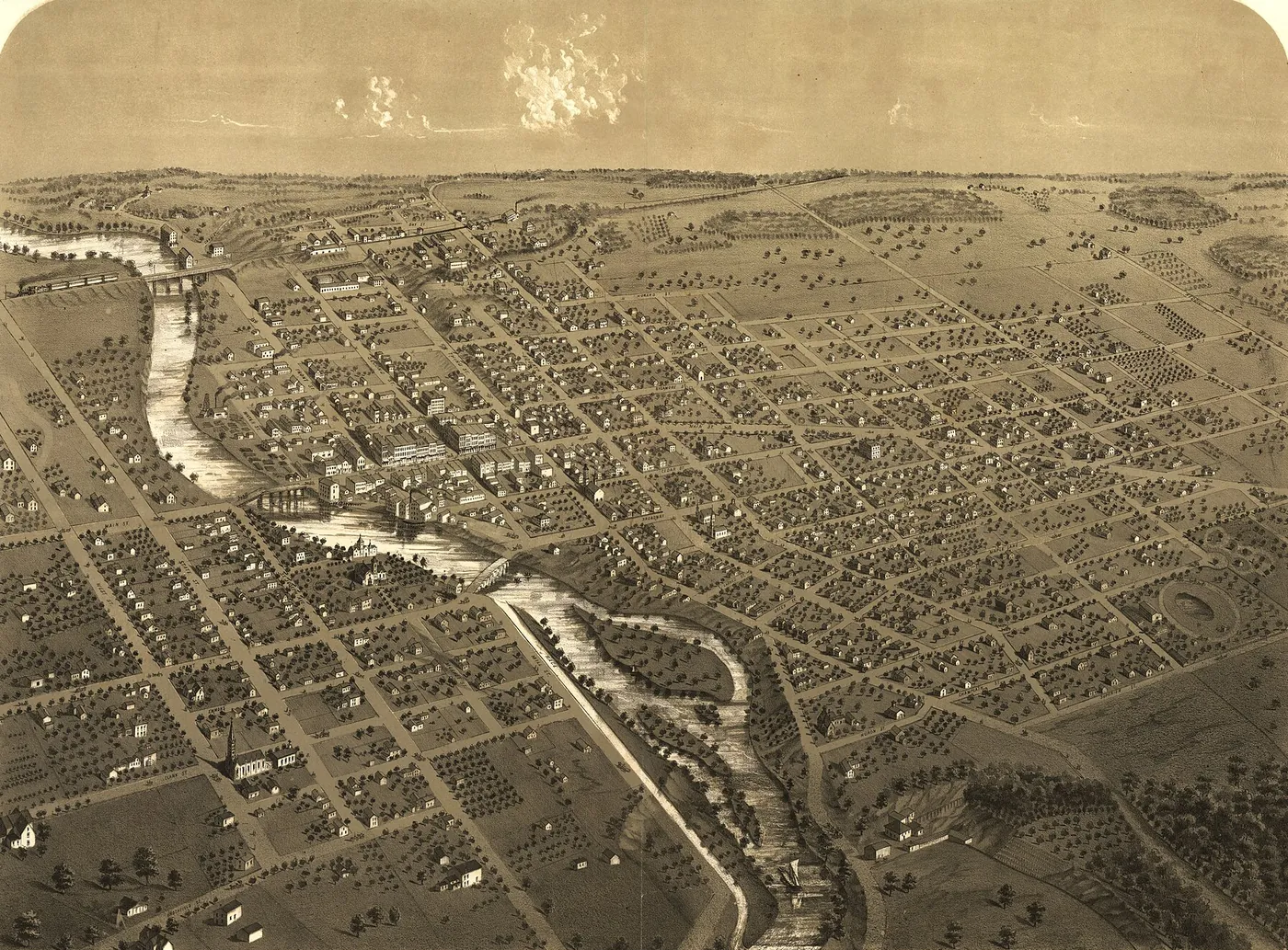
- Picture added 2 November 2026: A. Ruger, Bird’s Eye View of the City of Lafayette, Tippecanoe Co., Indiana (Chicago Lithographing Co., 1868). Library of Congress (public domain), via Wikimedia Commons.
- Pacific Commercial Advertiser (Honolulu), 22 April 1858, p. 3, and in the weeks after: “E Clampsus V.” Library of Congress, Chronicling America.
- Wheeling Daily Intelligencer, 17 January 1866, p. 4: Ephraim Bee, who “when he was here two years ago … founded a branch order in this city.” Library of Congress, Chronicling America.
- Marysville Daily Appeal, 23 October 1915: “Clampers Hold First Rousing Meeting.” California Digital Newspaper Collection.
- Colusa Daily Sun, 27 January 1920: “E. Clampus Vitus Very Deadibus Aroundaboutibus.” California Digital Newspaper Collection.
- The Historical Marker Database, the “E Clampus Vitus” series: the order’s markers, close to nineteen hundred. Accessed November 2026.
Numbers in the text point to this list; entries without a number are further sources we consulted. How we research › · The libraries behind all our stories ›
Read page 253, slowly Write to us Enter the hunt
Corrections (5)
First published 22 October 2026; last updated 2 November 2026. Like all our pages, it is expanded from time to time with new records, pictures and features. Factual corrections are listed here, with their dates.
- Claim narrowed: the Cassopolis lodge is the earliest of the order yet found with its members named; a Connersville, Indiana, letter of February 1846 is the earliest dated mention. Steamboat Jake was initiated at Yreka in 1856, not 1852.
- The Jackson Lodge bill’s dates (brought in 30–31 December 1846, report 6 January 1847, not 14 January); the Sons of Temperance sentence, the timing of the “jack-asses” bill, the Sentinel’s dates, and the spelling, which Wheat standardised in 1931 but did not invent.
- The 1864 “E Clampus Vitus” is in a satirical list, not a paper shouting at its opponents; the Sentinel spells it “Eclampees Vitus”; the bill’s second reading was on 31 December 1846; Helen Beall was a younger sister, not the youngest; a Metropolis record book of 1849 is older than the Morristown ritual; Michigan’s Sons of Temperance came after the Cassopolis lodge, not before; the hotel of the ball is our reading.
- The man who carried the ritual west was Joel Henry Zumwalt (1831–1906), as the Grand Council’s plaque of 2021 names him, not “Joe” or Joseph; with thanks to Jim Cirner.
- Mrs. Bonine’s aunt was Emily Talbot, not “Samuels”; Sarah Osborn’s husband was James B. Bonine of Vandalia, not James E.; the officer is the Sublime Grand Noble Recorder; the Masons of Cassopolis, not the county’s.
About this research
Research and reporting Michael Urbanski Project Scroll
- Sources
- Every fact on this page is drawn from the sources listed above, and each can be checked where it is held.
- Corrections
- Errors are corrected on the page, and each correction is noted there.
- Contact
- To report an error or share a record that adds to the story, write to research@projectscroll.com.
- Method
- How we research ›
© 2026 Michael Urbanski and Project Scroll. All rights reserved. The text, original maps, charts and illustrations may not be reproduced without permission; brief quotations with credit and a link back are welcome. Material from other sources belongs to its holders and is credited where it appears; public-domain material is marked as such.


