How the towns got their names
How Vandalia got its name
No source we have read explains why Vandalia is called Vandalia. The record shows a post office in 1850, a grist mill, a plat in 1851, and a creek named in 1822 by a missionary for his wife. Here is what is known, and the guesses that are not.
By Michael Urbanski · Project Scroll · · 8 min read

Vandalia, Mich. Some town names explain themselves, and some are explained in every county history. Vandalia is neither. It grew up around a grist mill on a creek in Penn Township, it had a post office called Vandalia by 1850, and its plat was filed early in 1851. Who chose the name, and why, no source we have read explains.
So this is a story about what the record does show, and about the guesses that fill the gap. We went back to the county histories of 1875, 1882 and 1906, Michigan’s first gazetteer of 1838 and the post-office lists.
The case in brief
What the record shows
- The name is first on record for a post office, in 1850.
- The village grew around a grist mill built on the creek in 1849 by two Quaker settlers, Stephen Bogue and Charles P. Ball, who laid out the village in 1851.
- The plat followed in 1851: laid out on 3 January, Rogers says; filed on 21 February, Glover says.
- The creek had its name first, from the missionary Isaac McCoy, who named it in 1822 for his wife.
What it does not show, yet
- Who chose “Vandalia,” and why. Neither the 1875 nor the 1906 county history says.
- Whether the name came from Vandalia, Illinois, as many assume.
Story or record? Play along
Here are eight things people say about the name. For each, make your call: true, false, or no record either way. Then see what the paper shows.
“Vandalia, Michigan, was named after Vandalia, Illinois.”
No record
It is the usual guess, and it may be right: the Illinois town had been the state capital and was well known by 1850. But neither the 1875 nor the 1906 county history explains the name.
“Vandalia comes from a Native-language word.”
No record
No source gives it a Native origin. It is a Latin-style European name, “land of the Vandals,” used for towns across the country.
“There was a Vandalia post office before there was a village plat.”
True
Postal listings date the Vandalia office from 1850; the village was laid out in January 1851.
“The village grew up around a grist mill.”
True
Glover, in 1906: the grist mill on Christiann Creek “served as the nucleus for the village of Vandalia.”
“The creek through Vandalia was named for a missionary’s wife.”
True
Rogers, 1875: “It was so named by the missionary in honor of his wife, as they crossed it the 18th of December.” The 1882 history names him: the Rev. Isaac McCoy, in 1822.
“Cass County’s first grist mill stood near the later village.”
True
Rogers puts Carpenter’s mill of 1828 on the creek, “just below where Vandalia now stands.”
“The two county histories agree on when the village was laid out.”
No
Rogers (1875) says 3 January 1851; Glover (1906) says the plat was filed on 21 February 1851. Both may be right: one is the survey, the other the filing.
“Vandalia became an incorporated village in 1875.”
True
Glover calls it “one of the three incorporated villages in Cass county,” and gives the year as 1875.
A post office first
DocumentedThe earliest record of the name we have found is the post office. Postal listings compiled from the Post Office Department’s records give “Vandalia” from 1850, and Rogers’s county history of 1875 names T. J. Wilcox as its first postmaster.
DocumentedThe village had grown up around a mill. Glover’s history of 1906 describes “a grist mill built on the banks of Christiann creek along the state road,” built in 1849 by two Quakers and pioneers of Penn Township, Stephen Bogue and Charles P. Ball, which “served as the nucleus for the village of Vandalia.”
DocumentedRogers says Bogue and Ball laid out the village on 3 January 1851. Glover says the plat of the village of Vandalia was filed on 21 February 1851, on the east side of the creek. It was incorporated in 1875; the railroad, Glover says, arrived in 1871.
Why Vandalia?
OpenNobody we have found says. Rogers mentions Vandalia eight times and never explains it; Glover, writing at length about the village in 1906, does not either. Walter Romig’s Michigan Place Names, the standard reference, may; we have not yet been able to read it.
ReadingThe guesses are borrowed from elsewhere. Vandalia, Illinois, founded in 1819, was the state capital until 1839 and the western end of the National Road, and its name was well known. The Illinois town’s own history of its name is uncertain: the ancient Vandals, a failed colony of the 1770s called Vandalia, and a surveyor’s coinage have all been proposed. Any of these could lie behind the Michigan name, or none.
ReadingWhat the word means is plain enough: Vandalia is a Latin-style “land of the Vandals,” the name of a Germanic people of the late Roman empire. It has no Native-language origin.
A station on the creek
DocumentedVandalia’s founders were Quakers, and their neighbourhood was one of the best-known stations of the Underground Railroad in Michigan. Stephen Bogue had come to the county in 1830; the Underground Railroad Society of Cass County calls him the county’s most famous stationmaster, and says his house, which still stands on M-60, sheltered many freedom seekers on their way to Canada.
DocumentedIn August 1847, slave catchers from Kentucky raided the Quaker farms of Calvin, Penn and Porter townships and seized freedom seekers living there. A crowd of white and Black neighbours, by some counts some hundreds strong, confronted the raiders at O’Dell’s Mill on Christiana Creek near Vandalia, and the Kentuckians agreed to stand trial at Cassopolis. The court commissioner found their papers wanting and released the captives, and dozens of people went on to Canada. The slaveholders’ lawsuit against the neighbours dragged on in federal court in Detroit for more than two years.
DocumentedThe house of James E. Bonine, Bogue’s son-in-law, stands at Penn Road and M-60. It was begun about 1844 and enlarged and restyled after the Civil War; the society, which bought it in 2010, says there is little evidence that the house itself was a station, but there is evidence that freedom seekers were sheltered in the Gothic Revival carriage house of the early 1850s across the road.
ReadingThe village that grew around Bogue and Ball’s mill was born a few years after the raid, in the middle of this Quaker country. The name they gave it is still unexplained; what they did there is not.
Christiann Creek
DocumentedThe creek the village stands on has a recorded name and a recorded reason. Rogers, 1875: the stream that runs into the St. Joseph “near the present site of Elkhart … is known as the Christiana creek. It was so named by the missionary in honor of his wife, as they crossed it the 18th of December.” The missionary was the Baptist Isaac McCoy, founder of the Carey Mission; in October 1803, Rogers says, he had married Miss Christiana Polk. The 1882 history dates the naming to 1822.
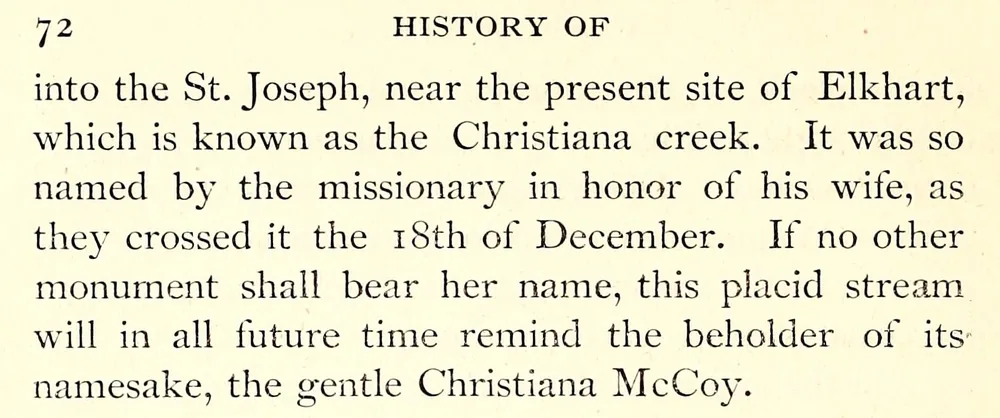
DocumentedThe spelling has drifted ever since. Blois’s Gazetteer of the State of Michigan (1838) has “Christiana river”; Rogers has both “Christiana creek” and “Christianna Creek”; the 1882 history “Christianna Creek”; and Glover in 1906 “Christiann creek,” the form used in Vandalia today. Federal maps still call it Christiana Creek.
DocumentedThe creek turned mills long before the village. Rogers puts Carpenter’s mill of 1828, the county’s first grist mill, on the creek “just below where Vandalia now stands.”
The name on paper
Vandalia has kept one spelling from the start. Its creek has not. Play the creek’s names in order.
- 1822 Christiana (Isaac McCoy names it for his wife)
- 1838 Christiana river (Blois’s gazetteer)
- 1875 Christiana creek (Rogers)
- 1882 Christianna Creek (the county history)
- 1906 Christiann creek (Glover, and the creek today)
To cite this page: Michael Urbanski, “How Vandalia got its name,” Project Scroll, projectscroll.com/news/how-vandalia-got-its-name/, first published 22 October 2026. Corrections are welcome, and any we make are noted on this page.
Sources
- Underground Railroad Society of Cass County, “The Bonine House” and “The Stephen Bogue House.”
- Wikipedia, “Kentucky raid in Cass County (1847),” with its sources.
- State Bar of Michigan, Michigan Legal Milestones: “The Freedom Road” (the 1847 raid and the trial).
- Howard S. Rogers, History of Cass County, from 1825 to 1875 (Cassopolis, 1875): McCoy and Christiana creek, pp. 67, 72; Carpenter’s mill, pp. 116, 181; Vandalia, p. 185. Internet Archive.
- History of Cass County, Michigan (Chicago: Waterman, Watkins & Co., 1882), chapter I: Christianna Creek. Internet Archive.
- L. H. Glover, A Twentieth Century History of Cass County, Michigan (Chicago, 1906): the creek, pp. 7–8; the mill, the plat and the village, pp. 130–131. Internet Archive.
- John T. Blois, Gazetteer of the State of Michigan (Detroit, 1838), p. 215. Internet Archive.
- Jim Forte Postal History, post offices of Cass County, Michigan (Vandalia from 1850).
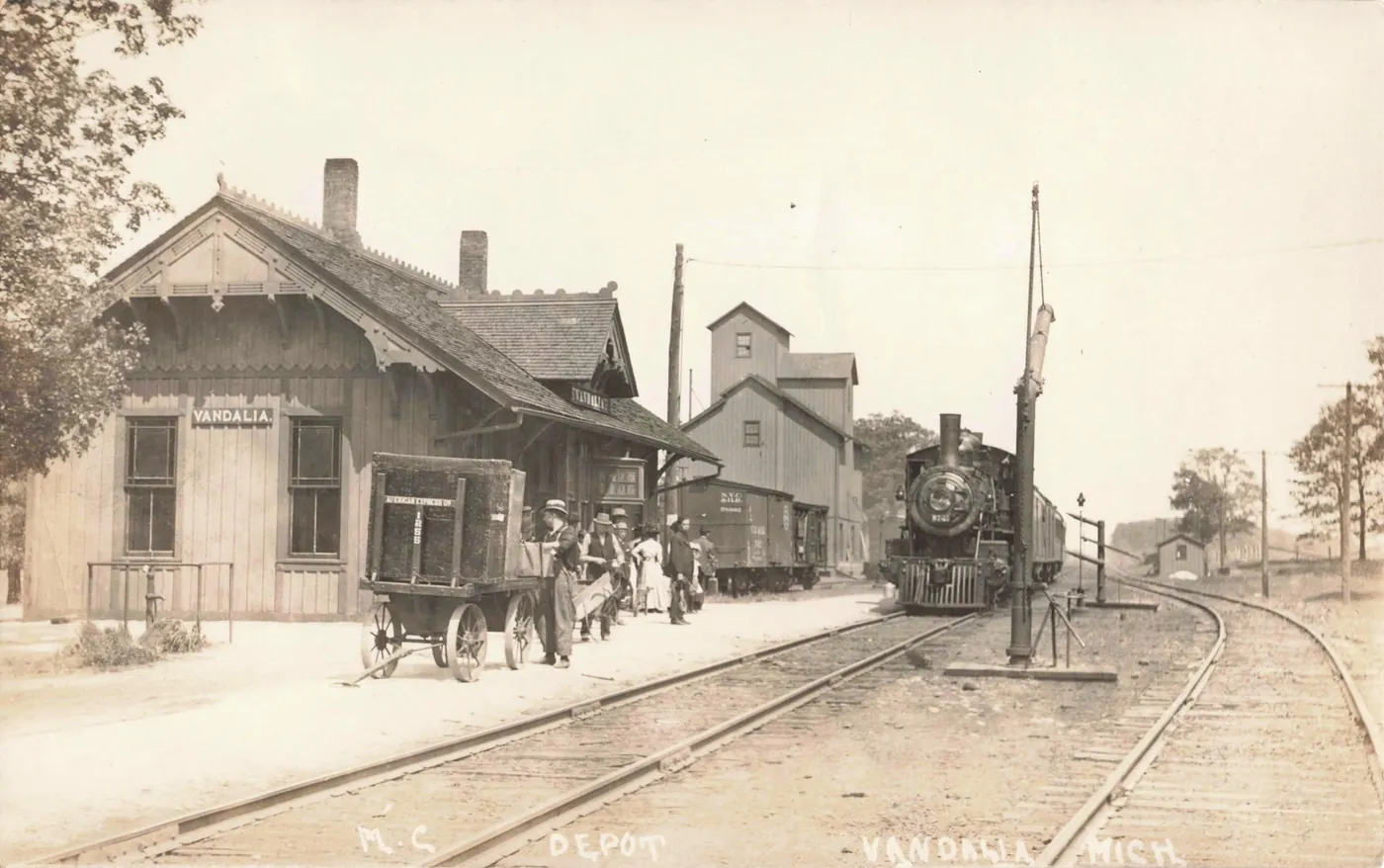
- M. C. Depot, Vandalia, Mich. (1913), real-photo postcard. David V. Tinder Collection, Clements Library, University of Michigan.
- The Old Mill, Vandalia, Mich., real-photo postcard, about 1908–1918. David V. Tinder Collection of Michigan Photography, William L. Clements Library, University of Michigan.
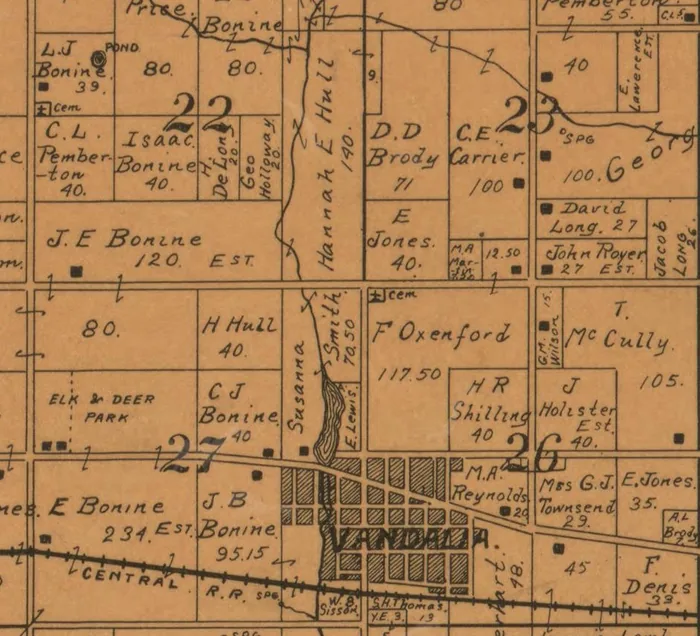
- Map of Cass County, Michigan (Battle Creek: Home Publishing Co., 1897). Library of Congress, Geography and Map Division.
Numbers in the text point to this list; entries without a number are further sources we consulted. How we research › · The libraries behind all our stories ›
The place-names map Write to us All the news
Corrections: none
First published 22 October 2026. Like all our pages, it is expanded from time to time with new records, pictures and features. No factual corrections have been needed so far.
About this research
Research and reporting Michael Urbanski Project Scroll
- Sources
- Every fact on this page is drawn from the sources listed above, and each can be checked where it is held.
- Corrections
- Errors are corrected on the page, and each correction is noted there.
- Contact
- To report an error or share a record that adds to the story, write to research@projectscroll.com.
- Method
- How we research ›
© 2026 Michael Urbanski and Project Scroll. All rights reserved. The text, original maps, charts and illustrations may not be reproduced without permission; brief quotations with credit and a link back are welcome. Material from other sources belongs to its holders and is credited where it appears; public-domain material is marked as such.


