How the towns got their names
How Paw Paw got its name
Paw Paw is named for its river, and the river for the pawpaw tree. But “pawpaw” is not a Native word, the village was laid out as Paw Paw, not Lafayette, and the first Paw Paw in local government was in the next county. We went back to the record.
By Michael Urbanski · Project Scroll · First published · Updated · 9 min read

New finding 1 new finding in this story. See what’s new ›
Paw Paw, Mich. Paw Paw takes its name from the Paw Paw River, and the river from the pawpaw, the small native tree with the big tropical-tasting fruit that grew, the county history says, thickly along its banks. So far, so simple. But the county history says the river was “named by the Indians,” and pawpaw is an English word; many people believe the village was first called Lafayette, though it was laid out as Paw Paw; and the first place in local government to be called Paw Paw was in Berrien County.
We went back to the county history of 1880, the federal place-names list of 1905, the state’s historical marker at the courthouse and the county map of 1860 to see what the record shows.
The case in brief
What the record shows
- The village was named for the river: the founders laid out “a village which they called Paw Paw.”
- Lafayette was the township, from 1835, not the village. The township took the village’s name on 15 March 1867.
- The post office opened in 1835 under Peter Gremps; the county seat came in 1837.
- The first civil “Paw Paw” was in Berrien County, a township erected in 1831 on the same river.
What it does not show, yet
- Any Native-language name of the river, in a published source.
- When the village plat was recorded. (The incorporation is now settled: 1859, and again 1867.)
- Why the township was called Lafayette.
Story or record? Play along
Here are eight things people say about the name. For each, make your call: true, false, or no record either way. Then see what the paper shows.
“Paw Paw takes its name from the Paw Paw River.”
True
The 1880 county history says the township was named from the village in 1867, and the village “was itself called after the river.”
“The village of Paw Paw was first called Lafayette.”
No
Lafayette was the township, from 1835 to 1867. The founders “laid out … a village which they called Paw Paw,” and the county-seat papers of 1837 say “village of Paw Paw.”
“The township changed its name from Lafayette to Paw Paw in 1867.”
True
“The name of the township of Lafayette was changed to Paw Paw on the 15th of March, 1867,” says the 1880 history.
“‘Pawpaw’ is a Potawatomi word.”
No
It is an English word, most likely from the Spanish papaya, and was used for the North American tree by about 1760.
“The Indians named the river for the pawpaw fruit.”
No record
The 1880 history says so, but it prints no Native-language name for the river, and we have not found one in any published source.
“Peter Gremps was Paw Paw’s first postmaster.”
True
“Peter Gremps was the first postmaster of Paw Paw, his appointment dating from 1835.” A street on the 1860 map carries his name.
“The state first picked Lawrence, not Paw Paw, as county seat.”
True
The state’s historical marker at the courthouse says that in 1837 “a gubernatorial commission chose Lawrence as the seat, but the board of supervisors chose Paw Paw.”
“The first Paw Paw in local government was in Van Buren County.”
No
Berrien County had a “township of Paw Paw … erected March 7, 1831,” now Watervliet and Hagar townships, four years before Van Buren’s Paw Paw post office.
The river and the tree
DocumentedThe 1880 county history says the township “was named from” the village in 1867, and the village “was itself called after the river, named by the Indians from the paw paw fruit, growing thickly upon its banks.” Henry Gannett’s federal Origin of Certain Place Names (1905) agrees, writing it as one word: Pawpaw, named for the “presence of pawpaw trees.”
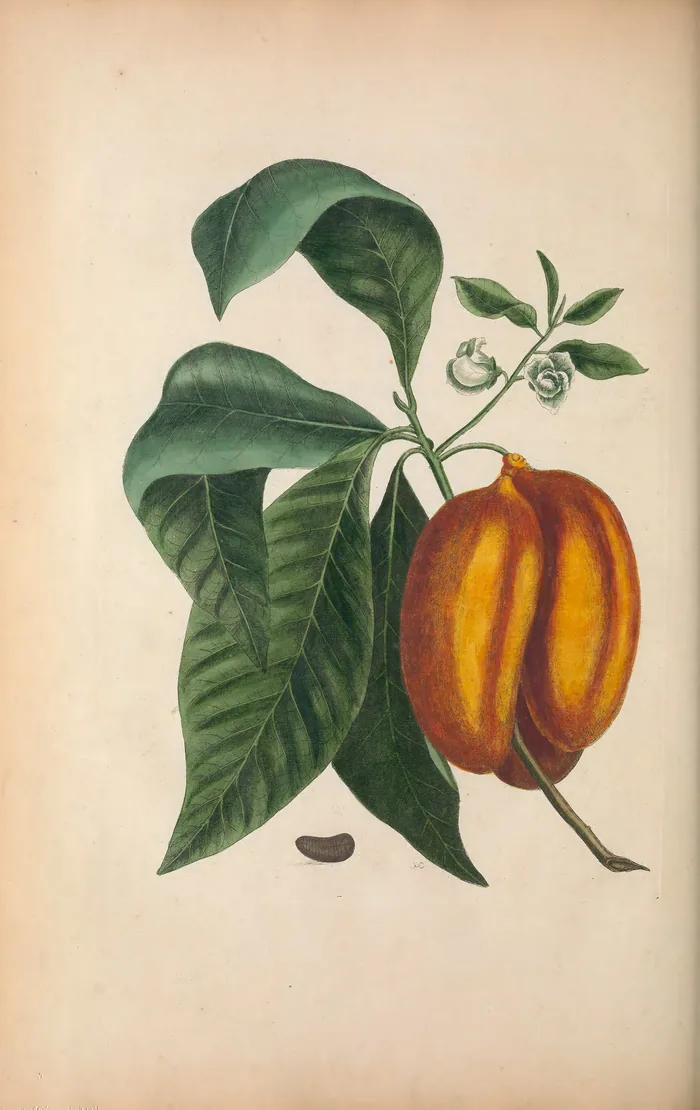
ReadingThe tree is real enough. The pawpaw, Asimina triloba, grows wild in southwest Michigan, near the northern edge of its range. But “pawpaw” is an English word, most likely from the Spanish papaya, first used for the tropical fruit and applied to this tree by about 1760. So the river’s English name may translate a Native one; it cannot be one.
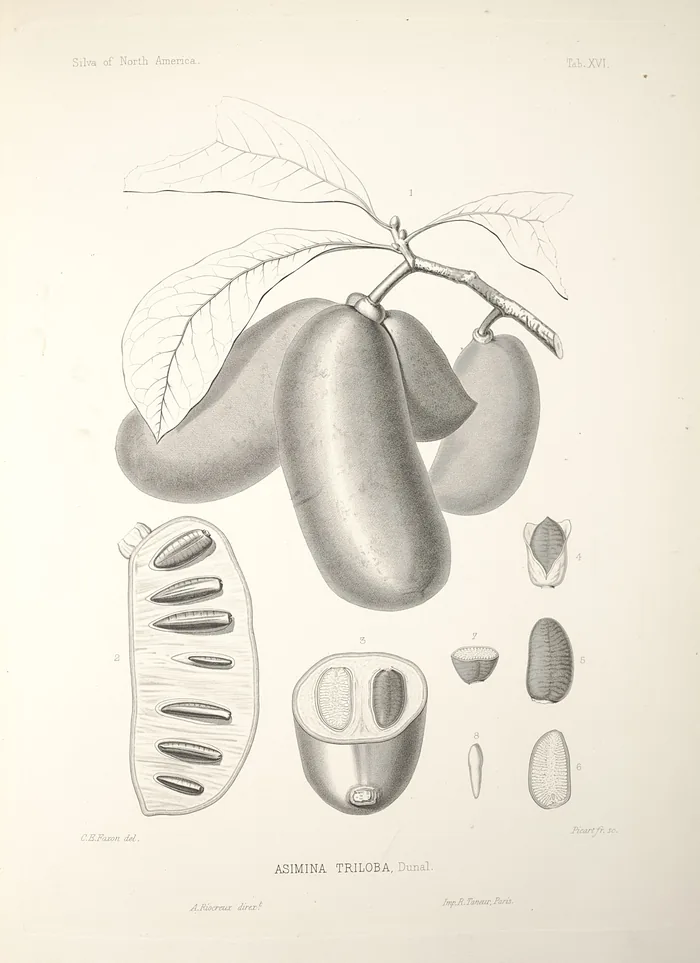
OpenThe history prints no Native-language name for the river, and we have found none in a published source. If the river had one, it is still to be found.
A village which they called Paw Paw
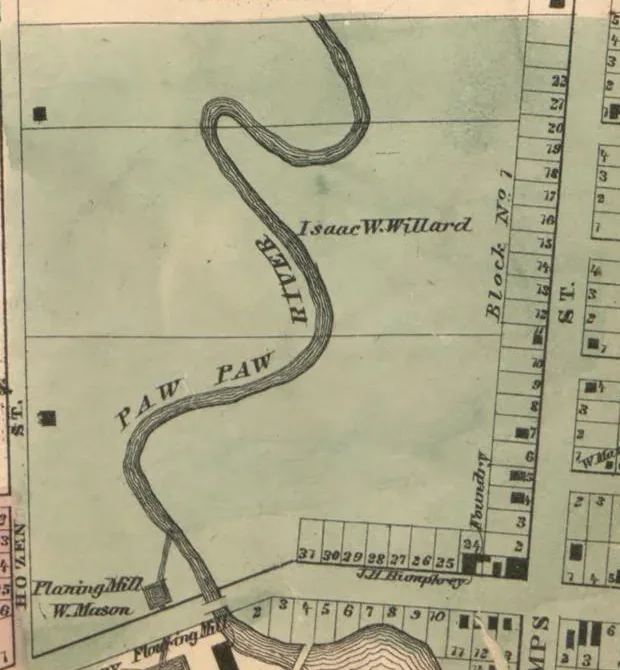
DocumentedPeter Gremps and Lyman J. Daniels bought the mill property at the forks of the river in 1833, the 1880 history says, and “laid out upon it a village which they called Paw Paw.” A settler named Rodney Hinckley had taken up a farm on the north side of the future village in 1832.
DocumentedThe same history’s sketch of Gremps, printed with his portrait, adds that he was born at Palatine, Montgomery County, New York, on 12 May 1801, and that “In company with Messrs. Willard and Daniels, he built the first grist-mill at Paw Paw, the same which is now standing.” It also says he lived on the family homestead in New York until 1835 before setting out for Michigan, which sits awkwardly with a purchase in 1833. The two parts of the book do not agree, and we have not yet settled which date is right.
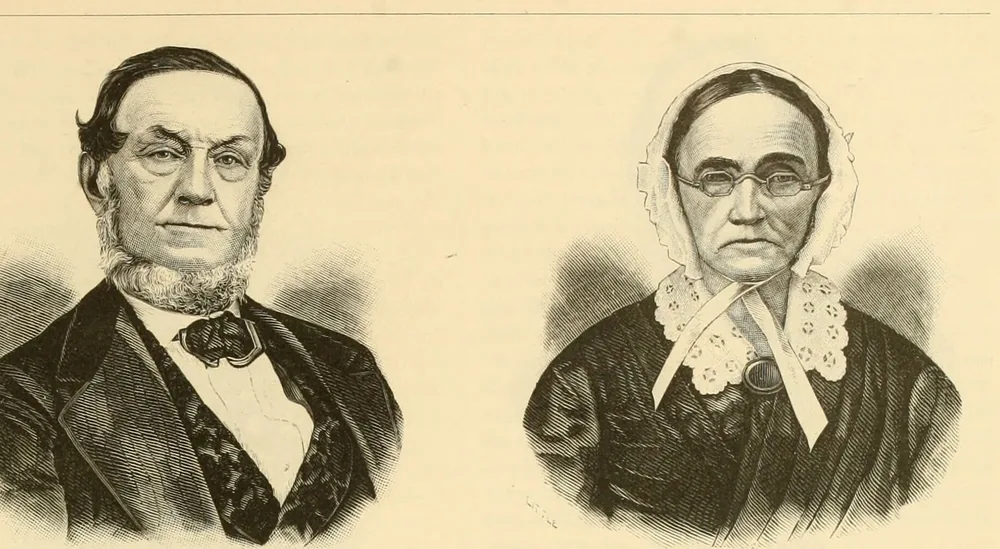
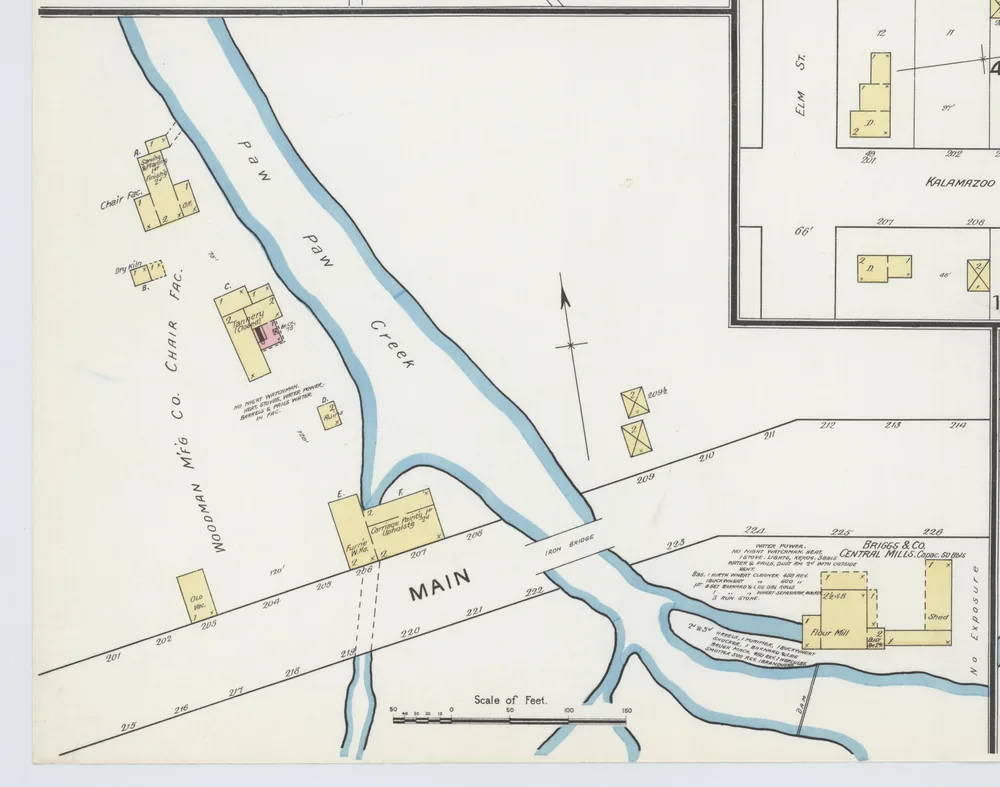
Documented“Peter Gremps was the first postmaster of Paw Paw, his appointment dating from 1835.” The county’s supervisors met “at the village of Paw Paw on the 27th day of March, A.D. 1837,” and the seat of justice was located “in the village of Paw Paw.”
DocumentedThe state’s historical marker at the courthouse adds that in 1837 “a gubernatorial commission chose Lawrence as the seat, but the board of supervisors chose Paw Paw,” and that the county’s voters kept the seat in Paw Paw on 1 April 1901.
The township called Lafayette
DocumentedIn 1835 the Legislative Council formed the whole of Van Buren County into one township, called Lafayette. When the county was divided in 1837, “the present Paw Paw retained the old name of Lafayette.” Then: “The name of the township of Lafayette was changed to Paw Paw on the 15th of March, 1867.”
New findingThe session laws settle when the village was incorporated, and the answer is neither of the dates usually given. Act No. 112 of the session of 1859, “An act to incorporate the village of Paw Paw,” is printed in the Laws of Michigan for that year, at page 292. The charter did not last: Act No. 55 of 1863 was “An act to repeal act number one hundred and twelve, of the session laws of eighteen hundred and fifty-nine, being ‘an act to incorporate the village of Paw Paw.’” The village was incorporated again by Act No. 519 of 1867, approved 28 March, the charter that later acts amend. So 1867 is the second charter, not the first, and 1837 is the county seat’s year, not the village’s.
ReadingSo for thirty years the village of Paw Paw stood in the township of Lafayette, and the two names were easily confused, even at the time: an early court paper is returnable “at the court-house in Lafayette.” That is almost certainly where the belief that the village was first called Lafayette comes from.
OpenWhy Lafayette? The Marquis de Lafayette’s tour of America in 1824–25 made his name popular for new towns, but the history does not say, and we have found no record of the choice.
The other Paw Paw
DocumentedThe first Paw Paw in local government was not here. The 1880 history records that “the township of Paw Paw was erected March 7, 1831,” in Berrien County, on the lower river, on the ground of today’s Watervliet and Hagar townships. That was four years before the Van Buren County post office.
The name on paper
Play the names in order, from the river township of 1831 to the town today.
- 1831 Paw Paw township (Berrien County, now Watervliet and Hagar)
- 1833 Forks of the Paw Paw (a road act, as the 1880 history reports it)
- 1835 Paw Paw (the post office)
- 1835 Lafayette (the township, Van Buren County)
- 1837 village of Paw Paw (the county-seat papers)
- 1859 village of Paw Paw incorporated (Act No. 112)
- 1867 Lafayette becomes Paw Paw (the township renamed)
- 1867 village of Paw Paw incorporated again
- 1905 Pawpaw (Gannett, as one word)
To cite this page: Michael Urbanski, “How Paw Paw got its name,” Project Scroll, projectscroll.com/news/how-paw-paw-got-its-name/, first published 22 October 2026. Corrections are welcome, and any we make are noted on this page.
Sources
- History of Berrien and Van Buren Counties, Michigan (Philadelphia: D. W. Ensign & Co., 1880): the Berrien township of Paw Paw, p. 131; Lafayette and the county seat, pp. 360–362; the chapter on Paw Paw township and village, pp. 505–508. Internet Archive.
- Henry Gannett, The Origin of Certain Place Names in the United States (U.S. Geological Survey Bulletin, 1905), “Pawpaw.” Internet Archive.
- Michigan historical marker “Van Buren County / Van Buren County Courthouse” (1990), on the Historical Marker Database.
- Geil, Harley & Siverd, Map of the Counties of Cass, Van Buren and Berrien, Michigan (Philadelphia, 1860), with the plan of Paw Paw. Library of Congress, Geography and Map Division.
- Laws of Michigan, session of 1859, Act No. 112, “An act to incorporate the village of Paw Paw,” p. 292. Internet Archive.
- Acts of the Legislature of the State of Michigan, 1863, Act No. 55, repealing Act No. 112 of 1859. Internet Archive.
- Local Acts of the Legislature of the State of Michigan, 1867, Act No. 519, “An act to incorporate the village of Paw Paw,” approved 28 March 1867, pp. 1115–1129. Internet Archive.
- Mark Catesby, The Natural History of Carolina, Florida, and the Bahama Islands, vol. 2 (London, 1771), plate 85 (the pawpaw). Internet Archive.
- C. S. Sargent, The Silva of North America, vol. 1 (Boston, 1891), plates XV–XVI (Asimina triloba). Internet Archive.
- Sanborn Fire Insurance Map from Paw Paw, Van Buren County, Michigan, 1892, sheet 1. Library of Congress, Geography and Map Division.
Numbers in the text point to this list; entries without a number are further sources we consulted. How we research › · The libraries behind all our stories ›
The place-names map Write to us All the news
Corrections: none
First published 22 October 2026; last updated 25 October 2026. Like all our pages, it is expanded from time to time with new records, pictures and features. No factual corrections have been needed so far.
About this research
Research and reporting Michael Urbanski Project Scroll
- Sources
- Every fact on this page is drawn from the sources listed above, and each can be checked where it is held.
- Corrections
- Errors are corrected on the page, and each correction is noted there.
- Contact
- To report an error or share a record that adds to the story, write to research@projectscroll.com.
- Method
- How we research ›
© 2026 Michael Urbanski and Project Scroll. All rights reserved. The text, original maps, charts and illustrations may not be reproduced without permission; brief quotations with credit and a link back are welcome. Material from other sources belongs to its holders and is credited where it appears; public-domain material is marked as such.


