Old Cassopolis · Part 3
Where Kellogg made its telephone cabinets
For more than twenty years the oak cases of Kellogg telephones and switchboards were made at Cassopolis, in an old drill works by the railroad. An old postcard shows the plant, the lumber stacked by the siding, and the words “Cabinet Shops” painted on the wall.
By Michael Urbanski · Project Scroll · First published · Updated · 12 min read
This is part 3 of a series. Start with Part 1 ›

Cassopolis, Mich. The card is a real photograph. Long stacks of sawn boards lie in the grass in front, a flatcar stands on the siding, and behind the tracks rise the long, many-windowed buildings of the Kellogg Switchboard & Supply Co. A chimney smokes. On the nearest wall, if you look closely, are the words “Cabinet Shops.”
In the years before the First World War, a farmer in Kansas or a hotel clerk in Buenos Aires who cranked a Kellogg telephone was very likely turning the handle on a piece of Cass County oak. The polished wooden cases of Kellogg wall telephones, and the cabinets of the switchboards that connected them, were made in this village, a hundred miles from the company’s Chicago works.
We followed the plant through the trade journal Telephony, which visited it more than once, through the Paw Paw and South Bend papers, through the business registers that listed the drill works it replaced, and through the company’s own history. The record shows when Kellogg came, how big it grew, and how the work was done. It is silent, so far, on when the saws stopped.
Before Kellogg: a drill works
DocumentedThe ground had been industrial before Kellogg arrived. The 1906 county history records that the Cassopolis Manufacturing Company was organized in the fall of 1899, with G. M. Kingsbury, who had sold his store in the village in the spring of 1900, as its president and general manager.
DocumentedKingsbury was a Cassopolis man through and through. The 1906 history says he was born in the village on 23 April 1862, went to school in Jackson, graduating from its high school in 1881, and kept a store in Cassopolis for eighteen years before selling it to G. L. Smith. He was also a director of the First National Bank of Cassopolis, and he stayed on as president of the manufacturing company until a short time before his death.
DocumentedIt made grain drills, the horse-drawn machines that sow seed in rows. The Mechanical Index of 1904 lists “Cassopolis Mfg. Co., Cassopolis, Mich.—Drills,” and the Thomas Register of 1905 lists it under grain drills. In January 1905 The Iron Age reported a new general manager for “the Cassopolis Mfg. Company, maker of grain drills.” That same year the company sent its grain drills and seeders across the continent: the official catalogue of the Lewis and Clark Centennial Exposition at Portland, Oregon, lists the Cassopolis Mfg. Co. among the exhibitors.
ReadingIn August 1906 the Paw Paw paper spoke of the land and buildings of “the late Cassopolis Drill Co.” We have found no company of exactly that name in the registers, and the Cassopolis Manufacturing Company is the only maker of drills at Cassopolis we can find. The two are very probably one concern, called by its product in the village. Cassopolis was a drill town’s neighbor: Dowagiac, ten miles north, was famous for its grain drills, and the 1906 history devotes pages to the drill works there.
Chicago comes to Cassopolis, 1906
DocumentedKellogg was a Chicago maker of telephones and switchboards, founded in 1897. In August 1906 a Paw Paw newspaper reported that Kellogg would put its new woodworking department in Cassopolis. The citizens of the village were to turn over the land and buildings of the late Cassopolis Drill Co., and the title would pass to Kellogg once it had spent an agreed sum on labor and additions.
ReadingThis was the usual bargain of the day between a small town and an outside manufacturer: the village offered a plant already built, and the company earned the deed by investing and hiring. The vacant drill works, with its buildings and railroad siding, was exactly what a woodworking shop needed.
The company and its founder
DocumentedThe man behind the company was Milo G. Kellogg. A history compiled by telephone collectors for the Made-in-Chicago Museum says that he joined the Chicago firm of Gray & Barton in 1870, soon after graduating from the University of Rochester; that firm became the Western Electric Manufacturing Company in 1872. He left Western Electric in 1889, held some 150 inventions, founded the Kellogg Switchboard & Supply Company in 1897, and was its president until his death in 1909. In 1899, the same history says, he was granted 125 telephone patents in a single day.
DocumentedKellogg supplied the independent telephone companies, the thousands of local exchanges that sprang up in competition with Bell after Bell’s basic patents expired in 1893 and 1894. The same history tells of the scandal that followed: in 1901, in poor health, Kellogg handed control to his brother-in-law, Wallace L. DeWolf, and in June 1903 a minority stockholders’ suit revealed that Bell interests had secretly owned the company for about eighteen months. The courts undid the sale; the Illinois Supreme Court’s final decision came in 1909.
ReadingSo the Cassopolis plant was founded in 1906 by a company still fighting to prove it was independent. Its customers were the independent exchanges of the small towns and farm country, the very kind of place where the cabinets were made.
Seven buildings, then eight
DocumentedThe plant grew. In 1909 the trade journal Telephony counted seven buildings with 46,000 square feet. The same article listed the company’s main building and three large storage warehouses of 71,000 square feet in Chicago, for a total of 235,000 square feet, about six acres, of which the Cassopolis woodworking plant was a substantial part.
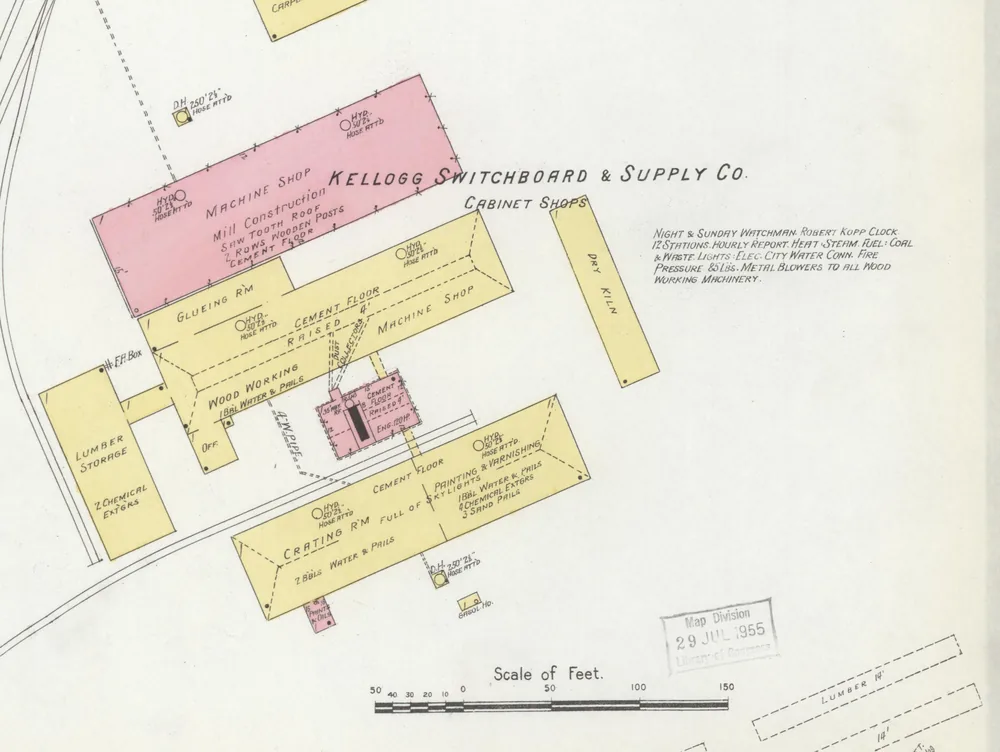
DocumentedIn November 1910 the company filed papers at Lansing for its Cassopolis woodworking plant and said it had a $75,000 plant there, where “the cabinet work for Kellogg switchboards and telephones” was made. By 1915 there were eight buildings, two warehouses and a dry kiln.
A visit to the cabinet shops, 1917
DocumentedIn April 1917 the South Bend News-Times reported seventy men at work and six more wanted. There were orders from Italy, from the Dutch East Indies and from the Russian government, and some departments worked until nine at night. That August Telephony walked its readers through an eight-acre plant with a two-acre lumber yard, where tiers of oak waited for the kiln and a new building was going up.
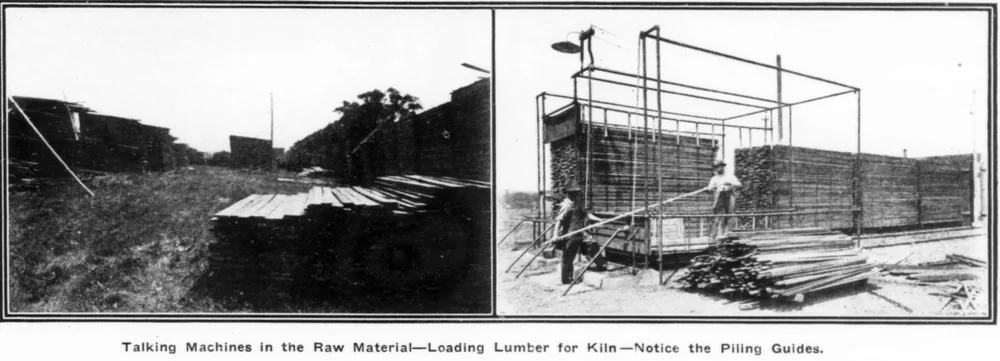
DocumentedThe August article, headed “Preparing Wood to Be Used in Telephone Cabinets,” opens almost like a pastoral. It describes a field shaded by big oak trees, the smell of fresh-cut wood on the air and bees humming in the clover, and says that no hive was busier than the Kellogg woodworking plant.
DocumentedThe lumber came in rough, “direct from the mills,” to the yard at a corner of the plant, where it was stacked and tagged. Long stacks of boards waited to be fed into a large dry kiln. The writer singled out a new piling frame at the kiln: the boards had once been stacked on low trucks, and lining them up straight had caused constant trouble and delay.
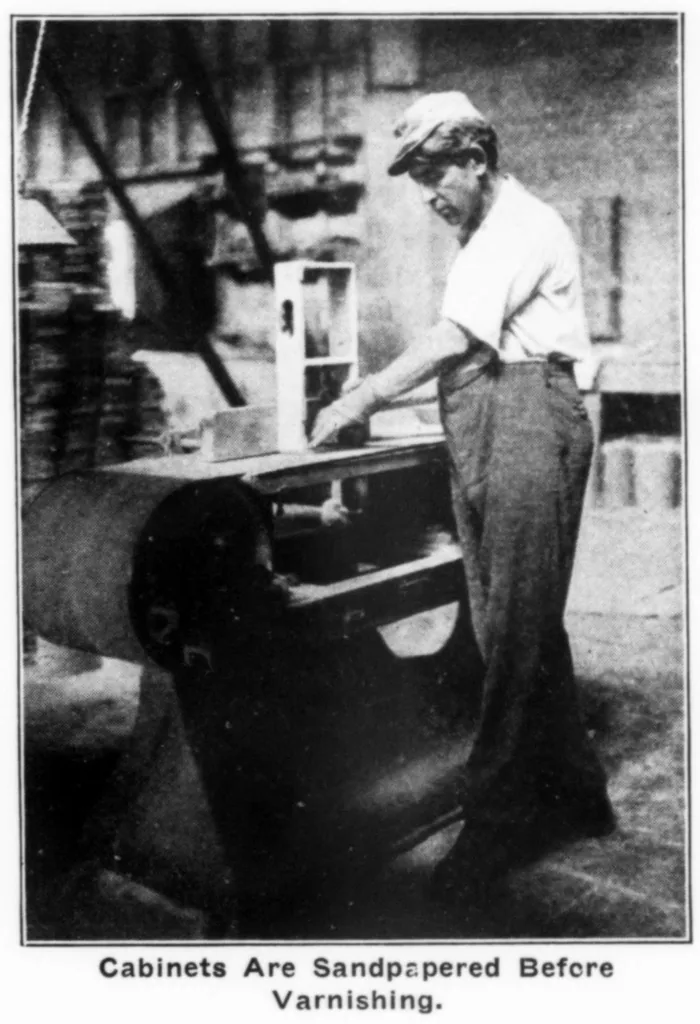
DocumentedIn the finishing rooms the varnish was now sprayed on by air pressure, with apparatus the writer compared to an artist’s airbrush, giving an even, well-set coat in a fraction of the time the old hand method took. Before the first coat, the cabinets were surfaced on high-speed sandpaper belts sized for each surface, and the writer praised the care for proper surfacing that was enforced at Cassopolis.
DocumentedA new building was due to be finished in September. Tracks would run straight to it from the dry kiln, with a turntable, so that raw lumber would be handled fewer times before it reached the departments.
ReadingThe orders from Italy and the Russian government in April 1917 fall in the months just before and after the United States entered the war. Telephone and switchboard equipment was war material, and the evening shifts at Cassopolis were part of that demand.
The cabinet department of a big company
DocumentedIn April 1918 Telephony printed a short history of Kellogg’s factories under the title “What the New Kellogg Factory Represents.” It recalled that the company had begun at Highland Park, Illinois, in an abandoned schoolhouse, and at first was largely an assembler of parts bought on the open market. By the fall of 1917 it was crowded again and had added a six-story addition, 66 feet wide and 396 feet long, bringing its Chicago factory to 584,000 square feet. It also dates the Cassopolis plant’s widest role. After leasing more floor space in Chicago on 1 May 1912, it says, “About this time they were obliged to organize and incorporate their entire cabinet work at Cassopolis, Michigan.” That suggests that from then on the company’s wooden cases were made at Cassopolis, though the article does not say so in as many words.
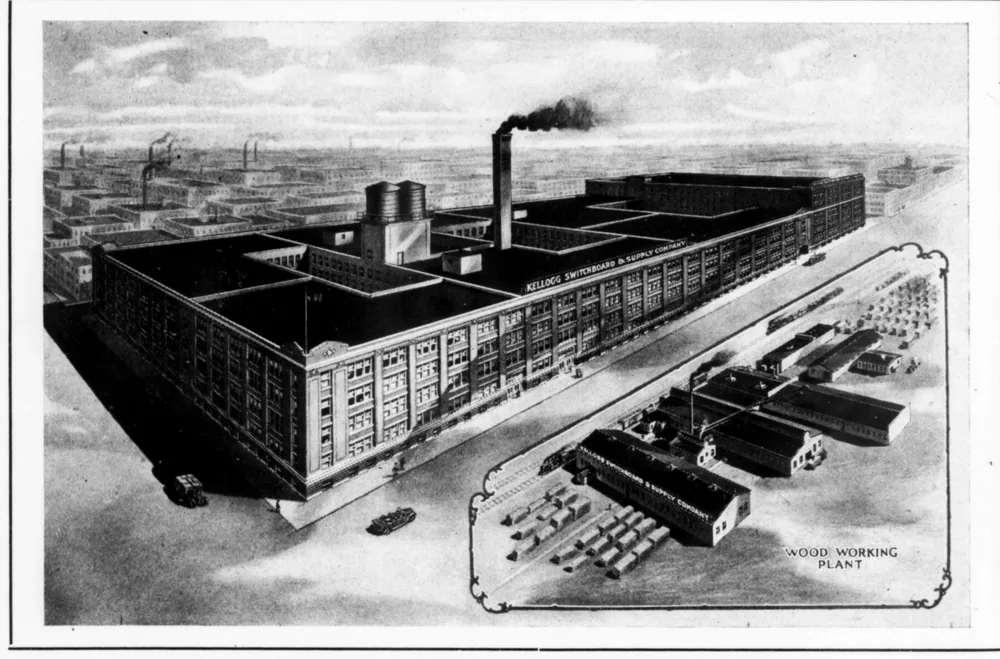
DocumentedThe article explains Cassopolis in one sentence: the company had found it necessary to form an organization and gather its whole cabinet department at Cassopolis, Michigan. Its illustration showed the new Chicago factory with a view of the Cassopolis plant in the foreground.
ReadingThat is the role the card records: Cassopolis was Kellogg’s cabinet shop, the one place where the wooden half of every telephone and switchboard was made, while the electrical works stayed in Chicago.
Reading the card
DocumentedThe card was published by O. L. Yerty of Cassopolis, and the William L. Clements Library, which holds it in the David V. Tinder Collection of Michigan Photography, dates it to about 1908–1916.
ReadingThose years fall between Telephony’s count of seven buildings in 1909 and its count of eight, with two warehouses and a dry kiln, in 1915; the long, many-windowed ranges on the card are the shops those counts describe. Almost everything else in the picture can be matched to the 1917 tour. The stacks of sawn boards in the foreground are the lumber yard, where rough stock “direct from the mills” was stacked and tagged before the kiln. The flatcar on the siding is how that lumber arrived, and how the finished cabinets left for Chicago. The smoking chimney most likely belongs to the boiler that heated the kiln and drove the machinery, though the card does not say so.
ReadingThe painted words “Cabinet Shops” sum up the plant’s purpose better than any article. Kellogg did not make telephones at Cassopolis; it made the wooden cases they went into, the cabinet work that the company’s own filing of 1910 described, and shipped them to Chicago, where the bells, coils and switchboard apparatus were fitted.
ReadingThe card also preserves something the trade journal took for granted: the scale of the place against the village. A plant of eight acres, with a two-acre lumber yard, beside a railroad siding, was a striking sight in a village of Cassopolis’s size, and a fitting subject for a local photographer selling views of his own town.
After the war, and the long silence
DocumentedThe work did not stop with the war. A Kellogg advertising budget printed in Printers’ Ink in 1929 still lists taxes for “Chicago & Cassopolis.”
ReadingBy 1929 the wooden telephone was giving way to metal and, soon, to molded plastic. A plant built to make oak cabinets would have been squeezed by that change, but we have found no record of the decision to close it.
DocumentedThe company itself lived on. The Made-in-Chicago history records that International Telephone and Telegraph began buying Kellogg stock in August 1951, that Kellogg became a division of ITT in 1952, and that the Kellogg name was dropped in 1965.
If you know, or if you have a Kellogg telephone with a Cassopolis case, write to research@projectscroll.com.
A timeline
- 1897 Milo G. Kellogg founds the Kellogg Switchboard & Supply Company in Chicago
- 1899 Cassopolis Manufacturing Company organized in the fall
- 1903 Suit reveals Bell interests’ secret ownership of Kellogg
- 1905 Cassopolis Mfg. Co. grain drills shown at the Lewis and Clark Exposition, Portland
- 1906 August: Kellogg to take over the drill works for its woodworking department
- 1909 Seven buildings, 46,000 square feet; Kellogg dies; final court decision
- 1910 Michigan papers filed for the $75,000 Cassopolis plant
- 1915 Eight buildings, two warehouses and a dry kiln
- 1917 Seventy men, export orders, evening shifts; an eight-acre plant with a new building
- 1918 The whole cabinet department gathered at Cassopolis
- 1929 Taxes still budgeted for “Chicago & Cassopolis”
- 1952 Kellogg becomes a division of ITT
Sources
- “Cassopolis Lands Chicago Concern,” True Northerner (Paw Paw, Mich.), 10 August 1906, p. 3. Digital Michigan Newspapers, Central Michigan University.
- The story of the Kellogg Switchboard & Supply Company, Telephony, 4 December 1909 (the wood-working plant at Cassopolis, seven buildings, 46,000 square feet). Internet Archive.
- Telephony, 19 November 1910 (Michigan incorporation; the $75,000 plant at Cassopolis). Internet Archive.
- “Manufacturing Plant’s Growth,” Telephony, 30 October 1915 (eight buildings, two warehouses, a dry kiln). Internet Archive.
- Cassopolis column (the Kellogg branch: seventy men, export orders), South Bend News-Times, 10 April 1917, p. 12. Hoosier State Chronicles.
- “Wood for Telephone Cabinets,” Telephony, 25 August 1917. Internet Archive.
- Kellogg Switchboard and Supply Company advertising budget, Printers’ Ink, 28 November 1929. Internet Archive.
- Kellogg Switchboard & Supply Co, Cassopolis, Mich. (real-photo postcard, O. L. Yerty). David V. Tinder Collection of Michigan Photography, William L. Clements Library, University of Michigan.
- “What the New Kellogg Factory Represents,” Telephony, 6 April 1918, p. 68 (Highland Park beginnings; the cabinet department at Cassopolis). Internet Archive.
- L. H. Glover, A Twentieth Century History of Cass County, Michigan (Chicago, 1906): sketch of G. M. Kingsbury, president of the Cassopolis Manufacturing Company, organized in the fall of 1899. Internet Archive.
- The Iron Age, 26 January 1905 (general manager of the Cassopolis Mfg. Company, maker of grain drills). Internet Archive.
- The Mechanical Index, 1904 (Cassopolis Mfg. Co., Cassopolis, Mich.: drills). Internet Archive.
- Thomas Register of American Manufacturers, 1905 (Cassopolis Mfg. Co.: grain drills). Internet Archive.
- Official Catalogue of the Lewis and Clark Centennial and American Pacific Exposition, Portland, Oregon, 1905 (Cassopolis Mfg. Co.: grain drills and seeders). Internet Archive.
- A History of the Kellogg Switchboard & Supply Company, Chicago, Illinois, compiled from articles by David Massey, Jay Neale and Roger Conklin, with research by Mike Neale (revised 2006). Made-in-Chicago Museum.
- Sanborn Fire Insurance Map from Cassopolis, Cass County, Michigan, January 1909, sheet 1 (Kellogg Switchboard & Supply Co. Cabinet Shops). Library of Congress, Geography and Map Division.
Numbers in the text point to this list; entries without a number are further sources we consulted. How we research › · The libraries behind all our stories ›
See the old Cassopolis cards Know when the plant closed? Write to us Enter the hunt
Corrections: none
First published 22 October 2026; last updated 25 October 2026. Like all our pages, it is expanded from time to time with new records, pictures and features. No factual corrections have been needed so far.
About this research
Research and reporting Michael Urbanski Project Scroll
- Sources
- Every fact on this page is drawn from the sources listed above, and each can be checked where it is held.
- Corrections
- Errors are corrected on the page, and each correction is noted there.
- Contact
- To report an error or share a record that adds to the story, write to research@projectscroll.com.
- Method
- How we research ›
© 2026 Michael Urbanski and Project Scroll. All rights reserved. The text, original maps, charts and illustrations may not be reproduced without permission; brief quotations with credit and a link back are welcome. Material from other sources belongs to its holders and is credited where it appears; public-domain material is marked as such.


