The lakes
Stone Lake, the lake that keeps secrets
No stream runs into Stone Lake, and none runs out. The village of Cassopolis was laid out on its shore in 1831, the county history of 1882 called it the most peculiar lake in the county, and people once believed it rose and fell with Lake Superior. Here is what the record says, and the seven mysteries it still keeps.
By Michael Urbanski · Project Scroll · First published · Updated · 9 min read

Cassopolis, Mich. Stone Lake lies at the foot of Broadway in Cassopolis, close enough to the courthouse that the village was laid out around its shore. It is not large, and it is not famous. But it has puzzled people for a long time. No stream runs into it, and none runs out. Its water was soft when its neighbor’s was hard. And in the 1880s, by the county history’s account, many people in Cass County believed it was fed by an underground river from Lake Superior.
We went back to the county histories of 1882 and 1906 and the county atlas of 1872 to see what the record says about the lake, and what it still keeps to itself.
The case in brief
What the record shows
- The lake is named for its stones: boulders the glaciers left on its shores.
- It has no visible inlet or outlet, and its water was “very fine and very soft” in 1882, when Diamond Lake’s was hard.
- People believed in a river from Lake Superior. The 1882 history reports the belief that the lake was fed by “the great subterranean stream” from Superior, and rose and fell with it.
- The village was laid out on its shore, and for years drew its drinking water from it.
What it does not show, yet
- Whether the lake still rises and falls when its neighbors don’t. Only people on the shore can tell us.
- Whether its water is still soft. A few dollars of test strips would answer it.
- Where the icehouse stood that, around 1899, supplied ice to the Diamond Lake cottages.
Story or record? Play along
Here are eight things people say about Stone Lake. For each, make your call: true, false, or no record either way. Then see what the paper shows.
“The 1882 county history called Stone Lake the county’s most peculiar lake.”
True
“The largest is Diamond Lake … and the most peculiar is Stone Lake.” History of Cass County (1882), p. 11.
“In 1882 Stone Lake’s water was hard, like Diamond Lake’s.”
No
Its water was “very fine and very soft”; Diamond Lake’s, “only half a mile distant, is hard.” 1882, p. 11.
“Stone Lake is named for the boulders on its shores.”
True
Its shores “were originally very thickly strewn with stone, in the form of bowlders.” 1882, p. 11.
“An underground river from Lake Superior feeds Stone Lake.”
No record
The 1882 history says only that it was “supposed by many people.” No study has ever shown it.
“Cassopolis once drank Stone Lake water.”
True
From 1891 the water works pumped “from the depths of Stone lake, where the water is crystal pure and ice cold, and free from lime, or ‘soft.’” Glover (1906), p. 152.
“The lake took a corner out of the village plat.”
True
The 1831 plat was a rectangle “broken on the southwest corner by the lake.” Glover (1906), p. 149.
“The first manufacturing business in Cassopolis stood on Stone Lake.”
True, as printed
In 1833, Glover says, the Silvers brothers “put up a distillery on the banks of Stone lake, the first manufacturing institution of Cassopolis.”
“Stone Lake is the largest lake in Cass County.”
No
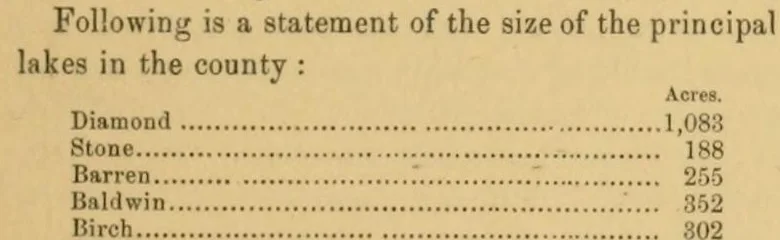
In the 1882 table it is 188 acres; Diamond Lake, half a mile away, is 1,083.
A shore of stones
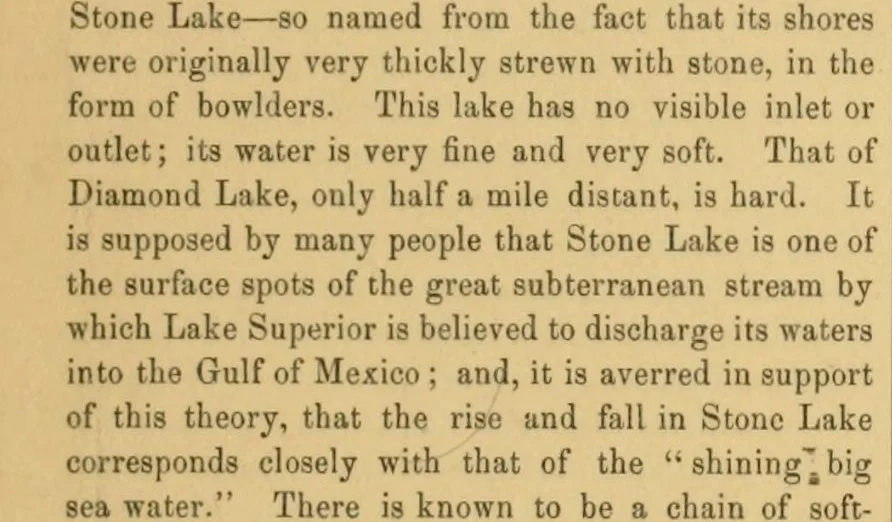
DocumentedThe 1882 county history explains the name plainly. Of all the county’s lakes, “the most peculiar is Stone Lake — so named from the fact that its shores were originally very thickly strewn with stone, in the form of bowlders.”
ReadingThe boulders came with the glaciers, dragged down from the north and dropped when the ice melted, as they were all across this county. Most of them are gone from the shore today.
OpenWhere did they go? If you know of a building in Cassopolis made of Stone Lake stone, we would like to hear about it.
No stream in, no stream out
Documented“This lake has no visible inlet or outlet; its water is very fine and very soft. That of Diamond Lake, only half a mile distant, is hard.” The same history adds: “There is known to be a chain of soft-water lakes extending for a considerable distance across the country from north to south.”
DocumentedThe village put that soft water to use. In 1891 Cassopolis built water works, and, Glover wrote in 1906, “the water is pumped into the mains from the depths of Stone lake, where the water is crystal pure and ice cold, and free from lime, or ‘soft.’”
DocumentedThe lake paid for its usefulness. In 1969 engineers from the University of Notre Dame used Stone Lake as a “test lake system” for a model of eutrophication, the over-feeding of a lake that turns it green. Their paper, given at a workshop on modeling eutrophication that November, reconstructs “the pollution history of Stone Lake from year 1939 to 1965 at which time direct domestic pollution of the lake was terminated.” The same winter Notre Dame’s student paper, The Observer, reported the engineers’ plan for a large-scale experiment to restore the lake.
ReadingThe paper does not say whose sewage it was, only that “direct domestic pollution” went into the lake until 1965: the same lake whose water Glover had called “crystal pure” in 1906.
OpenIs it still soft? Water-hardness test strips cost a few dollars at a hardware or pool store. Dip one at a public spot on Stone Lake and one on Diamond Lake, and send us the numbers. You could settle a question that goes back to 1882.
The river from Lake Superior
Documented“It is supposed by many people,” the 1882 history says, “that Stone Lake is one of the surface spots of the great subterranean stream by which Lake Superior is believed to discharge its waters into the Gulf of Mexico; and, it is averred in support of this theory, that the rise and fall in Stone Lake corresponds closely with that of the ‘shining’ big sea water.”
ReadingThe “shining big sea water” is Longfellow’s, from The Song of Hiawatha (1855): “By the shining Big-Sea-Water.” The history does not name him on that page, but it does a few pages later, where it gives Lake Superior’s name as “Gitchi Gomee, which Longfellow translates ‘Big Sea Water’ or ‘Shining Big Sea Water.’” Its writers had the poem in mind.
OpenNeighbors on the shore may be the only people who can answer this one: does Stone Lake rise and fall when the other lakes around it don’t?
The village on the shore
DocumentedWhen the county seat was fixed at Cassopolis in 1831, the proprietors laid out their village beside the lake. Glover, in 1906, describes the original plat: a rectangle of 119½ by 191 rods, “broken on the southwest corner by the lake.” “The lake,” he adds, “occupied the principal natural position in influencing the location of residence and business enterprises at the early period.”
DocumentedThe first manufacturing in the village was on its banks: in 1833, Glover says, Jacob, Abiel and Benjamin F. Silvers “put up a distillery on the banks of Stone lake.” By 1882 there was a bowl factory on the shore, and the road to Niles in early days, the 1882 history says, “led through the woods on the high ground west of Stone Lake.”
DocumentedThe county atlas of 1872, whose plan of Cassopolis heads this page, shows the lake at the foot of the village, with Broadway, Disbrow and the public square laid out beside it.
Ice in winter
DocumentedBefore refrigerators, the lake had a winter crop. The Diamond Lake Association’s history, drawn from Lois Webster Welch’s A Diamond Sparkles (1970), records under 1899: “Ice deliveries were made from the Stone Lake Icehouse.” We have not yet found the newspaper of the time.
ReadingSo for a while the iceboxes at the Diamond Lake cottages most likely ran on Stone Lake water, and the two lakes that never shared their water did, a block at a time.
OpenWhere did the icehouse stand, and who ran it? Do you have a photograph of an ice harvest, or of a summer day on Stone Lake? Tell us, and tell us where it came from.
Seven secrets still kept
Stone Lake has its own treasure hunt, on Facebook, with seven mysteries open. Answers count when they come with the page they came from: a book, a map, a deed, a newspaper. We will not give the answers here, but here are the questions.
- Who was the settler who gave away forty acres of lakefront for the village?
- Where is the 1831 parchment deed today?
- Where does Stone Lake’s water really come from?
- Where did the boulders on the shore go?
- What powered the flour mill on a lake with no stream, and where did it stand?
- Who was the doctor who dug into a mound in this county in 1878? (Not on this lake.)
- What became of the thigh bone, and of everything else from that grave?
Cracked so far: none. When someone solves one, we will name them here.
To cite this page: Michael Urbanski, “Stone Lake, the lake that keeps secrets,” Project Scroll, projectscroll.com/news/stone-lake-the-lake-that-keeps-secrets/, first published 22 October 2026. Corrections are welcome, and any we make are noted on this page.
Sources
- History of Cass County, Michigan (Chicago: Waterman, Watkins & Co., 1882): Stone Lake and the table of lakes, p. 11; the road to Niles; the bowl factory. Internet Archive.
- L. H. Glover, A Twentieth Century History of Cass County, Michigan (Chicago, 1906): the original plat, p. 149; the water works, p. 152; the distillery. Internet Archive.
- Atlas of Cass County, Michigan (Philadelphia, 1872): Ontwa Township, and Plan of Cassopolis, pp. 36–37. Internet Archive.
- Diamond Lake Association, “About Diamond Lake,” timeline, 1899 (compiled from Lois Webster Welch, A Diamond Sparkles, 1970).
- Henry Wadsworth Longfellow, The Song of Hiawatha (Boston, 1855).
- Michigan Department of Natural Resources, inland lake map, Stone Lake, Cass County.
- Wayne F. Echelberger, Jr., M. W. Tenney, P. C. Singer, F. H. Verhoff and W. A. Garvey (University of Notre Dame), “Biogeochemical Modeling of Eutrophic Lakes: A Position Paper,” in Modeling the Eutrophication Process (workshop proceedings, St. Petersburg, Fla., 19–21 November 1969): Stone Lake, Cassopolis, as a “test lake system.” Internet Archive.
- Steve Effler, “Specific pollution results presented,” The Observer (University of Notre Dame), vol. 4, no. 54, 9 December 1969, p. 1. University of Notre Dame Archives.
Numbers in the text point to this list; entries without a number are further sources we consulted. How we research › · The libraries behind all our stories ›
How Cassopolis got its name Write to us All the news
Corrections (1)
First published 22 October 2026; last updated 25 October 2026. Like all our pages, it is expanded from time to time with new records, pictures and features. Factual corrections are listed here, with their dates.
- The Longfellow note: the 1882 history does name him, a few pages on.
About this research
Research and reporting Michael Urbanski Project Scroll
- Sources
- Every fact on this page is drawn from the sources listed above, and each can be checked where it is held.
- Corrections
- Errors are corrected on the page, and each correction is noted there.
- Contact
- To report an error or share a record that adds to the story, write to research@projectscroll.com.
- Method
- How we research ›
© 2026 Michael Urbanski and Project Scroll. All rights reserved. The text, original maps, charts and illustrations may not be reproduced without permission; brief quotations with credit and a link back are welcome. Material from other sources belongs to its holders and is credited where it appears; public-domain material is marked as such.


