Old Cassopolis · Part 4
Race day at the Cassopolis fair grounds
A horse and sulky, a judges’ stand and a crowd at the rail: the Cass County fair raced at Cassopolis long before this card was made. The grounds moved three times for the railroads, fell silent for twenty years, and were twice brought back to life.
By Michael Urbanski · Project Scroll · · 12 min read
This is part 4 of a series. Start with Part 1 ›

New finding 1 new finding in this story. See what’s new ›
Cassopolis, Mich. The card is a real photograph taken on the track itself. Men in hats and dark suits stand along the left. A horse in harness, hitched to a light sulky, is being led along the dirt. To the right is a raised judges’ stand, and beyond it a long line of people at the rail. Under the trees at the far end the dust hangs in the air.
Nobody wrote a date on it, and nobody wrote the horse’s name. The library that holds the card dates it to about 1905–1918. That span happens to cover one of the liveliest and most uncertain stretches in the long life of the Cass County fair: the years when it came back from a twenty-year silence, called itself an exposition and race meet, went quiet again, and was rescued by the Grange.
We went back to the two county histories of 1882 and 1906, to the fair lists printed in The Billboard, to a harness-racing paper, to the South Bend News-Times, and to the speedway guides that still list a half-mile dirt oval at Cassopolis. What follows is the story of the ground behind that judges’ stand, as far as the paper lets us follow it.
A society of farmers, 1851
DocumentedThe Cass County Agricultural Society was organized in the spring of 1851 and held its first fair that fall. The county history of 1882 admits that it could not give the exact day: the society’s early records had been lost, and the historian thought the organizing meeting was probably held in March or April. The first president was Justus Gage and the first secretary George B. Turner.
DocumentedGage was not a gentleman farmer from the village. The 1882 history describes him as the Universalist minister who settled in Wayne Township in 1837, and says he was prominent in organizing and building up the county society and served eight years on the State Board of Agriculture.
DocumentedThe society had to recruit. On 13 May 1851, according to the 1882 history, a notice in the National Democrat, the Cassopolis paper, urged the farmers of the county to join at fifty cents each, so that the society could put together a list of premiums worth competing for.
DocumentedThe society kept going. Its second annual meeting, held to elect officers, met on 1 March 1852 at George B. Turner’s office in Cassopolis. Gage, of Wayne, was president again; Joseph Smith of Jefferson was treasurer; Turner was secretary; and a long list of vice presidents, one for each township, spread the work across the county.
The first fair, in the court house
DocumentedCassopolis had no fair grounds in 1851, and the first fair borrowed the biggest room in the village. The 1882 history records that the court house hall held the exhibits of fruit, vegetables and household goods, and that Heman Redfield gave the fair address there. Redfield told his audience that the county would one day stand first among the agricultural districts of the state.
ReadingThe court house in question was the two-story frame building finished in 1841 on the northeast quarter of the public square, the same building that, half a century later, was moved across the village and became the Colonial Opera House. The county’s first fair and its later opera house were, in a sense, under one roof.
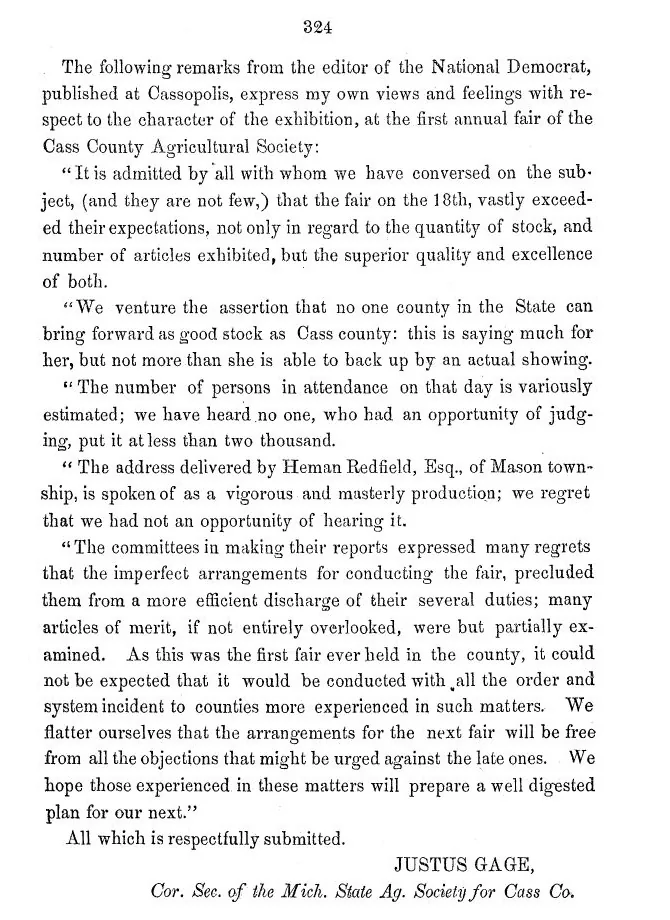
New findingThe day of that first fair was in print all along, only not in the county histories. The state agricultural society’s Transactions for 1851, printed at Lansing in 1852, carry the Cass County society’s own report. It resolved “That the First Annual Fair be held at Cassopolis, on Thursday, the 18th day of September next, provided the citizens of that place will, at their own expense, prepare the ground, pens, &c.” Afterwards Justus Gage passed on the verdict of the National Democrat: the fair “on the 18th” had “vastly exceeded” expectations, and “we have heard no one, who had an opportunity of judging, put it at less than two thousand.” As this was “the first fair ever held in the county,” the editor added, nobody could expect it to run with all the order of older counties.
ReadingA fair of 1851 was a different thing from the fair on the card. The histories speak of premiums for crops, stock and implements, and of an address; they say nothing of horse races at the first fairs. The racing track and the grandstand belong to the later grounds.
DocumentedThe 1882 history discusses the horses, cattle and sheep of the early fairs and prints a complete premium list for one of them; among the winners in the class for agricultural implements were Gideon Allen, Nathan Aldrich and Jesse G. Beeson. It also names the men who kept the society going for years afterward, among them David M. Howell, later register of deeds and a bank vice president, who served many years as one of its officers.
Three moves, and the railroads
DocumentedAccording to the 1906 county history, the society’s grounds had to move three times because of “the right of eminent domain.” Both histories tell the same sequence. Until 1857 the fairs were held on Samuel Graham’s land at Cassopolis.
DocumentedIn 1857, the 1882 history says, the society bought land where the Air Line Railroad depot later stood, and gave it up when the Peninsular Railroad, afterward the Grand Trunk, was built through. The next site was lost as well, this time to the Air Line Railroad.
ReadingIn a village that two railroads were crossing in the 1860s and 1870s, flat open ground near the tracks was exactly what both a fair and a railroad wanted. The society lost each contest. Eminent domain is a polite phrase for what happened: the railroads were entitled to take the land, and the fair moved on.
Twenty acres in the north of the village
DocumentedIn 1871 the society bought twenty acres from Samuel Graham in the north part of the village for $3,000. The 1882 history adds that the society had spent “considerable” money on buildings and improvements, and that while most of its exhibitions had been creditable, competing agricultural associations elsewhere in the county had hurt it.
DocumentedThe grounds were used for more than the fair. The 1906 county history records that the first annual Cassopolis reunion and picnic, planned by a committee whose by-laws were adopted in January 1874, was set for 17 June on the fair grounds.
DocumentedThe society held annual fairs until 1884. After the 1884 fair a mortgage on the grounds was foreclosed, and the village of Cassopolis bought the land. In 1906 the village still owned it.
ReadingThe twenty acres therefore passed from a farmers’ society to the village itself. That matters for the card: whoever held a fair or race meet at Cassopolis after 1884 was using ground the village owned, which may be one reason the fair could come back so quickly when a new organization was willing.
Twenty years without a fair
DocumentedThe 1906 history is blunt: the society had held no fairs since 1884. Then, “a new organization was effected and held a successful fair,” a year before the historian wrote. The same passage says that the fair of September 1906 would mark fifty-five years since the first county fair and the founding of the society.
ReadingA fair held in 1905 by a new body, and another planned for September 1906 as an anniversary, places the revival squarely inside the date range the library gives the card. The crowd at the rail may well be one of these early revival fairs, though nothing on the card says which year.
The race meet years
DocumentedFrom 1908 the Cassopolis fair begins to appear in the fair lists of The Billboard, the trade paper read by showmen, carnival men and concessionaires looking for dates. It listed the Cassopolis fair for 22 to 25 September 1908.
DocumentedIn 1911 The Billboard listed the “Cass Co. Fair” at Cassopolis for 19 to 22 September, with E. H. Black as secretary. In May 1912 it listed the fair for early September, with H. D. Badgley as secretary.
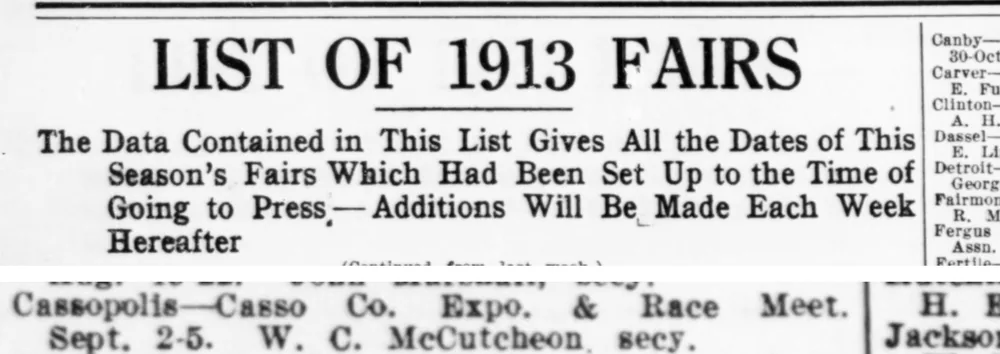
DocumentedIn 1913 the name changed. The Billboard of 24 May and again of 12 July 1913 listed a “Cass Co. Expo. & Race Meet” at Cassopolis for 2 to 5 September.
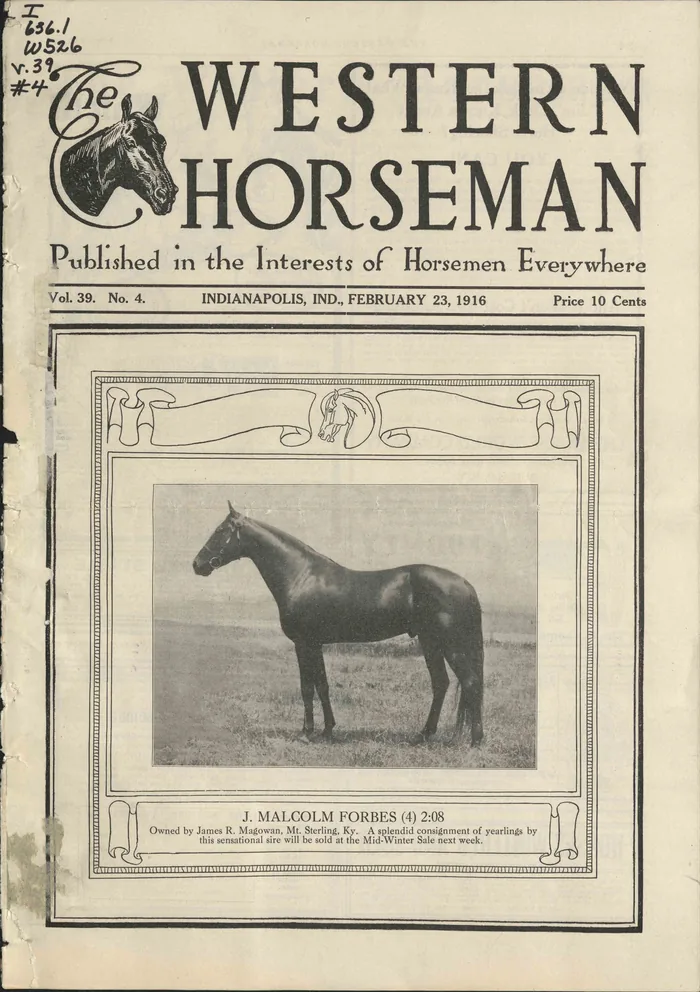
DocumentedThe horses left their own record. A harness-racing paper of 1916, the Western Horseman of Indianapolis, records a horse that had started at Cassopolis in 1911.
Reading“Race Meet” in the very name of the 1913 event says what the organizers thought would draw a crowd. Harness racing, trotters and pacers pulling light sulkies like the one on the card, was the main sport of the American county fair in these years, and a track with a judges’ stand and grandstand was the fair’s centerpiece.
The Grangers bring it back, 1915
DocumentedThe fair then stopped for three years. In October 1915 the South Bend News-Times reported that the Grangers had brought it back, under a headline that called it an event “Revived After Three Years’ Suspension.” Tents went up on the Cassopolis fair grounds again, the association got “the neglected race track” into shape, and the state master of the Grange spoke from the grandstand.
DocumentedBaseball and a motorcycle race came first, with horse races to follow on the Thursday and Friday.
ReadingThe News-Times counted three years without a fair, which would put the last one before the revival in 1912. Yet The Billboard printed dates for a race meet in September 1913. Either the 1913 meet was announced and not held, or the newspaper did not count it as a fair. We have not found a report of the 1913 meet itself.
ReadingThe motorcycle race of 1915 is a hint of what the track would become. The speedway guides of the late twentieth century list the Cassopolis fair’s track as a half-mile dirt oval, and one of them lists a “New Cassopolis Speedway” at the Cass County Fairgrounds.
Reading the card
ReadingThe details on the card fit a county fair race day of the revival years: a sulky horse being led rather than raced, which suggests the moments before or after a heat; a raised judges’ stand beside the track; a covered grandstand; and spectators along the rail. The men in the foreground, in hats and dark suits, look like officials, owners or drivers rather than paying spectators.
ReadingWhat the card cannot tell us is which of the Cassopolis grounds it shows. The obvious candidate is the village’s twenty acres, bought by the society in 1871 and by the village after 1884, since that was the only fair ground the histories describe at Cassopolis in these years, and the 1915 report speaks of “the” fair grounds and “the” race track as if there were one of each.
DocumentedThe Cass County Fair is still held at Cassopolis, on the fairgrounds at 590 North O’Keefe Street, usually in the first week of August. The county and the fair both date its history to 1851.
If you can place the grandstand, or you have a race program from these years, write to research@projectscroll.com.
A premium list, a race card or a newspaper report from September 1913 would settle it.
A timeline
- 1851 Cass County Agricultural Society organized in the spring; first fair on Thursday 18 September, with exhibits in the court house hall and, by one estimate, at least two thousand people
- 1852 Second annual meeting, 1 March, at George B. Turner’s office
- 1857 Fairs leave Samuel Graham’s land; the first of two sites later lost to the railroads
- 1871 Society buys twenty acres from Graham in the north part of the village for $3,000
- 1874 First annual Cassopolis reunion and picnic set for 17 June on the fair grounds
- 1884 Last fair of the old society; the mortgage is foreclosed and the village buys the grounds
- 1905 A new organization holds a successful fair
- 1908 Cassopolis fair listed for 22–25 September
- 1911 Cass County Fair, 19–22 September; a horse starts at Cassopolis
- 1913 “Cass Co. Expo. & Race Meet” listed for 2–5 September
- 1915 The Grangers revive the fair after three years; the race track is put back in shape
- Today The Cass County Fair, 590 North O’Keefe Street, each August
If you go
DocumentedThe Cass County Fair runs each summer, usually in the first week of August, at the fairgrounds at 590 North O’Keefe Street, just outside downtown Cassopolis; the grounds host other events through the year. Check the fair’s own site for dates before you travel.
Sources
- L. H. Glover, A Twentieth Century History of Cass County, Michigan (Chicago, 1906), pp. 205–206: Cass County Agricultural Society. Internet Archive.
- The Billboard, 29 August 1908 (list of fairs: Cassopolis, 22–25 September). Internet Archive.
- Western Horseman (Indianapolis), 23 February 1916 (a horse started at Cassopolis in 1911). Indiana State Library, via Internet Archive.
- Cassopolis fair report (“Event is Revived After Three Years’ Suspension”), South Bend News-Times, 7 October 1915, p. 16. Hoosier State Chronicles.
- Cass County Fair, 590 North O’Keefe Street, Cassopolis. Cass County, Michigan.
- Race Track at Cassopolis, Mich. (real-photo postcard). David V. Tinder Collection of Michigan Photography, William L. Clements Library, University of Michigan.
- History of Cass County, Michigan (Chicago: Waterman, Watkins & Co., 1882), chapter on the Cass County Agricultural Society (organization in 1851, the first fair, the court house exhibits, the second annual meeting, the grounds) and the sketch of Justus Gage. Internet Archive.
- The Billboard, 24 June 1911 (Cassopolis: Cass Co. Fair, E. H. Black, secretary). Internet Archive.
- The Billboard, 26 August 1911 (Cassopolis: Cass Co. Fair, 19–22 September). Internet Archive.
- The Billboard, 4 May 1912 (Cassopolis: Cass Co. Fair, September; H. D. Badgley, secretary). Internet Archive.
- The Billboard, 24 May 1913 (Cassopolis: Cass Co. Expo. & Race Meet, 2–5 September). Internet Archive.
- The Billboard, 12 July 1913 (Cassopolis: Cass Co. Expo. & Race Meet, 2–5 September). Internet Archive.
- The History of the American Speedway, Past & Present (1984): Cassopolis Fair (Cass County Fair), half-mile dirt oval. Internet Archive.
- History of America’s Speedways, Past & Present (1994): Cassopolis Fairgrounds; New Cassopolis Speedway. Internet Archive.
- Cass County Fair (since 1851; dates and events). Official site.
- Transactions of the State Agricultural Society of Michigan … for 1851, vol. III (Lansing, 1852), pp. 314 and 324: the Cass County society’s report (the first fair set for Thursday, 18 September 1851; “not less than two thousand” attending). Internet Archive.
Numbers in the text point to this list; entries without a number are further sources we consulted. How we research › · The libraries behind all our stories ›
See the old Cassopolis cards Can you place the grandstand? Write to us Enter the hunt
Corrections: none
First published 22 October 2026; last updated 24 October 2026. Like all our pages, it is expanded from time to time with new records, pictures and features. No factual corrections have been needed so far.
About this research
Research and reporting Michael Urbanski Project Scroll
- Sources
- Every fact on this page is drawn from the sources listed above, and each can be checked where it is held.
- Corrections
- Errors are corrected on the page, and each correction is noted there.
- Contact
- To report an error or share a record that adds to the story, write to research@projectscroll.com.
- Method
- How we research ›
© 2026 Michael Urbanski and Project Scroll. All rights reserved. The text, original maps, charts and illustrations may not be reproduced without permission; brief quotations with credit and a link back are welcome. Material from other sources belongs to its holders and is credited where it appears; public-domain material is marked as such.


