Old Cassopolis · Part 1
Dr. Goodwin’s hotel on Broadway
He drew pictures in an artillery camp at Shiloh, led a company of Michigan cavalry, went back to school to become a doctor, and built the brick hotel that carried his name on Broadway. It took guests into the 1950s, and nothing of it is left.
By Michael Urbanski · Project Scroll · First published · Updated · 12 min read

New finding 1 new finding in this story. See what’s new ›
Cassopolis, Mich. Three stories of brick under a mansard roof, with a pointed tower on the corner and HOTEL GOODWIN carved into the parapet. On the card of 1916 a covered wagon and two white horses wait at the curb, there are striped awnings in the windows, and the last shop on the right has a sign that reads BAKERY.
For about seventy years, says a village walking tour, the Goodwin was, after the courthouse, perhaps the best-known landmark in Cassopolis. It is gone now, and so is most of what people knew about the man whose name was carved across its top. He was a Civil War artilleryman who drew pictures in camp, a cavalry captain, a country doctor who went back to school at thirty-six, and a builder who could not leave a vacant lot alone.
We read his three nineteenth-century biographies, the 1899 village directory, the 1906 county history, the papers he left to posterity at the University of Michigan, and the newspaper report of the fire that nearly finished his hotel in 1920. They agree on the outline of his life and disagree, interestingly, on several of its dates.
A boy from Madison County
DocumentedThe man behind the name was Dr. Fairfield Israel Goodwin. The county history of 1882, the Portrait and Biographical Record of 1893 and the 1899 village directory all give his birth as 12 May 1835, in Madison County, New York. The University of Michigan’s William L. Clements Library, which holds his wartime papers, gives “ca. 1833” and names the town as Lenox, which is in Madison County.
DocumentedAccording to the 1893 sketch he was the third of four children of Samuel M. and Almira (Atchison) Goodwin. His father, born in Madison County in 1805, moved to Michigan, settled at Pontiac in Oakland County, and died in 1840. The same sketch traces the family back to a grandfather, Samuel Goodwin, who served in the War of 1812, and a great-grandfather, Fairfield Goodwin, one of six brothers who served in the Revolution. His mother was born in what is now Rochester, New York.
DocumentedThe 1882 history says the family moved to Detroit when he was a year old; the 1899 directory says they settled near Pontiac. The Clements Library adds that he worked in Chicago as a young man. In 1859, the 1882 history says, he began to read medicine with Dr. D. Alden of Pontiac.
The artillery: Taylor’s Chicago Battery
DocumentedHe was in Chicago when the war began. The 1893 sketch says he enlisted on 15 April 1861, the day after the fall of Fort Sumter, in Taylor’s Chicago Battery, which the Clements Library identifies as part of the 1st Illinois Light Artillery. He served about nineteen months. His battles, as the sketches list them, were Belmont, Fort Henry, Fort Donelson, Springfield, Pea Ridge, Shiloh and Iuka. The 1882 history says he was promoted through every noncommissioned rank.
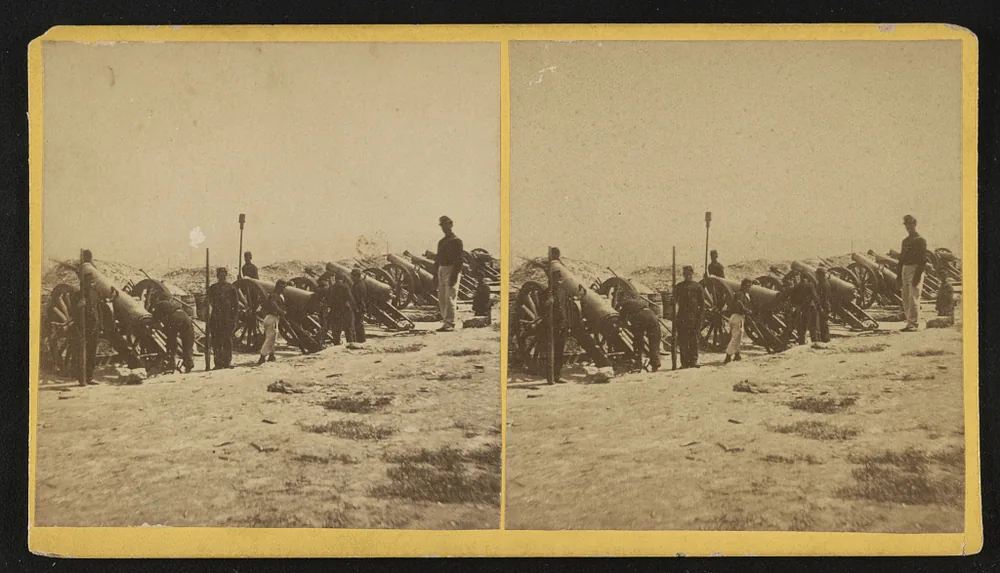
DocumentedHe was wounded at Iuka, according to the 1893 sketch and the Clements Library, and laid up for six months; the 1882 history places the wound at Shiloh. Either way, it ended his time in the artillery.
DocumentedHe drew and wrote his way through it. The Fairfield Goodwin papers at the Clements Library hold twenty-seven poems, essays and drawings, the dated ones falling between 5 November 1861 and 20 September 1862. There is a full-page drawing, in blue and orange, of a Union camp at Shiloh, with men chopping wood, slaughtering pigs and fowl, cooking and reading among the cannon and tents. He sketched himself more than once, propped up sick in bed. He drew his home at Pontiac, a “Missouri Rural Cotage,” and a bearded Jefferson Davis captioned “Jeff Davis returning from war.” No never!”
ReadingThe papers date from the very months of his wound and recovery. A soldier with a pencil and a sense of humor, writing titles like The Lazy Club Song and A Dream of Heaven, is not the figure one expects behind a brick hotel. His writings were edited by Ann Gebhard and published in Michigan History in 1990 under the title “Doubly Paid for Any Sacrifice.”
Captain of Company C
DocumentedBack in Michigan he raised a company of cavalry, Company C of the 8th Michigan Cavalry, at Pontiac, and became its captain. The 1893 sketch says his officers and men presented him with a sabre on 20 January 1863, which he still treasured thirty years later. The company, it says, rode against Morgan’s raid and helped capture a Confederate general, then served mostly as scouts, spent four weeks at the siege of Knoxville, and fought in East Tennessee and Georgia.
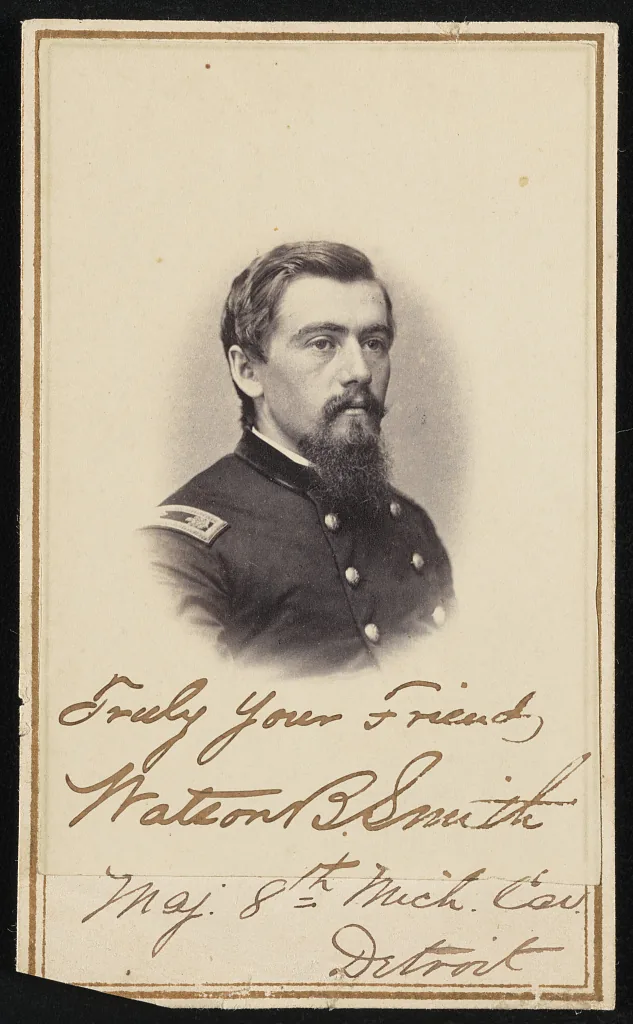
DocumentedThe regiment itself was organized at Mount Clemens between 30 December 1862 and 2 May 1863. It pursued Morgan’s raiders through Ohio in July 1863, served in Burnside’s East Tennessee campaign and at the siege of Knoxville that November, and rode in the Atlanta campaign in 1864.
ReadingThe 1882 history and the 1899 directory both say he was mustered as captain in January 1862. Since the regiment did not yet exist, and the sabre was presented in January 1863, the local histories’ year is very likely a slip for 1863. They also say he served until the end of the war; we have not checked his service record to confirm the date he left the regiment.
The doctor goes back to school
DocumentedHe married Mary Gordon of Pontiac, daughter of the pioneer Samuel Gordon, at Christmas during the war (the 1882 history gives 25 December 1861, the 1899 directory 25 December 1862). They had two daughters and a son: Carrie L., Lena Belle and Charles L. Mary died on 17 September 1872. On 15 January 1879 he married Lida R. Wadsworth of Petersburg, in Monroe County.
DocumentedAfter the war, the 1882 history says, he clerked for two years in Detroit, then went back to Dr. Alden’s practice and took it over when his teacher died. In 1871 he entered the office of Dr. William Brodie of Detroit, and that fall began the course at the medical department of the University of Michigan. He took his medical degree in 1874 and began to practice at Cassopolis the same year.
DocumentedThe Michigan State Gazetteer of 1875 lists him as physician and surgeon at the Cassopolis House, one of the village’s older hotels. In 1881 he took Dr. J. D. Mater into partnership; by 1899 his partner was Dr. William C. McCutcheon, a young physician born in Ontario. He served a year as president of the Cass County Medical Society, belonged to Backus Lodge, Kingsbury Chapter and the Niles Commandery of Knights Templar, and was for many terms surgeon of the Albert Anderson Post of the Grand Army of the Republic.
DocumentedThe 1899 directory shows how deep he was in village life: among the officers of Kingsbury Chapter No. 78, Royal Arch Masons, it lists Fairfield Goodwin as King. His land reached beyond the village, too. The 1893 sketch says his son Charles was then farming fruit land owned by his father.
A builder on Broadway
DocumentedThe county history of 1906 says he was also active in real estate, and adds: “He built Hotel Goodwin and is its landlord.” He was building long before that. The 1882 history credits him with Goodwin’s Hall, in the block on the east side of Broadway, and calls it an example of his zeal for building. The 1899 directory calls him a public-spirited builder and landowner, and an insurance journal of the same year lists him as the Cassopolis agent of the Insurance Company of North America.
ReadingA walking tour by the county and the Cass District Library’s Local History Branch says he built the hotel probably in 1896–97, in place of an earlier Goodwin hotel of 1887 at 130 South Broadway, a building that still stands. The tour says the Goodwin was a hotel until 1951 and was torn down in the late 1950s or early 1960s. A parking lot in front of Cassopolis Auto Supply is now on the site.
DocumentedBy 1899 the hotel had a manager. W. A. Norton’s directory of that year lists “The Goodwin Hotel, T. S. Morrison, prop.,” with the street numbers 113 to 119, and the Goodwin House Bar, also Morrison’s, at 115 North Broadway. Albert Northrop and William Shaffer worked there as waiters. The directory’s history of the post office adds a detail any guest might have enjoyed: the village’s first post office, opened in 1831, had stood where the Goodwin House kitchen then was.
Documented New findingBy 1915 the name over the register was a Goodwin again. An advertisement in that year’s Cassopolis High School annual reads: “Hotel Goodwin, F. Goodwin, Proprietor,” with “Steam Heat, Hot and Cold Water,” a “Good Sample Room on Ground Floor” for travelling salesmen, “Baths and Electric Lights,” and a “Bus to All Trains, to Night Trains on Call.” It adds two words the 1899 directory, with its Goodwin House Bar, could not have printed: “No Bar.”
Reading F. Goodwin is very probably the doctor himself, Fairfield Goodwin, then about eighty and three years from his death, back in charge of the house he built.
DocumentedGuests came and stayed. A member list of the American Institute of Homeopathy of 1909 gives a Dr. Sarah J. Allen’s address as the Goodwin Hotel, Cassopolis.
The family, and the fire of 1920
DocumentedFairfield Goodwin died at Cassopolis in 1918. His son Charles had died on 15 July 1895, aged about twenty-three. His elder daughter, Carrie L., had married William A. Ellis of Detroit, according to the 1893 and 1899 sketches; the Clements Library gives her dates as 1865–1961.
DocumentedIn the autumn of 1920 the hotel was badly damaged by fire, most of all inside. The South Bend News-Times called it “Cassopolis’ only hotel.” Two weeks later contractors had nearly finished the roof, and the proprietor, Carrie Ellis, planned to remodel and reopen within a month.
ReadingA Carrie Ellis running the Goodwin two years after the doctor’s death is very probably his daughter Carrie, Mrs. William A. Ellis, keeping her father’s hotel in the family. No document found says so in as many words, which is why it is marked as our reading.
Where it stood
DocumentedIn 1906 the county history placed the Goodwin House at the north edge of the old public square, on the west side of Broadway: to imagine the square as first planned, it says, one must clear away the business buildings on the west side of Broadway from the Goodwin House down to the alley ten rods south of State Street. The 1899 directory gives the hotel’s bar a North Broadway address.
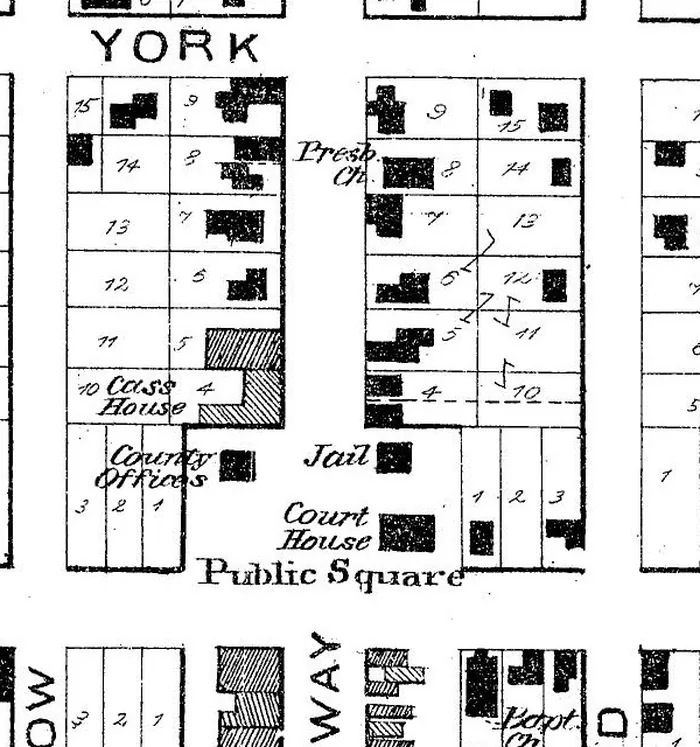
DocumentedThe walking tour, on the other hand, places the 1890s hotel near the southwest corner of Broadway and State.
DocumentedThe fire-insurance map settles it. The Sanborn Map Company surveyed Cassopolis building by building in January 1909, and its sheet for the blocks north of State Street prints HOTEL GOODWIN along the west side of North Broadway, filling the first block north of State, with the Town Hall and Fire Department at the north end of the same block. That agrees with the county history and with the North Broadway address the 1899 directory gives. On the same map the southwest corner of Broadway and State is a row of stores: a furniture store on the corner, a printing office, a saloon and a bank.
Write to research@projectscroll.com.
A timeline
- 1835 Fairfield Goodwin born 12 May in Madison County, New York (the Clements Library says about 1833)
- 1861 Enlists 15 April in Taylor’s Chicago Battery
- 1862 Wounded; recovers in Michigan and raises Company C, 8th Michigan Cavalry
- 1863 Presented with a sabre by his company, 20 January
- 1874 Medical degree from the University of Michigan; begins practice at Cassopolis
- 1882 Goodwin’s Hall noted on the east side of Broadway
- 1887 The first Goodwin hotel, at 130 South Broadway (walking tour)
- 1896–97 Hotel Goodwin built, probably in these years (walking tour)
- 1899 The Goodwin Hotel, T. S. Morrison, proprietor
- 1915 “Hotel Goodwin, F. Goodwin, Proprietor … No Bar” (Cassopolis High School annual)
- 1916 C. R. Childs’s real-photo card of the hotel
- 1918 Dr. Goodwin dies at Cassopolis
- 1920 Fire guts the interior; Carrie Ellis plans to reopen
- 1951 Last year as a hotel (walking tour)
- Late 1950s–early 1960s Torn down
If you go
ReadingNothing of the Goodwin is left, but Broadway is a public street and the walk is short. The 1887 building at 130 South Broadway, which the walking tour identifies as the first Goodwin hotel, still stands in the middle of the west block, and the 1899 courthouse a block north gives the scale of the old square. Please treat the businesses along the street as the private premises they are.
Sources
- L. H. Glover, A Twentieth Century History of Cass County, Michigan (Chicago, 1906): the physicians of Cassopolis (Dr. Goodwin, p. 265) and the old public square (the Goodwin House, p. 145). Internet Archive.
- Fairfield Goodwin papers, 1861–1862: biographical note. William L. Clements Library, University of Michigan.
- Cassopolis Historic Walking Tour (Goodwin Hotel). Cass County Council on Aging with the Cass District Library Local History Branch.
- South Bend News-Times, 12 November 1920, p. 5 (the Goodwin hotel after the fire). Hoosier State Chronicles.
- Hotel Goodwin, Cassopolis, Mich (real-photo postcard, 1916, C. R. Childs). David V. Tinder Collection of Michigan Photography, William L. Clements Library, University of Michigan.
- Hotel Goodwin, Cassopolis, Mich. (real-photo postcard, O. L. Yerty). David V. Tinder Collection of Michigan Photography, William L. Clements Library, University of Michigan.
- History of Cass County, Michigan (Chicago: Waterman, Watkins & Co., 1882): biographical sketch of Fairfield Goodwin (Goodwin’s Hall; partnership with J. D. Mater). Internet Archive.
- Portrait and Biographical Record of Berrien and Cass Counties, Michigan (Chicago: Biographical Publishing Co., 1893), p. 322: Dr. Fairfield Goodwin. Internet Archive.
- W. A. Norton’s Directory of Dowagiac, Cassopolis … 1899: the Goodwin Hotel (T. S. Morrison, prop.), the Goodwin House Bar, the first post office, and the sketch of Fairfield Goodwin, M.D. University of Michigan, via Internet Archive.
- Michigan State Gazetteer and Business Directory, 1875 (Cassopolis: Goodwin, Fairfield, physician and surgeon, Cassopolis House). Internet Archive.
- The Western Underwriter, 20 July 1899 (North America: Fairfield Goodwin, Cassopolis). Internet Archive.
- Journal of the American Institute of Homoeopathy, 1909 (Sarah J. Allen, care Goodwin Hotel, Cassopolis). Internet Archive.
- Fairfield Goodwin, drawing of a bird with the banner “Can I forget thee? No never!”, 1 September 1862. William L. Clements Library, University of Michigan.
- Michigan History, vol. 74 (1990), index: Ann Gebhard, “Doubly Paid for Any Sacrifice,” pp. 10–16 (March/April 1990). Internet Archive.
- 8th Michigan Cavalry Regiment (organization and service). Wikipedia.
- Sanborn Map Company, Cassopolis, Cass County, Michigan, January 1909, sheet 3 (Hotel Goodwin) and sheet 2 (the west side of South Broadway). Library of Congress, Sanborn Fire Insurance Maps; copy on Wikimedia Commons.
- Cassopolis High School, Annual (Cassopolis, 1915): advertisements for Hotel Goodwin and O. L. Yerty’s Cash Bargain Store. Internet Archive.
- Union artillery, Taylor’s battery, Ft. Donelson (stereograph, between 1861 and 1864). Library of Congress, Prints and Photographs Division.
- Watson B. Smith, Co. C, 8th Michigan Cavalry Regiment (carte de visite, between 1862 and 1865). Liljenquist Family Collection, Library of Congress.
- Atlas of Cass County, Michigan (Philadelphia: C. O. Titus, 1872), plan of Cassopolis. University of Michigan copy, Internet Archive.
Numbers in the text point to this list; entries without a number are further sources we consulted. How we research › · The libraries behind all our stories ›
See both Hotel Goodwin cards Walk the old square Know the year it opened? Write to us
Corrections: none
First published 22 October 2026; last updated 26 October 2026. Like all our pages, it is expanded from time to time with new records, pictures and features. No factual corrections have been needed so far.
About this research
Research and reporting Michael Urbanski Project Scroll
- Sources
- Every fact on this page is drawn from the sources listed above, and each can be checked where it is held.
- Corrections
- Errors are corrected on the page, and each correction is noted there.
- Contact
- To report an error or share a record that adds to the story, write to research@projectscroll.com.
- Method
- How we research ›
© 2026 Michael Urbanski and Project Scroll. All rights reserved. The text, original maps, charts and illustrations may not be reproduced without permission; brief quotations with credit and a link back are welcome. Material from other sources belongs to its holders and is credited where it appears; public-domain material is marked as such.


