E Clampus Vitus® · The register
E Clampus Vitus: the register of early lodges
Every place E Clampus Vitus is on record before 1905, from Indiana in 1846 to Sierraville in 1904, each with its earliest surviving source and a mark for how close that source stands to the event; with the maps, the founding documents in full, a reading list of the order’s histories and every source we have found.
By Michael Urbanski · Project Scroll™ · First published · Updated · 73 min read

New finding 10 new findings in this story. See what’s new ›
Every place, with its proof. In 1966 the historians of E Clampus Vitus wished that someone would one day compile a complete list of the order’s early lodges. This page is that list: 101 places where the order is on record before 1905, from Connersville, Indiana, in February 1846 to Sierraville, California, in 1904. Each place has the earliest surviving source we could find, a mark for how close that source stands to the event, and a link so you can read it yourself.
The story behind these places, from the jokes of the 1840s to the lunch at the Clift that revived the order, is told in Part 1, Cassopolis, 1846, and Part 2, the complete record. This page is the evidence room: the register, the maps, the founding documents in full, and every source behind them.
The register of early lodges
How sure are we? Two kinds of mark run through this page. The first says what kind of statement it is: Documented (a source says so, and you can read it yourself), Reading (our interpretation, kept apart from the facts) or New finding (found by us in a primary source, and not in any earlier telling we could find). The second, in the register and on the maps, says how close the source is to the event: Record, written at the time; Reported, a record of the time that has been cited, or that we have seen only as a clipping, but not read on the original page; Remembered, written down years later; Legend, no record of the date at all. The two can combine: Judge Hall’s Bedford chapter is Documented (you can read every word of it) but Remembered (he wrote it in 1890, about 1847).
New findingEach place below has its earliest surviving record, marked Record, Reported, Remembered or Legend as explained above. Sort the table by place, date or tier.
| Place | Lodge, and names on record | Date claimed | First record, and source | Tier |
|---|---|---|---|---|
| West UnionVa. (now W. Va.) | Ephraim Bee, “Grand Gyascutis”Ephraim Bee | c. 1845 (legend) | 1853Weston Herald, 28 Nov 1853, as quoted by Boyd Stutler, West Virginia Review, Aug 1931 (reprinted in Credo quia absurdum, 1949)67Stutler: “perhaps … as early as 1850. By 1853 it was being introduced to other towns.” The date 1845 first appears in Dane, 1938 (reprinted in Credo, 1949, p. 23)67.Plaque: “Ephraim Bee” (2003)68Plaque: “Beehive Inn” (2005)69 | Legend |
| ConnersvilleInd. | a lodge | by Feb 1846 | Feb 1846Indiana American (Brookville), 27 Feb 1846, p. 270“an order of which, we have in our town.” The letter defends a travelling mesmerist, and the jibe is aimed at his two critics, the editors William Stewart of Connersville and James H. Hunt of the Cambridge City Reveille (History of Fayette County, 1885350; History of Wayne County, 1884351). | Record |
| CassopolisMich. | a lodgeDr. E. J. Bonine, Laban Harter, J. P. Osborn, Dr. L. Osborn | spring 1846 | 1875James M. Shepard, in Rogers, History of Cass County (1875), pp. 253–25471A ball at the Union Hotel, winter 1846–47, “over two hundred badges.” Collapsed 1847; revived 1860 as “The Brothers of Charity.” | Remembered |
| IndianapolisInd. | Tent No. 43 | Jul 1846 | Jul 1846Indiana State Sentinel, 15 and 16 Jul 1846, p. 372Members to meet “attired in full regalia.” Numbered “Tents” were the lodges of the Rechabites, a temperance order. | Record |
| BloomfieldIowa | “the ‘ancient and honorable’ institution—Eclampus Vitus”Drs. Selman, Phelps and Findley; Judge Riggs; Israel Kister | February 1846 | 1866Hosea B. Horn, “History of Davis County, Iowa. Chapter IV. Churches, Etc.,” Annals of Iowa 4:2 (April 1866), pp. 656–657353New finding“In February, 1846, the ‘ancient and honorable’ institution—Eclampus Vitus—was organized at our county seat, and for some time flourished above anything of the kind ever before or since tried in this meridian.” Horn, a Bloomfield man who became the first Master of its Masonic lodge in 1847, names its “devotees and patrons”: “Drs. Selman, Phelps and Findley, Judge Riggs and Hon. I. Kister,” and says the order “went on ‘conquering and to conquer,’ until pretty much everybody had been ‘taken in.’” Iowa was still a territory. Israel Kister sat for Davis County in the state’s First General Assembly that December, and Dr. John J. Selman later in its Senate. | Remembered |
| CentrevilleInd. | Jackson Lodge | winter 1846–47 | Jan 1847Journal of the House of Representatives of Indiana, 1846–47, pp. 259, 272, 345 (House bill No. 242)73Asked the legislature for a charter; refused with a joke about improving “the breed.” | Record |
| BedfordPa. | a lodgeJoe Mann (grand worthy patriarch); John Ottinger and Ben Cromwell (past grand worthies); Jacques W. Johnson (orator); Samuel Shuck; John H. Filler; Dr. Keyser; William M. Hall | 1847 | 1890William M. Hall, Reminiscences and Sketches (1890), pp. 121–12774Brought “from the west” by a travelling agent for a cutting-box. Lasted “some eight or ten weeks.” | Remembered |
| GeorgetownKy. | a lodge at the Western Military Institute | Nov 1847 | 15 Nov 1847 (journal, later copy)William Preston Johnston’s journal, ed. A. M. Shaw, Filson Club History Quarterly 18 (1944), p. 83267“Started a lodge of [the] Eclampsus Vitus. Took in about a dozen members.” His note: “The E. V. a mock society, started by me to retaliate the attempts at practical jokings on me. I initiated 60 cadets in one week.” The text is a copy Johnston made some years later. | Reported |
| LafayetteInd. | the members called to “the Tent Room, No. 15” | Feb 1848 | Feb 1848Lafayette Weekly Courier, 4 Feb 1848, as clipped in Jim Cirner’s album “ECV ® Back in the Day” #3, seen as a clipping“The members of the Order of E Clampsus Vitus, will meet on Monday Evening, Feb. 7th, at the Tent Room, No. 15, over the Courier Office. By order of the R. J.” Two years after Connersville and Cassopolis, and before news of the gold reached the East. The order still “flourishes in Vincennes,” a Lafayette paper said on 15 Feb 1870. | Reported |
| MetropolisIll. | Division No. 53 (1938) or No. 110 (1941) | 1849 | 1849 (record book, original not traced)G. Ezra Dane, Ghost Town (1941), p. 309; Credo quia absurdum (1949)75; described in the Oakland Tribune, 9 Jan 1938, as clipped in Jim Cirner’s album “ECV ® Back in the Day” #3Its roster showed members who had joined “in Missouri, Alabama, Georgia, and other Southern States.” “Now in the Henry E. Huntington Library” (Dane, 1941). A Monterey column of 18 Oct 195155 also places it “in the Huntington Library in Pasadena”; the Dane family papers16 there (Box 16) list “E Clampus Vitus. Constitution, rules, roll of members etc., and clippings.” | Reported |
| Bowling GreenMo. | the ritual, printedJ. H. Zumwalt; W. C. Wright | 1849 | 1896Calaveras Prospect, 30 May 1896 (reprinted in Credo quia absurdum, 1949)67Rituals “printed in the office of the Bowling Green Journal.” | Remembered |
| Virginia (reported at Alexandria)Va. | “the new order” | by Mar 1852 | Mar 1852Alexandria Gazette, 13 Mar 1852, p. 276“the new order introduced recently into Virginia, called the ‘E. Clampus Vitas’ … dog Latin.” | Record |
| StocktonCalif. | David Lodge No. 1Joseph Miles, N. G. H. (1852); D. S. Terry, N. G. H., and H. A. Crabb (1855) | 1850 (Dane) | Apr 1852San Joaquin Republican, 14 Apr 185277“the grand centre” of the order (1853); “nearly four hundred members” in its jurisdiction (1855). The earliest California record found. | Record |
| San AntonioTexas | San Antonio Sanhedrim No. 22 | May 1852 | May 1852 (card, printed 1892)A travelling card of 30 May 1852, transcribed in the Marysville Daily Appeal, 24 Sep 1892, from the Oroville Mercury78Known only from the 1892 transcription, which the Marysville Appeal printed again on 17 Feb 1916 (as clipped in Jim Cirner’s album “ECV ® Back in the Day” #3); the card was G. K. Hendle’s, of Oroville, signed by O. P. Wharton, N. G. H., and Matthew Haskett, C. P. (Mathew in 1916). Both printings read No. 22. The card, “issued to Mr. Hendle in San Antonio, Texas, he brought with him to California”; George K. Hendle was Oroville’s assessor in 1858 (Butte Record, Oroville, 26 Feb 1858), Chief Patriarch of the Odd Fellows’ Oro Fino Encampment in 1861 (Weekly Butte Record, 28 Dec 1861), and later of Chico. | Reported |
| San FranciscoCalif. | San Francisco Lodge (Branch Lodge No. 250)R. H. Sinton, R. G. T. | 1852 | Aug 1852Daily Alta California, 31 Aug 185279Gave $100 to the Firemen’s fund, Sept 1852. | Record |
| BardstownKy. | Wapsipinico Lodge | 1852 | Oct 1852Bardstown Herald, 14 Oct 1852 (and 18 Nov 1852)7A standing notice among the town’s lodges: “E Clampsus Vitus. Wapsipinico Lodge meets regularly on the first Monday in each month at 9 o’clock, P. M. Transient brethren are invited to attend” (our reading of a worn scan). The name is an Iowa river’s. | Record |
| ColumbusGa. | a lodge | Dec 1852 | 9 Dec 1852Southern Sentinel (Columbus), 16 Dec 1852, p. 380“A LODGE of the Ancient Order of E Clampsus Vitus, will be organized at the Columbus Guards’ Armory, on THIS EVENING, the 9th inst.” A called meeting for those “notified of their election,” signed by I. T. Robinson, Secretary (Times and Sentinel, 14 Jan 1853298); a “regular meeting” with “business of importance” and candidates for initiation (Columbus Enquirer, 18 Jan 185381; the Enquirer, recalling it in 1875, gives the secretary as Peabody); a gift of $25 to Trinity Church’s parochial school, thanked 9 Feb 1853 (Times and Sentinel, 12 Feb 1853299). Also extracted from the Columbus Inquirer in the San Joaquin Republican, 2 Mar 185382. Read on the page images (the Enquirer of 18 Jan 1853 in the machine-read text). | Record |
| WoodstockOhio | “the ‘E Clampus Vitus,’ which prospered for a few years” | before the Know Nothings (1854) | 1907Joseph Chamberlin and Warren D. Sibley, History of Woodstock (Woodstock, Ohio, 1907), p. 48340New finding“Woodstock was an anti-secret society town for many years. The Lodges organized were the ‘E Clampus Vitus’ which prospered for a few years; then the ‘Know Nothings’ who thrived for awhile; then the A. P. A’s.” The Know Nothings organized in Ohio in 1854, so the lodge belongs to the years before. The village is in Champaign County. | Remembered |
| MurphysCalif. | a lodge | 1852–53 | Feb 1853San Joaquin Republican, 16 Feb 185383Gave $150 toward a school; a lodge room “over Buffum’s saloon, which had been built expressly for the purpose.”Plaque: “Site of E.C.V. Saloon” (1965)84Plaque: “E Clampus Vitus,” the Wall of Comparative Ovations85 | Record |
| SonoraCalif. | a branch lodge | Dec 1852 | Feb 1853San Joaquin Republican, 2 Feb 185386Dane also cites a “Bogus E Clampus Vitus” in the Sonora Herald, winter 1852–53. | Record |
| BeniciaCalif. | members at the state capital; a branch by 1857 | Mar 1853 | Mar 1853Sacramento Daily Union, 19 Mar 185362New finding A resolution to lend the order the Senate chamber, debated on 17 March 1853 and set aside (laid on the table, says the Union; indefinitely postponed, 9 to 7, says the Republican); the Senate afterwards voted, probably on 18 March, 10 to 7 to strike it from its journal (Daily Alta California, 19 Mar 185364). A branch is on record in October 1857 (Daily Alta California, 31 Oct 185787). | Record |
| Mokelumne HillCalif. | Mokelumne Hill Lodge No. 1001J. H. Zumwalt | Sept 1851 (1896 account) | Mar 1853Calaveras Chronicle, reprinted in the San Joaquin Republican, 16 Mar 185388The 1851 date and the number come from the Calaveras Prospect of 1896; the number is first in print in 1867 (Weekly Calaveras Chronicle, 4 May 1867, p. 389: “Mokelumne Lodge No. 1001”). The order’s own histories call this the first lasting lodge.Plaque: “Mokelumne Hill” (Matuca Chapter, 2010)90 | Record |
| MariposaCalif. | “an order yclept the E. C. V.’s” | 1853 | Apr 1853San Joaquin Republican, 9 Apr 1853285A traveller’s letter dated Mariposa, 4 April 1853, signed “Pembroke Pinckney”: “There are at present four societies here, all I believe in a flourishing condition, to wit: Free masons Odd Fellows, and an order yclept the E. C. V.’s.” Read on the page image. | Record |
| ColumbusMiss. | Balaam Lodge No. 1 | Aug 1853 | Aug 1853Southern Standard (Columbus, Miss.), 10 and 17 Sep 1853, p. 232A mock charter headed “A. I. O. O. E. V.”: the “Supreme Grand High Council of the Ancient and Independent Order of Old Eclampsus Vitus of the United States of America” grants a lodge “in the town of Columbus and State of Mississippi,” under the seal of “the Grand Giasticutis,” 8 Aug 1853 (the machine-read text of the 17 September printing says 1852; the page image32 says 1853). The earliest lodge named Balaam we have found; the California Balaam Lodge is named only in later accounts. Earlier insertions are not digitized. | Record |
| WestonVa. (now W. Va.) | a lodge“Colonel Yancey”; “Dr. Eagon” | Nov 1853 | Nov 1853 (not seen)Weston Herald, 28 Nov 1853, as quoted by Stutler (1931)67A typescript of selected local-history articles from the Weston Herald, beginning with this issue (vol. 1, no. 13) and running to 1861, is at the West Virginia & Regional History Center, West Virginia University (Box 22, Notebook 10, pp. 6–78). | Reported |
| ColumbiaCalif. | a lodge | 1854 | Aug 1854Columbia Gazette, 5 Aug 185491Slopes (2000) cites the Columbia Gazette of 5 Aug 1853; the issue on record is of 5 Aug 1854. | Record |
| VincennesInd. | the “Ancient and Honorable Fraternity”Captain Mass, “head center” of the order (1884) | 1854 | Sept 1854Evansville Daily Journal, 20 Sep 1854, p. 2 (a Vincennes letter)92A joke “special meeting” electing a visiting official an honorary member. In 1884 the Daily Wabash Express called a Vincennes hotel man “head center of the ancient order of Eclampsus Vitus.” In 1902 the city’s historian, Henry S. Cauthorn, still remembered the “Eclampus Vitus” among the fraternal orders that had come and gone (A History of the City of Vincennes, p. 151362). | Record |
| BaltimoreMd. | meetings; a “Second Grand Banquet”B. W. Vick, N. G. H. | by Feb 1855 | Feb 1855Fredericksburg Herald, copied in the Alexandria Gazette, 19 Feb 1855, p. 4, quoting the Baltimore Clipper33“This institution seems to be flourishing in Baltimore from the number of meetings that are held.” A lecture by “the Grand Master of Georgia” on “the Rise and Progress of the order in Ancient Greece.” The Clipper itself is not digitized. | Record |
| FredericksburgVa. | “It had its day here” | before 1855 | Feb 1855Fredericksburg Herald, copied in the Alexandria Gazette, 19 Feb 1855, p. 433“It had its day here, and we suppose numbered almost as largely as the Know Nothings do at this time.” The Herald’s own paragraph, looking back. The name was in town by April 1852, signing a poem in the Fredericksburg News of 20 Apr 1852328. | Remembered |
| SacramentoCalif. | a branch lodgeHenry Haden, G. S. (1856) | spring 1855 | Apr 1855San Joaquin Republican, 25 Apr 185593“nearly five hundred persons … initiated … within three weeks.” | Record |
| WeavervilleCalif. | the “Mother Lodge” of the northJ. C. Burch, N. G. H.; C. E. Williams, N. S. | 1855 | Jun 1855Trinity Journal, 9 Jun 185594Plaque: “E Clampus Vitus 1855 & 1962” (2012)95Plaque: “Cameron Building Site” (1983)96 | Record |
| MarysvilleCalif. | a branch; King David Lodge (1888)E. A. Forbes, N. G. H. (1888) | 1855 | Jun 1855San Joaquin Republican, 2 Jun 1855 (from the Marysville Herald)97Revived 1888 with about 80 members; Lord Sholto Douglas initiated 1896 (San Francisco Call, 23 Jan 1896, p. 398); incorporated 9 Nov 1915 (Then and Now, 196630).Plaque: “Lord Sholto Douglas” (1983)99 | Record |
| MontereyCalif. | a festival called | 1856 | Jul 1855Monterey Sentinel, 14 Jul 1855, p. 3, and 21 Jul 185557“E Clampsus Vitus. [Th]ere will be a grand gala festival in [.]n full regalia—on the first of August [.] in this place.” Read on the page image. Mayo Hayes O’Donnell’s columns of 1951, 1953 and 1965 quoted it as a meeting of “August, 1856” and placed it in issues of February to July 1856; two of them also speak of “the notice in the Monterey Sentinel of July 1855,” which is right. | Record |
| San Juan BautistaCalif. | “brethren” invited to Monterey | 1856 | Jul 1855Monterey Sentinel, 14 Jul 1855, p. 3, and 21 Jul 185557“[O]ur San Juan brethren, of special de[gree] of B. A. H. & P. in good standing, [are r]equested to attend.” Read on the page image; see Monterey. | Record |
| Nevada CityCalif. | the “Nevada Encampment” | 1855 | Jul 1855Nevada Journal, 27 Jul 1855100“over three hundred Knights” (Nevada Journal, 9 Jan 1857, p. 2101). | Record |
| Hangtown (Placerville)Calif. | a lodgeD. W. Gelwicks, acting N. G. H.; George Pen Johnston | 1850 (1896 account) | Jan 1856Placer Herald, 12 Jan 1856102The 1896 account says Zumwalt’s Hangtown lodge of 1850 “did not seem to take well.” A Glenn County family history of 1918 remembers James Monroe, a forty-niner from Howard County, Missouri, as “a member of the E. Clampus Vitus organization” while he was at Hangtown, before he went home for his family in 1851 (History of Colusa and Glenn Counties, 1918, p. 323334). A lodge was established there 28 Nov 1855 (Shumate, A Note on ECV in the Gold Fields, 1961103). On Washington’s Birthday 1856 the order led a procession “in full regalia,” heard an oration by George Pen Johnston and gave a ball at the Orleans (Sacramento Daily Union, 26 Feb 1856104; machine-read text only). He is the man the town credited with the order’s arrival. At the El Dorado County Society’s reunion at Placerville in 1888, the historical sketches said: “It was introduced into Hangtown by the late Hon. George Penn Johnston,” and by February 1856 it “exceeded all other orders, societies and institutions in El Dorado county combined” (Sacramento Daily Record-Union, 26 May 1888, p. 1345; read on the page). At the Placerville dinner for J. M. Studebaker in 1912, Steve Gage, elected to the legislature from the district in 1857, said the same of “Penn Johnson, that brilliant genius, who introduced to this community the ancient and honorable order known as E Clampsus Vitus” (Wells Drury, An Editor on the Comstock Lode, 1936, p. 329338). | Record |
| ShastaCalif. | a lodge | 1855 | Dec 1855Shasta Courier, 22 Dec 185531“What has become of the regalia of the Shasta Order?” (Shasta Courier, 15 Dec 1860, p. 246). Shumate (1960) prints the Shasta Courier of 9 Feb 1856: “Scores are joining.” | Record |
| DownievilleCalif. | Balaam Lodge (named 1896) | c. 1855 | Jan 1856Nevada Journal, 18 Jan 1856105A Mountain Messenger of 23 Feb 1859 (as printed by Shumate, 1960): “At Downieville and Red Bluff, two Lodges are now in successful operation.” In December 1887 a Reno paper told old Downieville hands that “the old Lodge of the Ancient Order of the E Clampsus Vitus was never so active or prosperous as at the present time,” and that membership was “the sine qua non in doing business with the natives” for travelling salesmen (Reno Evening Gazette, 21 December 1887347; machine-read text). Thomas E. Farish, The Gold Hunters of California (1904), pp. 82–83, puts its founding at Downieville “about this time,” after a Marysville story of 1855, with “the gewgaw, a big horn,” to call the members to “the Clampus Hall” (Internet Archive342).Plaque: “Downieville” (1987)106 | Record |
| El Dorado (Mud Springs)Calif. | a lodge, instituted by D. K. NewellD. K. Newell | Feb 1856 | Feb 1856Mountain Democrat (Placerville), 23 Feb 1856, as clipped in Jim Cirner’s album “ECV ® Back in the Day” #2, seen as a clipping (the Mountain Democrat is online only from 1857)“On Tuesday last a new Lodge of the E Clampus Vitus Society was instituted at El Dorado.” | Reported |
| Knight’s FerryCalif. | a lodge | 1856 | Mar 1856San Joaquin Republican, 19 Mar 1856107 | Record |
| North Fork, Oregon Gulch, Manzanita Flat (Trinity Co.)Calif. | lodges | 1856 | Apr 1856Trinity Journal, 5 and 19 Apr 1856108 | Record |
| Young’s HillCalif. | “the E Clampsus Vitus Order on the hill”Charles E. De Long; G. McMurray, J. P. Brown and G. W. Butler, initiated | Apr 1856 | Apr 1856Charles E. De Long’s journal, 27 Apr–13 Jun 1856, ed. Carl I. Wheat, California Historical Society Quarterly 9:1 (Mar 1930), pp. 59–62339De Long, a storekeeper at Young’s Hill and later United States Minister to Japan, kept a daily journal: “helped organize the E Clampsus Vitus Order on the hill” (Sunday 27 April); “attended a meeting of the E Clampsus Vitus Order” (4 May); “Attended E Clampsus Vitus at Son’s Hall” (9 May); “E Clampsus Vitus met and organized initiated brother G McMurray by way of experiment” (16 May); “E Clampsus initiated J P Brown & G W Butler” (19 May); and “a grand ball at May’s an E Clampsus party” (13 June). The journal was edited for print in 1930 by Carl I. Wheat, who revived the order the next year. | Record |
| Spanish FlatCalif. | a SanhedrimJames Thompson, N. G. H.; H. C. Carson, R. P. | May 1856 | May 1856Georgetown News, 22 May 185644 | Record |
| YrekaCalif. | a lodge, with a hall on Fourth Street | 1856 | Jun 1856Sacramento Daily Union, 3 Jun 1856109Steamboat Jake’s initiation (Wells, History of Siskiyou County, 1881). New findingThe town’s church ladies published a little paper, The Ladies’ Budget, for two issues; it was “remembered for its earnest inquiry respecting the regalia of the E Clampsus Vitus brotherhood” (Edward C. Kemble, “History of California Newspapers,” Sacramento Daily Union, 25 December 1858349).Plaque: “Clampers Meeting Hall” (1982)110 | Record |
| San AndreasCalif. | Lodge No. 1002 | 1856 | May 1856Sacramento Daily Union, 9 May 1856111 | Record |
| Georgetown (El Dorado Co.)Calif. | Knights of the order | 1856 | May 1856Georgetown News, 22 May 1856, p. 244“A number of Knights from Placerville and Georgetown were present and assisted at the organization” of the Spanish Flat Sanhedrim. | Record |
| Smith’s FlatCalif. | a lodgeWm. E. Jenkins, N. G. H.; Charles Hatch, C. V. | 1856 | Jun 1856Sierra Citizen (Downieville), 28 Jun 1856112New finding Placed: the Sierra County camp that grew into Alleghany, the first of its camps of 1851 (the Alleghany marker). The lodge’s officers were Smith’s Flat miners: the same paper’s “Smith’s Flat correspondent” names Chamberlin of the Hook & Bull Co. and H. Winchell, with the Alleghany Co. and the Keystone tunnel (Sacramento Daily Union, 26 Feb 1856). | Record |
| OrovilleCalif. | a lodge | 1856 | Jul 1856Weekly Butte Record (Oroville), 19 Jul 1856, p. 245A “regular meeting … at the Hall of the Temple of Honor” (Jul 1856); “about being revived” (Butte Record (Oroville), 17 Dec 1856113); “flourishing” (Placer Herald, 26 Mar 1859, p. 1114). | Record |
| Sierra CityCalif. | Balaam Lodge No. 107,304Samuel Hartley, “the pioneer N. G. H.”; Adam Lee Moore | 1857 | 1882Fariss & Smith, Illustrated History of Plumas, Lassen & Sierra Counties (1882), p. 471115Laid a cornerstone with a “brazen serpent” in 1871. The number comes from Adam Lee Moore, who helped revive the order in 1931. Moore remembered in 1941 that “in 1875 A. C. Bush built his Clamper building three stories high, and had painted on the front the letters E. C. V.” (Mountain Messenger, 31 May 1941, as clipped in Jim Cirner’s album “ECV ® Back in the Day” #3).Plaque: “Busch & Heringlake Building” (1990)116 | Remembered |
| Yankee Jim’sCalif. | a lodgeW. C. Parker, N. G. H. | Jan 1857 | Jan 1857Placer Herald, 31 Jan 1857117 | Record |
| QuincyCalif. | a lodge | 1857 | Sept 1857Plumas Argus, 17 Sep 1857118“100 Copies of the Ritual … $5 per set of three.”Plaque: “Forest Stationers” (2009)119 | Record |
| VisaliaCalif. | a lodge | Dec 1857 | Dec 1857Mariposa Democrat, 17 Dec 185735A grand ball. | Record |
| RichmondVa. | initiations at the capitalEphraim Bee, “Grand Ariscutis” | 1858 | Feb 1858Winchester Republican, 26 Feb 1858, quoting the Parkersburg Gazette18“The solemn and impressive ceremony of initiation is nightly performed, and, so great is the rush for admission into the order, that many of the applicants are ‘put through by daylight.’” Bee’s winter of initiations at Richmond, in a record of the time; Clarksburg papers of 1855 and 1856 name him in the order earlier. | Record |
| JacksonOhio | “that ancient and honorable institution” | 1858 | Apr 1858Jackson Standard, 29 Apr 185836An editor threatens to take a rival “through” the order, to see “the Great Chinese Scroll unfurled.” The paper still knew the name in 1885: “The E. Clampus Vitus, with headquarters at the Mayor’s Office … is doing a brisk business” (2 Apr 1885325). | Record |
| HonoluluHawaii | a branchL. F. Beatty, N. G. H.; M. Brown; Wm. E. Cutrell; C. N. Spencer; J. O. Dominis; M. Raplee; J. H. Brown; C. W. Vincent; C. P. Ward; J. O. Carter, Secretary; E. J. Smith, Treasurer (Sept 1858) | 1858 | Apr 1858Pacific Commercial Advertiser (Honolulu), 22 Apr 1858, p. 323The order’s “Mystic Emblem” had come “per bark Yankee,” and E. J. Smith, of King Street, was appointed to form “a branch … in Honolulu”; the notice ran for weeks after. On 16 Sept 1858 the paper printed the eleven officers elected “on Monday evening last” (p. 2302), all eleven traced by Seth Slopes. From 23 Sept 1858 the lodge called regular Monday meetings “at the Hall, over Dr. McKibbin’s Drug Store,” and the Advertiser’s directory of 30 Dec 1858 names L. F. Beatty, N. G. H. By 1 Jan 1859 The Friend lists “E Clampsus V.,” whose “Lodge meets on Queen street over Dr. McKibbin’s Drug store.” The order’s historians (Shumate, 1991; Slopes, 2000) give 1858 without a source; Seth Slopes’s E Clampsus Vitus Goes International (2026) gives the Honolulu lodge a chapter of its own. In May 1882 the Pacific Commercial Advertiser (27 May 1882, p. 3)120 reported talk of a revival, with original members “residing here”; in June the old records were “in the hands of the former J. H. A. P.” (17 Jun 1882304). | Record |
| Red BluffCalif. | a lodge; the “Red Bluff Division” | 1858 | Apr 1858Red Bluff Beacon, 28 Apr 1858, p. 2170$20 toward the May-Day festival. “After a year or two’s suspension, has resuscitated” (Beacon, 2 Feb 1859); sealed proposals for a two-story brick hall on Clay Square, the lower floor for a public schoolroom (Beacon, 16 Nov 1859, as printed by Shumate, 1960). | Record |
| Canyon Creek (Josephine Co.)Ore. | the order “conferred” on George H. WilliamsGeorge H. Williams | Jun 1858 | 1895Seattle Post-Intelligencer, 5 Jun 1895, “Pioneers in Session,” as clipped in Jim Cirner’s album “ECV ® Back in the Day” #3Maj. W. V. Rinehart, an Oregon pioneer, remembered riding the mines with “Old Flaxbreak,” George H. Williams, in June 1858: after a speech “to the boys on Canyon creek,” they did him honour by “conferring on him the secret order of the ‘E. Clampsus Vitis.’” Williams was later Grant’s Attorney General. | Remembered |
| ForbestownCalif. | “one of the most flourishing lodges of that time” | Apr 1859 | 1892Oroville Mercury, as reprinted in the Marysville Appeal, 24 Sep 1892, and again 17 Feb 1916; as clipped in Jim Cirner’s album “ECV ® Back in the Day” #3The lodge gave a ball at Brown’s hotel on 7 April 1859, the Oroville Mercury recalled in 1892; the same item prints G. K. Hendle’s travelling card from San Antonio. | Remembered |
| Stewart FlatCalif. | a lodgeSam. McCurdy, N. G. H. | May 1859 | May 1859Placer Herald, 21 May 1859121New finding Placed: a camp on Secret Ravine, about 1.5 miles east of Penryn, Placer County (Durham, California’s Geographic Names, 1998, p. 537), near Newcastle, and a polling place in the 1863 election (Placer Herald, 25 July 1863). | Record |
| Brandy CityCalif. | a lodge | 1859 | Jul 1859Hydraulic Press (North San Juan), 30 Jul 1859122 | Record |
| Gold Hill (Placer Co.)Calif. | a lodge | 1859 | Jul 1859Placer Herald, 23 Jul 1859123 | Record |
| Springville and Mitchell (Lawrence Co.)Ind. | lodges | 1859 | Sept 1859Dayton Daily Empire, 24 Sep 1859, credited to a Bedford, Ind., paper124Members planned a parade “in full regalia, under command of the N. G. H.” at the State Fair at New Albany, “accompanied by the members of the Springville and Mitchell lodges.” The paper’s source is hard to read in the scan. | Record |
| PetalumaCalif. | a lodge proposed | 1859 | Oct 1859Shasta Courier, 8 Oct 1859, p. 3, quoting the Marysville Express37“This questionable institution is about to establish a Lodge at Petaluma.” | Record |
| KnoxvilleTenn. | initiations at the Court House | before the Civil War | Jun 1874Letter in the Morristown Gazette, 10 Jun 1874, p. 150“The first initiations took place in an office on Main street but the applications for membership became so numerous, and the attendance of members so large, that it was found necessary to remove to the Court House.” Placed among the “ante bellum days.” | Remembered |
| Carson CityNev. (then Utah Terr.) | a meeting called by poster | Feb 1860 | Feb 1860Territorial Enterprise (Carson City), 18 Feb 1860, as clipped in Jim Cirner’s album “ECV ® Back in the Day” #1, seen as a clippingPosters called the order to meet on Monday, 13 Feb 1860; “the Elite Circle of Virginia.” Shumate (1960) prints the same joke from the Red Bluff Beacon, dated “May 7, 1860,” a Monday; the Beacon was a Wednesday weekly, and the item is not in the machine-read text of any issue from 22 Feb to 27 Jun 1860. | Reported |
| WatsonvilleCalif. | a lodge | 1860 | Oct 1864Daily Alta California, 7 Oct 1864125Credo cites the Santa Cruz Sentinel, 1860. | Record |
| Sabine City (Sabine Pass)Texas | members of the “Clampsus Vitus order” | 1860 | Apr 1860Navarro Express (Corsicana), 21 Apr 1860, p. 2, from the Sabine Pass TimesMembers “are notified by the Sabine Pass Times that there will be a grand ‘pow-wow’ held by the members thereof in Sabine City on the second Monday in May next.” The Sabine Pass paper itself does not survive online. Read in the machine-read text. | Record |
| Forest CityCalif. | a meeting near Fashion Hall | Jun 1860 | Jun 1860Letter from Wet Ravine, 14 Jun 1860, in the Sierra Democrat (Downieville), as clipped in Jim Cirner’s album “ECV ® Back in the Day” #1, seen as a clipping“The E.C.V.’s had a meeting Saturday night,” and a spark from where “they had heated the iron” may have caused a fire at Fashion Hall. The Sierra Democrat of 1860 is not in the California Digital Newspaper Collection. | Reported |
| SusanvilleCalif. | a subordinate lodge | Jun 1860 | Jun 1860Red Bluff Beacon, 27 Jun 1860126 | Record |
| HorsetownCalif. | a lodge proposed | 1860 | Dec 1860Shasta Courier, 15 Dec 1860, p. 2, quoting the Horsetown Argus46“This ancient and honorable Order, says the Horsetown Argus, is about to be established in that town.” A vanished town on Clear Creek, Shasta County. | Record |
| IoneCalif. | the order | 1861–62 | 1881J. D. Mason, History of Amador County (1881), p. 281282“The E-Clampsus Vitus flourished in 1861–62, especially in Ione,” and “many sober, honest, middle-aged men were induced to join to become the possessors of the great secret.” | Remembered |
| Port DouglasB.C. | a lodge | 1862 | Feb 1862Daily British Colonist (Victoria), 5 Feb 1862272; reprinted in Weekly British Colonist (Victoria), 11 Feb 1862, p. 49“A lodge of the Ancient and Honorable Order of E. Clampsus Vitus has been organised at Port Douglas, B. C. Members are initiated nightly, and the lodge is in a flourishing condition.” The lodge is mentioned, undated, in Ramsey’s Ghost Towns of British Columbia (1963), and put in 1858 by Shumate (1991) and Slopes (2000, and again in 2026); this is the first dated record. | Record |
| NapaCalif. | a lodge | 1862 | Aug 1862Napa County Reporter, 16 Aug 1862127 | Record |
| WheelingW. Va. | a branch order; Ephraim Bee initiatingEphraim Bee | c. 1864 (1866 account) | Jan 1866Wheeling Daily Intelligencer, 17 Jan 1866, p. 447“When he was here two years ago he founded a branch order in this city” (Jan 1866); a “glorious revival … at Wheeling, in 1866” (Intelligencer, 15 Jul 187048). In 1867, at the McLure House, Bee is “the recognized American head” of the order, Caleb Cushing “the man who brought the secrets of the order to this country” (Intelligencer, 1 Feb 1867128). | Record |
| DaytonNev. | “only one lodge” in Nevada, “during a dull period” | 1866–1870 | 1933Alfred Chartz of Carson City, letter in the San Francisco Chronicle, 25 May 1933, as clipped in Jim Cirner’s album “ECV ® Back in the Day” #3“Nevada suffered from only one lodge of ‘E Clampus Vitus’ and that was at Dayton during a dull period in the Comstock’s history, between 1866 and 1870.” Chartz did not know of Carson City (1860), Reno (1869) or Tuscarora (before 1883); see those rows. | Remembered |
| Brown’s ValleyCalif. | a lodge | 1866 | Jul 1866Marysville Daily Appeal, 8 Jul 1866129 | Record |
| Fort JonesCalif. | a lodge | 1867 | Mar 1867Trinity Journal, 23 Mar 1867130 | Record |
| Bear Valley and CoultervilleCalif. | reorganized | 1867 | Jun 1867Mariposa Gazette, 15 Jun 1867131 | Record |
| SavannahGa. | “the Old Eclampsus Vitas Lodge” | before 1867 | Jul 1867Daily News and Herald, Savannah, 8 July 1867, p. 2359New finding“The members of the Old Eclampsus Vitas Lodge are requested to meet at the Hall of the Metropolitan Fire Company, corner of Whitaker and President streets, on Tuesday evening, July 9, at 8½ o’clock. A full attendance is requested, with the view of reorganizing the Society.” An “old” lodge, called back to be reorganized, two years after the war: so Savannah had a lodge before. Read on the original page, a special notice that ran once, on 8 July. First found through the Works Progress Administration’s digest of the Savannah papers (Annals of Savannah, vol. 18, 1867, p. 460). | Record |
| Boise CityIdaho | a lodge | 1868 | Dec 1868Cheyenne Leader, 23 Dec 1868132“in a flourishing condition.” | Record |
| RenoNev. | members called to form a “Grand Lodge” | Mar 1869 | Mar 1869Reno Crescent, 20 Mar 1869, as clipped in Jim Cirner’s album “ECV ® Back in the Day” #1, seen as a clippingMembers “in good standing” called to Jack Holmes’s saloon “preparatory to establishing a ‘Grand Lodge’ in Reno.” A lodge proposed again on 30 Jan 1883: “In Modoc county there is a flourishing lodge” (a Reno newspaper, as clipped). | Reported |
| ParkersburgW. Va. | the Parkersburg lodge (reopened) | before 1870 | Jul 1870Parkersburg Times, reprinted in the Wheeling Daily Intelligencer, 15 Jul 1870, p. 348“Great Revival at Parkersburg”: applications “were reported on the day fixed for the reopening of the Parkersburg lodge.” A Wood County history of 1899 remembers Ephraim Bee initiating, at an unstated date, in the jury hall of the old court house (Gibbens, 1899, p. 4843). | Record |
| LoyaltonCalif. | the Clampers’ Lodge | 1870s | 1924Feather River Bulletin (Quincy), 21 Feb 1924, p. 2180“The most flourishing of all the fraternal societies in Loyalton, in the seventies, was the Clampers’ Lodge”; it “made its entrance into Sierraville and Loyalton in the ’60s.” Read in full in the machine-read text. | Remembered |
| Rio MimbresN.M. | a ball at the democratic hallI. Bolivar, Grand Scribe | Oct 1871 | Oct 1871The Borderer (Las Cruces), 4 Oct 1871, as clipped in Jim Cirner’s album “ECV ® Back in the Day” #3, seen as a clipping“The ball announced to be given by the Ancient and Honorable Order of E Clampsus Vitus, at the democratic hall at Rio Mimbres on the first of October, 1871, is postponed until the 15th … By order of the N. G. H. I. Bolivar, Grand Scribe.” The order’s first known appearance in New Mexico, more than sixty years before the revived order’s Quivira chapter at Santa Fe. The ball was moved to the Academy of Music. | Reported |
| GraftonW. Va. | revived | 1874 | Jan 1874Grafton Sentinel, as noticed in the Wheeling Daily Intelligencer, 31 Jan 1874, p. 249“The ancient order of the ‘Eclampus Vitis’ has been revived at that place.” | Record |
| Sawpit FlatCalif. | a lodge | 1875 | Feb 1875Feather River Bulletin, 13 Feb 1875133 | Record |
| NewportInd. | the “Society of Old Eclampsus” | c. 1873 | May 1875Chicago Daily Tribune, 13 May 1875, p. 1151“The Society of Old Eclampsus put a ticket in the field at Newport, … and elected it. Now will somebody tell us what the Old Eclampsus is?” In 1888 the county history53 recalled “an imaginary secret society” “taking its rise at Newport and other points in this county probably about fifteen years ago, whose entertainment consists in blindfolding the candidate for initiation and playing a variety of make-believe tricks upon him.” | Record |
| LouisaKy. | “Council Eclampus Vitus” | 1876–77 | 1876Kentucky State Gazetteer and Business Directory, vol. 1 (1876–77), p. 253, “Louisa”356New findingThe gazetteer’s sketch of the county seat of Lawrence County, on the Big Sandy: “The following lodges meet here: Masonic Lodge, R. A. Chapter, I. O. O. F. Lodge, Temple of Honor and Council Eclampus Vitus.” Forty years later an old resident remembered “the time the ‘Eclampus Vitus’ were holding occasional sessions” in the town (Big Sandy News, Louisa, 11 February 1916). | Record |
| WashingtonGa. | “the Old Eclampsus Vitis” | 1876 | Dec 1876Washington Gazette, 15 Dec 1876, p. 3290“The ‘Old Eclampsus Vitis’ held a meeting on last Monday night, when two ‘outside barbarians’ were initiated into the mysteries of ‘this ancient and honorable order.’ Another meeting will take place to-night, at which several other candidates will be admitted to full fellowship.” A month later: “Are there any more candidates for initiation into the Old Eclampsus Vitis?” (12 Jan 1877300). Read on the page image (the 1877 item in the machine-read text). | Record |
| ColusaCalif. | a subordinate lodge | 1878 | Sept 1878Weekly Butte Record, 28 Sep 1878134Ordered “by the Supreme Grand Lodge of Clampsus.” | Record |
| CedarvilleCalif. | a lodge | 1879 | Jan 1879Sentinel, 25 Jan 1879135 | Record |
| ZanesfieldOhio | “the Eclampus Vitus, whose history was as brief as its initiatory ceremony was unique” | none given | 1880W. H. Perrin and J. H. Battle, History of Logan County and Ohio (Chicago: O. L. Baskin, 1880), p. 419, “Zanesfield”358New finding“The different secret societies have been pretty well represented in Zanesfield. Passing by the Eclampus Vitus, whose history was as brief as its initiatory ceremony was unique, the first in order was the Sons of Temperance, organized in the spring of 1848.” The village is in Logan County, next to Champaign County and Woodstock. The book gives the lodge no date. | Remembered |
| Lake City (Modoc Co.)Calif. | a lodge | 1880 | Feb 1880Feather River Bulletin, 7 Feb 1880136 | Record |
| Idaho CityIdaho | the “T. T.’s” | 1880 | Sept 1880Idaho Semi-Weekly World, 14 Sep 1880, p. 352“An organization—a revival of the ancient order of Eclampsus Vitus, known here as the T. T.’s—has been having a successful run for the last two or three months.” | Record |
| AlturasCalif. | a lodge, and a society of young ladies against it | Dec 1882 | Dec 1882A newspaper of 26 Dec 1882 (title not shown), as clipped in Jim Cirner’s album “ECV ® Back in the Day” #3, seen as a clipping“The young ladies of Alturas have organized a society, the object of which is to annihilate the order known as the E Clampus Vitus. The society is known as the ‘Young Ladies’ Independent Association.’” A Reno newspaper of 30 January 1883 said that “in Modoc county there is a flourishing lodge” (see Reno). | Reported |
| TuscaroraNev. | a lodge, gone by 1883 | before 1883 | Feb 1883Tuscarora Times-Review, 3 Feb 1883, as clipped in Jim Cirner’s album “ECV ® Back in the Day” #3, seen as a clipping“The order of E Clampsus Vitus has no existence in Tuscarora. The old members have all joined dancing school.” | Reported |
| SierravilleCalif. | Moses Lodge No. 12038 | 1884 | Jan 1884Feather River Bulletin, 19 Jan 1884137“The Clamps Petrix and the Clamps Vitrix have dusted out the Sanhedrim, and the Royal Platrix has sounded the hewgag.” Still initiating in 1904.Plaque: “Henness – Zumwalt Pass” (1982)138 | Record |
| BrazilInd. | “Original Lodge, No. 1, Eclampus Levitas”J. T. Buck, “grand guy”; George Law, “vice-grand guy”; Robert Kennedy, orator (1884) | 1884 | Mar 1884Indianapolis Journal, 6 Mar 1884, p. 8286Articles of incorporation filed with Indiana’s Secretary of State for “a social order of Brazil”: motto “friendship, fidelity and amusement,” emblem “a laughing face,” about twenty-five charter members. In January 1885 the “Eclampsus Levitus order” there gave a ball and promised “a public expression of the internal diabolism of the order” (Daily Wabash Express, 25 Jan 1885315, read in the machine-read text). The 1884 item read on the page image. | Record |
| EurekaCalif. | the Clampers’ ball | 1884 | Apr 1884Humboldt Times, 11 Apr 1884139 | Record |
| CamptonvilleCalif. | officers and members | 1888 | Mar 1888Marysville Daily Appeal, 6 Mar 1888140Plaque: “William Bull Meek / ECV Redivivus” (1956, 1982)141Plaque: “Capt. Brown House” (2010)142 | Record |
| WoodlandCalif. | a meeting | 1891 | Feb 1891Marysville Democrat, 7 Feb 1891143Visited by “the Grand officers from Mokelumne Hill.” | Record |
Download the register (CSV spreadsheet) 101 places · free to reuse with credit (CC BY 4.0)
ReadingRead down the dates and the shape of the story is plain. The order was on record in Indiana in 1846, and is remembered or reported in Pennsylvania in 1847 and in Missouri and Illinois in 1849; it was in a cadet’s journal in Kentucky in 1847, in print in Virginia, Kentucky and Georgia by 1852 (and a Texas lodge card of that year survives in a later printing), in Mississippi by 1853 and in Maryland by 1855, and in California from the spring of 1852; by April 1858 it was at Honolulu, and by 1862 across the border in British Columbia. In California it spread from Stockton and the southern mines in 1852 and 1853, boomed in 1855 and 1856, when Sacramento initiated “nearly five hundred persons … within three weeks,” and reached the northern camps by the end of the decade; by February 1860 it was calling meetings by poster at Carson City, over the Sierra. It was still meeting in the 1880s and was initiating candidates at Sierraville in 1904.
Maps: where it was, and where it is
Watch the order march west, in 3D › Every place in the register rises on a relief map in the year of its first record, from Indiana in 1846 to the gold camps, the boosters’ revival of 1915 and the lunch at the Clift Hotel in 1931. Press Play, or drag the year.
- Written down at the time
- Written down years later
- Cited; original not traced
- Legend
- First record 1852–54
- 1855–59
- 1860–79
- 1880–1904
- Hollow: remembered later, or cited with the original not traced
- A chapter today
- Boise City (1868) and Idaho City (1880), on record
Drawn for this page. State outlines: U.S. Census Bureau, via us-atlas. Places are placed by town; where a camp has vanished, by its nearest modern point.
The documents
The founding texts, transcribed from the original pages. Spelling and punctuation are the originals’. Square brackets mark words the scan does not show clearly.
“the ‘Eclampsus Vitus’ society, an order of which, we have in our town”Indiana American, Brookville, Ind., 27 February 1846, p. 2 · a letter from Connersville
Dated Connersville, 20 February 1846, signed “W.” The letter defends the mesmerist I. I. Keely, whose lectures had restored a deaf man’s hearing, and turns on the skeptics: “‘Stewart,’ our editor, who has just returned from the State Legislature, who believes himself to be the only wise man in the County, … has boldly brayed ‘humbug.’ But he is not alone. The long eared editor of the ‘Cambridge Reveille’ came out in a long and labored article; exposing his ignorance in reference to the history of Mesmerism. To both of these learned expositors of news our citizens are universally of the opinion that they are naturally qualified members of the ‘Eclampsus Vitus’ society, an order of which, we have in our town.”
The earliest dated mention of the order yet found anywhere.
Tent No. 43, in full regaliaIndiana State Sentinel, Indianapolis, 16 July 1846, p. 3 · the whole notice
“The members of Tent No. 43 of the order of Eclampees Vitus are notified to meet in their Hall on Thursday Evening, July 16, at early candle lighting, attired in full regalia. A general attendance is requested. By order.”
“the first Secret Society, of which there is any record”Howard S. Rogers, History of Cass County, from 1825 to 1875 (Cassopolis, 1875), pp. 253–254 · written by James M. Shepard · the whole passage
The first Secret Society, of which there is any record, was a Lodge of the “Ancient and Honorable Order of the Eclampsus Vitus,” which was instituted in the spring of 1846, with Dr. E. J. Bonine, Laban Harter, J. P. Osborn and Dr. L. Osborn as charter members.
The Order was in broadest burlesque of legitimate secret organizations and was afterward merged in the “Sons of Malta,” which died from exposure (by Frank Leslie) in the next decade.
The candidates for admission were bound fast, blindfolded and dragged into the hall by halters. They were placed in the most ludicrous positions and required to pledge themselves to performances and courses of conduct which, by a cunningly devised double entendre in the wording of the pledges, were either impossible or eminently ridiculous.
A peculiarity of human nature, which renders the victim of a “sell” restless and unhappy until he has inveigled others into the same meshes, insured the rapid growth and financial prosperity of this monstrous hoax. Numerous neophites were found to assuage the grief and soothe the wounded pride of the earlier victims.
A grand ball was given by the Lodge in the winter of 1846–7, at the Union Hotel, at which over two hundred badges of the “Ancient and Honorable Order” were displayed, and that, too, by men who stood among the highest in popular esteem and respectability.
The (dis) Order collapsed in 1847, partly from lack of raw material and partly from a growing satiety amounting to disgust on the part of the better portion of the members, but it was successfully resurrected in 1860, under the alias of “The Brothers of Charity.”
The second edition, although enlarged and improved, was of “few days and full of trouble” to all except the charter (?) members.
“a species of animals with which the country is now abundantly supplied”Journal of the House of Representatives of Indiana, 1846–47, p. 345 · the committee’s whole report on House bill No. 242
“The committee on corporations, to which was referred bill of the House No. 242, entitled ‘An act to incorporate the Jackson Lodge of the ancient order of Eclampses Vitus, of Centreville, Indiana,’ have had the same under consideration, and are not able to ascertain from the bill itself what objects are to be attained by the proposed corporation; but if they are correctly informed from other sources, the bill is for the benefit of a species of animals with which the country is now abundantly supplied, and of which it is not desirable either to increase the number or improve the breed. They therefore recommend that it be indefinitely postponed.”
The Ancient and Venerable Order of Ecclampsis VitisWilliam M. Hall, Reminiscences and Sketches, Historical and Biographical (Harrisburg, 1890), pp. 121–127 · Bedford, Pennsylvania, 1847 · the chapter, all but the oath and the signs
In 1847, while I was reading law, there came to Bedford, from the west, a traveling agent for a patented invention of a cutting-box. He instituted a new secret society called the Ecclampsis Vitis. It was in truth a burlesque on all secret societies—an exaggerated travesty, full of fun and very enjoyable for the younger members. The secret of the thing was wonderfully well kept for many weeks, and the society flourished and had grown to large proportions, with numerous candidates for initiation, at the time of the dénouement, which resulted in its downfall.
The society was constituted with a worthy patriarch and two past grand worthy patriarchs, with out-door sentinels and in-door sentinels, and divers other officers. The ceremony of initiation was formal, solemn and imposing. The place of meeting was the grand jury room of the court house, quite a large room, now divided by a partition into two rooms, one of which is used as the sheriff’s office and the other by the recorder of deeds.
Behind a long table sat the grand worthy patriarch, Joe Mann, as homely a specimen of humanity as you could find in a week’s travel, who was then a student-at-law. He was supported on either side by the past grand worthies, John Ottinger and Ben Cromwell. The only light in the room was a short piece of tallow candle, which stood in the center of the table in front of the worthy patriarch, without a candle-stick, supported in an upright position by a spot of its own grease, dropped on the table for that purpose. The dim light only served to make darkness visible and show the eyes of the circle of members who sat around on chairs and benches.
[Here Hall describes the initiation itself. It is left out of this transcription, out of respect for the order.]
Well, we had a torch-light procession all over town and a speech. Jacques W. Johnson, a young lawyer, delivered an oration on the order in the court house. Judge Black was there to hear it, and old Mr. Russell and all the beauty and the chivalry of the village. Johnson’s oration was in manuscript, and Judge Black borrowed it and read it through with a great deal of pleasure, he said. He couldn’t understand, however, how the society existed without levying contributions on its members; he couldn’t possibly see or comprehend where the funds came from. But that was a mystery only to be learned by initiation into the royal arch degree, and the judge did not seem willing to go that far.
John Ottinger and Ben Cromwell were made past grand worthies because of their ability to sit and look wise with grave faces. Nothing would stir the facial expression of either into animation except the immediate prospect of a drop of old rye.
One of the laughable features of the meetings was to call upon P. G. W. Ottinger for a story. During the intervals of initiation, a brother would rise and gravely move that P. G. W. Ottinger now favor the lodge with the narration of some little incident or story from his extensive repertory. This being voted, in response, Ottinger told always the same story, utterly oblivious that he had ever told it before. It became a matter of absorbing interest to see how often he would, with no glimmer of recollection that he had previously told it, retell the story, and as long as the institution survived, some eight or ten weeks, Ottinger repeated, with a grave face, the same little story, and wound up with a peculiar laugh, which contorted his face but gave forth no sound, except a rumble, as if a laugh was rolling around somewhere in the cavities of his capacious abdominal development.
Cromwell rode at the head of the torch-light procession, as chief marshal, on a gray horse. The regalia was a strip of muslin about two yards long and four inches wide, which passed over the right shoulder and was fastened in a knot at the waist on the left side, ornamented with a star cut out of the heavy purple colored paper that loaf sugar used to come in. For the officers the muslin was blue. The torches were balls of candle wick soaked in turpentine and fastened with wire upon upright sticks. The Bedford band headed the procession.
Samuel Shuck was chairman of the committee on regalia, and John H. Filler of the committee on torch lights.
Dr. Keyser was the first man to betray the order. He had been peculiarly anxious for initiation. His name was pending a good while before he was voted in. Somehow we feared he might divulge it, and hesitated to trust him. His anxiety to join sprang from an idea that the order was going to be a great power socially and politically—just the thing for a rising young doctor to belong to.
But Keyser, when initiated, got furiously mad, and would not be placated, and denounced the order as a burlesque. We talked some of drowning him, but didn’t do it. Our fun was done for, and the ancient and venerable order of Ecclampsis Vitis passed away forever, so far as the village of Bedford was concerned. But we had fun—lots of it—while it lasted.
“dog Latin, and means ‘squeezing the life out of you’”Alexandria Gazette, Alexandria, Va., 13 March 1852, p. 2 · communicated · the whole item, read on the page image
[Communicated.] Much curiosity having been expressed in reference to the new order introduced recently into Virginia, called the “E. Clampus Vitas,” [I] am happy to inform the public that I have discovered the secret, and hasten to make it known, notwithstanding the danger I run from the fraternity’s resenting the development. E. Clampus Vitas, is dog Latin, and means “squeezing the life out of you.” [The writer’s account of the ceremony is left out of this transcription.] It is expected that this exposure will break up the fraternity of E. Clampus Vitas.
A PEQUOD.
The earliest California notice yet foundSan Joaquin Republican, Stockton, 14 April 1852, p. 2 · the whole notice
“THE MEMBERS of the E. C. V. are requested to meet at their hall on the corner of El Dorado and Centre streets, this evening at 8 o’clock, P. M., a full attendance is requested as business of importance will be brought before the order, by order of the [N.] G. H.”
The scan reads “W. G. H.”; the order’s chief officer signed as N. G. H., Noble Grand Humbug.
Bee at the McLure HouseWheeling Daily Intelligencer, Wheeling, W. Va., 1 February 1867, p. 2 · an extract
“We understand that our venerable friend Ephraim Bee, the member from Doddridge county … has set up his tabernacle at the McLure House, and is now initiating candidates for immortal honors into the mysteries of the ancient order of the ‘E. Clampus Vitis,’ of which order Mr. Bee is the recognized American head, as much so as Mr. Wilday [Wildey] was of the Odd Fellows. … The Hon. Caleb Cushing, of Massachusetts, is said to be the man who brought the secrets of the order to this country, and communicated them to Mr. Bee.”
“the Royal Platrix has sounded the hewgag”Feather River Bulletin, Quincy, Calif., 19 January 1884 · Sierraville
“The Clampers have turned loose again at Sierraville. The Clamps Petrix and the Clamps Vitrix have dusted out the Sanhedrim, and the Royal Platrix has sounded the hewgag. Satisfactory[!]”
“Unprecedented proceedings were had in the Senate”Sacramento Daily Union, 19 March 1853, p. 2 · “Our Benicia Correspondence,” dated Benicia, 17 March · the whole passage
Unprecedented proceedings were had in the Senate this morning, on the presentation of a resolution, praying that body to grant the use of their chamber for the meetings of the “E. Clampsus Vitus” Society. The resolution was supported seriously and earnestly by many Senators, which called forth equally spirited remarks from opponents.
Mr. Wambaugh considered this “E Clampsus Vitus” nothing more than a burlesque upon secret societies—he was anxious that Senators who were so desirous for the passage of this resolution should record their votes in favor of it, and send them forth to the world. He could scarcely be prevailed upon to vote for a chaplain to occupy a legislative hall, and he would rather cut his right arm off than vote for the resolution.
Mr. Coffroth assumed the last speaker to know nothing of the society or its objects. He begged to remind him that among its members were numbered one Senator, who was the head and front of the association in the State, and also the eloquent and accomplished Chairman of the Committee on Personal Beauty, the editor of the San Joaquin Republican, besides high and low, all over the country.
The Senator referred to then arose, and said that the opposition of the member from Colusa was attributable to the fact ef his having been “black-balled” by the society.
The member from Mariposa, although a member of the renowned “E Clampsus Vitus,” was opposed to granting the use of the hall to any societies, of any description.
The resolution was, very properly, laid on the table.
“ef” is the printer’s. The Daily Alta California of the same day adds: “Mr. Wambough moved to strike from the journal all proceedings had in relation to the ‘E Clampsus Vitus’ Association. Carried, 10 to 7.”
“the N. G. H. of the State was present and gave the Grand Sign”San Joaquin Republican (Stockton), 19 March 1853 · a letter dated Benicia, 17 March · the passage on the order
I give you the following report of a very interesting discussion that occurred this morning in the Senate:
“Mr. De la Guerra introduced a resolution granting to the ancient and honorable order of ‘E Clampsus Vitus’ the use of the Senate chamber, when not otherwise occupied.
Mr. Colgrove urged the passage of the resolution. The order was one highly renowned in ancient and modern times, and comprised among its members many of the most distinguished names of our country. Looking around the Senate chamber he discovered a number of honorable senators who were ornaments of the order, and outside the bar were also several members of the press, belonging to the society prominent among whom was one alike distinguished for his graces of manner and mind. He hoped those gentlemen would be gratified in their request.
Mr. Lind moved to lay the resolution on the table. Lost.
Mr. Wombough hoped for the reputation of the Senate, the resolution would not go upon the journal. The order was nothing more than a burlesque upon secret societies. He could scarcely be prevailed upon to vote for a chaplain to occupy the hall, and he would rather cut his right arm off than vote for granting it to such purposes.
A Senator remarked that the last Senator must have been black-balled, judging from his inveterate opposition.
Mr. Wade, although a member of the order, was opposed to the resolution.
On motion of Mr. Wombough, the resolution was indefinitely postponed—ayes 9, nays 7.”
I should tell you that the N. G. H. of the State was present and gave the Grand Sign.
I am indisposed—so no more at present from Benicia.
No senator named Colgrove sat in 1853; the Sacramento Daily Union gives the same speech to James W. Coffroth.
“a grand gala festival in full regalia”Monterey Sentinel, 14 July 1855, p. 3, and again on 21 July · the whole notice
E Clampsus Vitus.
[TH]ERE will be a grand gala festival in [.]n full regalia—on the first of August [.] in this place.
[O]ur San Juan brethren, of special de[gree] of B. A. H. & P. in good standing, [are r]equested to attend.
By order of the M. G. H. [M]onterey, July 14, 1855.
Letters in square brackets are lost in the binding of the bound volume; [.] marks a letter or two that cannot be read.
Where the rest lies
OpenClose every archive, book and newspaper behind the register
Every substantial source on the order we have found, grouped by what kind of witness it is, with where to read it.
Written at the time, 1846–1904
- Indiana American (Brookville), 27 Feb 1846; Indiana State Sentinel (Indianapolis), 16 Jul 1846 and 7–14 Jan 1847; Richmond Palladium, 5 Jan 1847. The order in Indiana: Connersville, Tent No. 43, the Centreville bill. Hoosier State Chronicles, free70
- Journal of the House of Representatives of the State of Indiana, 31st session, 1846–47, pp. 259, 272, 345. House bill No. 242, Jackson Lodge of Centreville, and the committee’s report. Internet Archive, free73
- Alexandria Gazette, 13 Mar 1852, p. 2. The order “introduced recently into Virginia”; the “dog Latin” joke. Library of Congress, free76
- California newspapers, 1852–1904: San Joaquin Republican, Daily Alta California, Sacramento Daily Union, Placer Herald, Trinity Journal, Nevada Journal, Shasta Courier, Marysville Daily Appeal, Feather River Bulletin and others. Every California entry in the register, each linked to its page. California Digital Newspaper Collection, free253
- Wheeling Daily Intelligencer, 1 Feb 1867, p. 2; Cheyenne Leader, 23 Dec 1868, p. 1; Pacific Commercial Advertiser (Honolulu), 27 May 1882, p. 3; San Francisco Call, 23 Jan 1896, p. 3. Bee and Cushing; Boise City; Honolulu; Lord Sholto Douglas at Marysville. Library of Congress, free: 1867128, 1868132, 1882120, 189698
- Southern Standard (Columbus, Miss.), 10 Sep 1853; Alexandria Gazette, 19 Feb 1855; Wheeling Daily Intelligencer, 17 Jan 1866, 15 Jul 1870 and 31 Jan 1874; Morristown Gazette, 10 Jun 1874; Chicago Daily Tribune, 13 May 1875; Idaho Semi-Weekly World, 14 Sep 1880. Columbus, Mississippi; Baltimore and Fredericksburg; Wheeling, Parkersburg and Grafton; Knoxville; Newport, Indiana; Idaho City. Library of Congress, free: 185332, 185533, 186647, 187048, 187449, Knoxville50, 187551, 188052
- Frank Leslie’s Illustrated Newspaper, Feb–Mar 1860; Vanity Fair, 25 Feb 1860; Thomas Williams, The Sons of Malta Exposed (New York, 1860). The exposure of the Sons of Malta, into which the Cassopolis order was said to have merged. Internet Archive, free (Leslie’s)153
- Southern Sentinel, Times and Sentinel and Columbus Enquirer (Columbus, Ga.), Dec 1852–Feb 1853 and 8 Aug 1875; Washington Gazette (Washington, Ga.), 15 Dec 1876 and 12 Jan 1877. The Columbus lodge’s first winter and its gift to Trinity Church’s school; the Old Eclampsus Vitis of Washington, Georgia. Georgia Historic Newspapers, free80
- Indianapolis Journal, 6 Mar 1884, p. 8; Daily Wabash Express (Terre Haute), 25 Jan 1885, p. 5. The “Original Lodge, No. 1, Eclampus Levitas” of Brazil, Indiana. Hoosier State Chronicles, free286
- Recent Election in Louisiana, Senate Report No. 701, 44th Congress, 2nd session (1877), p. 2055. Senator McDonald asks a Baton Rouge witness about “the Eclampsis Vitis.” Internet Archive, free274
- Lewis Collins, Historical Sketches of Kentucky (1847), pp. 506–508. The Western Military Institute at Georgetown, with its engraving, in the year of the cadets’ lodge. Internet Archive, free291
- San Joaquin Republican (Stockton), 9 Apr 1853. A traveller’s letter from Mariposa: “an order yclept the E. C. V.’s.” California Digital Newspaper Collection, free285
- Pacific Commercial Advertiser (Honolulu), 22 Apr–30 Dec 1858. The emblem “per bark Yankee,” the lodge’s meeting notices over Dr. McKibbin’s Drug Store, and the directory naming its officers. Library of Congress, free296
- Carson Daily Appeal, 1 Jul 1875; Silver State (Winnemucca), 29 Jun 1875. “The once powerful E. Clampus Vitus,” and Winnemucca’s Thumpers. Library of Congress, free
Written down years later
- Howard S. Rogers, History of Cass County, from 1825 to 1875 (Cassopolis, 1875), pp. 253–254; Alfred Mathews, History of Cass County, Michigan (Chicago, 1882), p. 174. Cassopolis, 1846, written by James M. Shepard. Mathews reprints Rogers and names Shepard; it is not a second witness. Internet Archive, free71
- Harry L. Wells, History of Siskiyou County (Oakland, 1881), pp. 108 and 111. Yreka’s Fourth of July procession and the initiation of Steamboat Jake, 1856. Internet Archive, free154
- Fariss & Smith, Illustrated History of Plumas, Lassen & Sierra Counties (San Francisco, 1882), p. 471. Sierra City, 1857; the brazen serpent. Internet Archive, free115
- William M. Hall, Reminiscences and Sketches, Historical and Biographical (Harrisburg, 1890), pp. 121–127. Bedford, 1847, by a member. Transcribed in full on this page. Internet Archive, free74
- J. A. Smith, “Early Days in Calaveras County,” Calaveras Prospect, 30 May 1896. Zumwalt, the Bowling Green ritual, Hangtown 1850 and Mokelumne Hill 1851. Reprinted in Credo quia absurdum (1949)67
- William Preston Johnston, journal, 15 Nov 1847, printed in the Filson Club History Quarterly 18 (1944). The cadets’ lodge at Georgetown, Kentucky, in Johnston’s own later copy. Filson Historical Society, free267
- J. D. Mason, History of Amador County, California (Oakland: Thompson & West, 1881), p. 281. The order at Ione, 1861–62, and its initiations. Internet Archive, free282
- William Dudley Foulke, The Quaker Boy (1910), pp. 109–110, and Dorothy Day (1911), p. 127. Fiction: boys of the 1860s take the name from Saint Vitus, “blessed patron of the dance.” Internet Archive, free287
The order’s own histories
- Boyd B. Stutler, “Ephraim Bee, Grand Gyascutis,” West Virginia Review, Aug 1931. Bee’s life, and “perhaps … as early as 1850.” Reprinted in Credo67
- Carl I. Wheat, The Enigmatical Book of Vitus (Yerba Buena, 1934), and later books of the revived order. The revival’s own first book. HathiTrust155
- G. Ezra Dane, “The Origin of E Clampus Vitus,” Pony Express Courier, 1938, reprinted in Credo quia absurdum (1949), p. 23; G. Ezra Dane with Beatrice J. Dane, Ghost Town (New York, 1941). The first to date the order to “about 1845”; the Metropolis record book. The 1938 essay: HathiTrust, free67; Ghost Town: Internet Archive (borrow)75
- E Clampus Vitus, Credo quia absurdum (Placerville: the Order, 1949; Onager Press). Documents and trivia: Hall, Stutler, Dane, the 1896 Prospect, Adam Lee Moore. HathiTrust, free67
- Carl I. Wheat, “The Clampers,” Pacific Historical Review 18:1 (1949), 67–69. The revival, by its prime mover. JSTOR156
- Albert Shumate, ECV News from the Miners, 1856–1860 (San Francisco: Lawton Kennedy, 1960); A Note on ECV in the Gold Fields (San Francisco: Lawton Kennedy, 1961). Extracts from the 1850s papers; Placerville, 28 Nov 1855. HathiTrust, free: 1960157, 1961103
- Dave Dunlap, R. Coke Wood and others, Then and Now (Stockton, 1966). The order’s history to 1966, and its call for a list of the early lodges. Sent to us by Jim Cirner. Free from Joaquin Murrieta Chapter No. 1330
- Lois Rather, Men Will Be Boys: The Story of E Clampus Vitus (Oakland, 1980). 150 copies. Huntington Library; her papers at the Bancroft Library158
- Albert Shumate, “The Mysterious History of E Clampus Vitus” (1991); Alan L. Wilson, “A Short History of E Clampus Vitus” (1995). Talks by the order’s historians. Julia C. Bulette Chapter No. 1864159
Scholarship
- Edward Von der Porten and others, “Who Made Drake’s Plate of Brass? Hint: It Wasn’t Francis Drake,” California History 81:2 (2002), 116–133. The 1936 plate as a Clamper in-joke. JSTOR160
- Michelle D.-L. Laguna, Landmarks, Plaques, and Practical Jokes: E Clampus Vitus and Memory Making in California (M.A. thesis, CSU Sacramento, 2025). The plaques; at least 149 California Historical Landmark plaques. Open access161
Archives
- E Clampus Vitus Archives, Mss101, Holt-Atherton Special Collections, University of the Pacific (43.75 linear ft.). The revived order’s papers and photographs. Online Archive of California162
- E Clampus Vitus records, 1933–1984, mssEClamp, Huntington Library. Platrix Chapter and Sidney Platford files. Online Archive of California163
- E Clampus Vitus Records, 1935–1970, LSC.1796, UCLA Library Special Collections. Online Archive of California164
- Boyd B. Stutler Collection, Ms78-1, West Virginia State Archives. Bee’s biographer’s papers. West Virginia Archives165
The order’s histories: a reading list
OpenClose the books, 1928 to 2026
Every history of the order we know of, oldest first, with a line on what each one covers. All are cited on this page where they are used; the order’s archives are listed under “Where the rest lies.”
- 1931Boyd B. Stutler, “Ephraim Bee, Grand Gyascutis, and his Virginia E C V of 1853,” West Virginia Review, August 1931; reprinted in Credo quia absurdum (1949) and by Slopes (2000). Read or find it ›67The founding legend’s first serious study, quoting the Weston Herald of 1853. Stutler’s papers are at the West Virginia State Archives (Ms78-1).
- 1928Robert Welles Ritchie, The Hell-Roarin’ Forty-Niners (New York: J. H. Sears, 1928), ch. 15, “Concerning Bald-headed Whizzers.” Read it free ›316A journalist’s gold-country book with five pages on the old order at Downieville and Marysville, written from what “old tads” remembered. In the public domain.
- 1934Carl I. Wheat, The Enigmatical Book of Vitus (Yerba Buena, 1934). Read or find it ›155The revived order’s first book: its spirit and its jokes, more than its history.
- 1941G. Ezra Dane with Beatrice J. Dane, Ghost Town (New York: Knopf, 1941). Read or find it ›75Columbia’s gold-rush tales; its bibliography records the Metropolis record book of 1849. Dane’s papers are at the Huntington Library.
- 1949E Clampus Vitus, Credo quia absurdum (Placerville, 1949). Read or find it ›67The order’s own anthology: Stutler on Bee, Dane’s essay on the origin (1938), Judge Hall on Bedford (1890) and the 1896 Bowling Green story. The single most useful book on the old order.
- 1949Carl I. Wheat, “The Clampers,” Pacific Historical Review 18:1 (1949), 67–69. Read or find it ›156The reviver’s own short account, in a scholarly journal.
- 1960Albert Shumate, ECV News from the Miners, 1856–1860 (San Francisco: Lawton Kennedy, 1960). Read or find it ›157Newspaper notices of the gold-camp lodges, printed as found.
- 1961Albert Shumate, A Note on ECV in the Gold Fields (San Francisco: Lawton Kennedy, 1961). Read or find it ›103A short companion to the above.
- 1966Dave Dunlap, R. Coke Wood and others, Then and Now: The Story of E Clampus Vitus (Stockton, 1966). Read or find it ›30The order’s own history of itself, from the legend to the revival; it ends by wishing for a list of the early lodges. Online from Joaquin Murrieta Chapter No. 13.
- 1980Lois Rather, Men Will Be Boys: The Story of E Clampus Vitus (Oakland: Rather Press, 1980). Read or find it ›158A fine-press history in 150 copies; a copy is at the Huntington Library, her papers at the Bancroft.
- 1991Albert Shumate, “The Mysterious History of E Clampus Vitus,” a talk to the San Francisco Corral of Westerners, 25 June 1991. Read or find it ›159The order’s historian on the dated eastern lodges, Hangtown and Wheat’s spelling. Published online by the Julia C. Bulette Chapter.
- 1995Alan L. Wilson, “A Short History of E Clampus Vitus” (1995). Read or find it ›159With Carl Wheat’s invitation of 1931 reproduced. Published online by the Julia C. Bulette Chapter.
- 2000Seth Slopes, E Clampus Vitus: Now & Then: The Replete History of ECV (Murphys: Old Timers Museum, 2000). Read or find it ›22The modern anthology, with a chronology of places by year that this page builds on.
- 2017Robert J. Chandler, James M. Spitze and Stephen Zovickian, An E Clampus Vitus Hoax Goes Awry: Sir Francis Drake’s 1579 Plate of Brasse, ed. David Holmes (Grand Council of E Clampus Vitus and El Barbareño Publishing, 2017; ISBN 978-0-9996486-0-5).The order’s own account of the Drake’s Plate affair, published for the Bancroft Library’s keepsake project.
- 2022Seth Slopes, E Clampus Vitus Now & Then II: The Repleter History of ECV, ed. Dave “Al 1st” Holmes (El Barbareño Publishing and the Grand Council of E Clampus Vitus, 2022; ISBN 978-0-9996486-6-7). Limited edition of 1,000.The second, enlarged anthology: Shumate, Stutler, Hall, J. A. Smith, Wheat and Adam Lee Moore among its chapters, with pictures from the Holt-Atherton Special Collections, University of the Pacific.
- 2026Seth Slopes, E Clampsus Vitus Goes International, ed. David “Al 1st” Holmes (El Barbareño Publishing, 2026; ISBN 978-0-9821636-1-0).The order’s lodges abroad and at the edges of the country: Australia, British Columbia, Mexico and Hawaii. Its chapters on the eleven officers of the Honolulu lodge, and on the man who brought the order there, are the fullest account in print. Jim Cirner photographed its Hawaii and Fraser River chapters for us.
- OnlineJennifer Wilt, “Ephraim Bee & E Clampus Vitus,” Doddridge County Heritage Guild. Read or find it ›29Bee’s life in West Union, with the Parkersburg State Journal account of 1896 reprinted.
The poster
The whole story on one page, for a lodge hall, a classroom or a refrigerator door: “E Clampus Vitus on Paper,” 1846 to today, every date from the record. Letter size, landscape; it prints well larger.
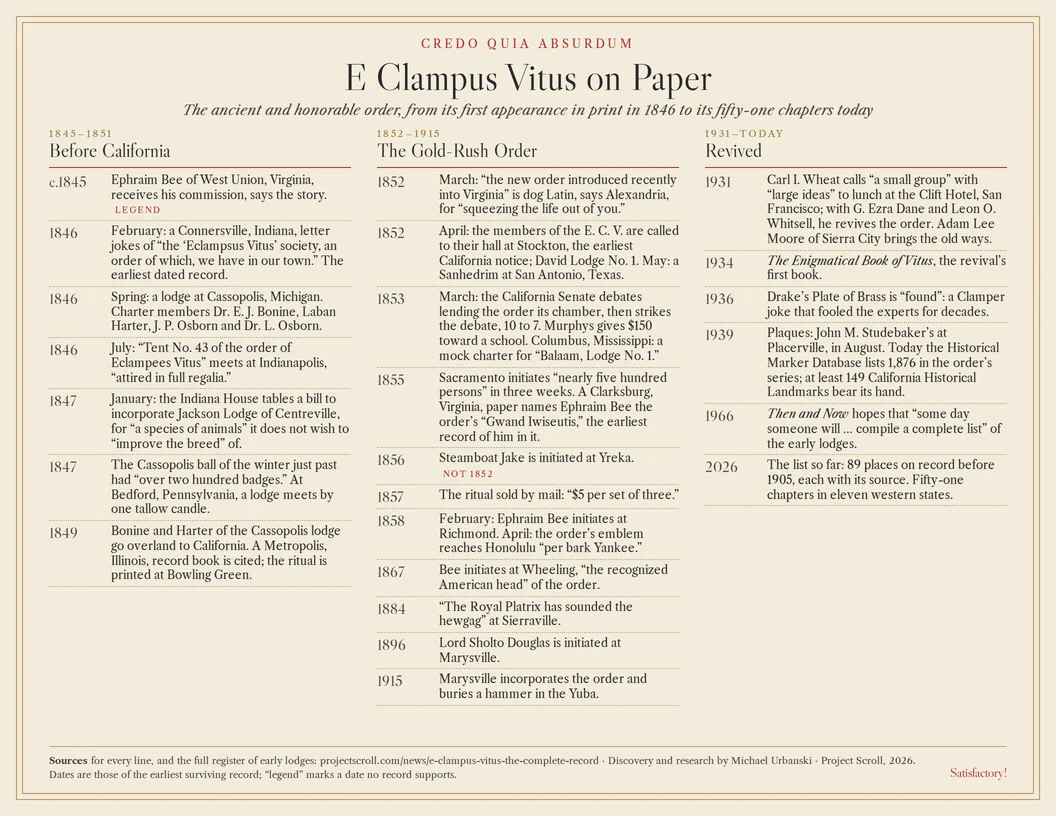
The case file: what we asked, and what we found
OpenClose the questions this research set out to answer
The questions this page set out to answer, and what the record showed.
8 answered
Answered
Answered Monterey, a year earlier
When was the order at Monterey?
- What we know
- By July 1855. The notice that Mayo Hayes O’Donnell’s columns placed in 1856 ran in the Monterey Sentinel of 14 July 1855, and again on 21 July: “E Clampsus Vitus. [Th]ere will be a grand gala festival in [.]n full regalia—on the first of August [.] in this place. [O]ur San Juan brethren, of special de[gree] of B. A. H. & P. in good standing, [are r]equested to attend. By order of the M. G. H. [M]onterey, July 14, 1855.” Its invitation puts the order at San Juan Bautista by then too. Two of O’Donnell’s columns had spoken of a July 1855 notice; the “August, 1856” in his quotation was his own.
- Where we read it
- Read on the page image, page 3 of the 14 July issue, in the Monterey Public Library’s digital newspaper archive57. Letters in brackets are lost in the binding.
Answered Before the Senate, and struck out
What lies behind Slopes’s “Benicia, March 1853”?
- What we know
- A debate in the state Senate. On 17 March 1853, at Benicia, then the capital, Senator De la Guerra asked the Senate to lend its chamber “for the meetings of the ‘E. Clampsus Vitus’ Society.” Senator Wombough of Yolo and Colusa “would rather cut his right arm off than vote for” it; the order’s own “head” in the state, a senator, replied that Wombough had been “black-balled.” The senator for Mariposa, James H. Wade, was named as a member, and “the N. G. H. of the State was present and gave the Grand Sign.” The resolution was set aside, and the Senate afterwards voted 10 to 7 to strike the whole affair from its journal. The printed Journal has not a word of it. Benicia moves from 1857 to 1853 in the register and on both maps, and the story has a section of its own.
- Where we read it
- Read on the page images of the Sacramento Daily Union and the Daily Alta California of 19 March 1853, with the San Joaquin Republican’s two reports of the same day, in the California Digital Newspaper Collection; the 1853 Journal of the Senate at the Internet Archive, for 17 and 18 March and for the senators and their districts.
Answered Stewart Flat, found
Where was Stewart Flat?
- What we know
- In Placer County. Durham’s gazetteer puts Stewarts Flat “on Secret Ravine, 1.5 miles east of Penryn,” and the county papers show it near Newcastle and among the polling places of 1863. Its lodge, under Sam McCurdy, is on record in May 1859. It is now on both maps.
- Where we read it
- David L. Durham, California’s Geographic Names (1998), p. 537; the Placer Herald, 25 July 1863, and the Sacramento Daily Union, 13 February 1867, in the California Digital Newspaper Collection.
Answered Smith’s Flat, found
Which of California’s Smith’s Flats had the order in 1856?
- What we know
- The Sierra County camp that grew into Alleghany. The Sierra Citizen of Downieville printed “the officers elect of the Order of E Clampsus Vitus at Smith’s Flat” on 28 June 1856, and the same paper’s Smith’s Flat correspondent wrote that February of the Hook & Bull Co. (Chamberlin, one of the officers), H. Winchell (another), the Alleghany Co. and the Keystone tunnel. The Alleghany marker names Smith’s Flat as the first of the camps of 1851 from which the town grew. It is now on both maps.
- Where we read it
- The Sierra Citizen, 28 June 1856, and the Sacramento Daily Union, 26 February 1856, in the California Digital Newspaper Collection; the Alleghany historical marker.
Answered Two lodges, a town and a joke
What did the Library of Congress’s leads hold?
- What we know
- The charter of “Balaam, Lodge No. 1” at Columbus, Mississippi, is dated 8 August 1853 on the page image (the machine-read text of the 17 September printing says 1852). In February 1855 the order was “flourishing in Baltimore,” and the Fredericksburg Herald said of its own town, “It had its day here.” The “Grand Gyastacutus” of 1858 is a joke at a senator in a St. Paul paper: the order’s language, not a lodge.
- What the sweep added
- A sweep of the Library’s papers from 1845 to 1904 then added Georgetown (1856), Petaluma (1859), Horsetown (1860), Parkersburg (1870), Grafton (1874), Knoxville (remembered in 1874) and Idaho City (1880), and moved Oroville back to July 1856, Wheeling to January 1866 (a record that dates its founding to about 1864) and Newport, Indiana, from a county history of 1888 to a newspaper of 1875.
Answered South before the war, and the far north
Did the order reach the South before the Civil War, and how far north did it go?
- What we know
- Yes, and as far as British Columbia. Wapsipinico Lodge at Bardstown, Kentucky, kept a standing notice in the Bardstown Herald in October and November 1852; and in February 1862, in the first year of the war, a lodge was “organised at Port Douglas, B. C.” Both are in the register.
Answered “Clampus” before Wheat
Did Carl Wheat invent the spelling “Clampus”?
- What we know
- No. It was in print by March 1852 (“E. Clampus Vitas”), in January 1854, again in 1856, in several papers of 1857 to 1860, and in 1864. Wheat chose it from the old order’s many spellings and made it the only one.
Answered By bark to Honolulu
When was the order first at Honolulu?
- What we know
- By April 1858. The Pacific Commercial Advertiser of 22 April 1858 announces that the order’s emblem had come “per bark Yankee” and that E. J. Smith would form a branch. From 23 September 1858 the lodge called its own meetings “at the Hall, over Dr. McKibbin’s Drug Store,” and the Advertiser’s directory of 30 December names L. F. Beatty as N. G. H. By 1 January 1859 The Friend lists the lodge meeting “on Queen street over Dr. McKibbin’s Drug store.” The order’s historians had the year, 1858, without citing a source.
Add to the register
This register has grown with help. Jim Cirner sent us the Daily Alta California’s report of the Senate at Benicia, the order’s 1966 history Then and Now, clippings from his albums, a photograph of Joel Henry Zumwalt’s plaque and Carl Wheat’s invitation of 1931. Every one of them is in this history. If you have a lodge to add, an earlier record for one that is here, or a name, a badge or a photograph, write to research@projectscroll.com. Every addition is credited. The register is free to download and to reuse under a Creative Commons Attribution 4.0 licence: share it, republish it or build on it, with credit. Please cite it as: Michael Urbanski, “E Clampus Vitus: the register of early lodges,” Project Scroll, 2026, https://projectscroll.com/news/e-clampus-vitus-register-of-early-lodges/.
Every place on this page left a mark in print: a notice, a ball, a quarrel, a line in a diary. Read the story they tell in Part 1, Cassopolis, 1846 › and Part 2, the complete record ›
To cite this page: Michael Urbanski, “E Clampus Vitus: the register of early lodges,” Project Scroll, 2026, https://projectscroll.com/news/e-clampus-vitus-register-of-early-lodges/. The register was first published on 22 October 2026 as part of “E Clampus Vitus: the complete record” and was given its own page on 3 November 2026. To cite a single finding, use its own link on our Discoveries page. Corrections are welcome, and any we make are noted on this page.
Sources
- Every entry in the register carries its own source and link; the register can be downloaded as a spreadsheet. Accessed November 2026.
- E Clampus Vitus Inc., Chapters (51 recognised chapters in 11 western states), accessed 22 Oct 2026.
- The Historical Marker Database, series “E Clampus Vitus Historical Markers,” accessed 22 Oct 2026.
- Alan J. Stein, “E Clampus Vitus Doc Maynard Chapter No. 54-40 is chartered,” HistoryLink essay 8162. Accessed November 2026.
- Mark Twain Project, notes to “Jim Smiley and His Jumping Frog.” Accessed November 2026.
- The books, newspapers and archives in “Where the rest lies,” above.
- Bardstown Herald (Bardstown, Ky.), 14 October 1852: Wapsipinico Lodge. Kentucky Digital Newspaper Program, University of Kentucky Libraries, via Internet Archive.
- Bardstown Herald, 18 November 1852: the same notice. Internet Archive.
- The Weekly British Colonist (Victoria), 11 February 1862, p. 4: the lodge at Port Douglas. University of Victoria Libraries, via Internet Archive.
- The Friend (Honolulu), 1 January 1859 (running head misprinted “January, 1858”), the list of societies: “E Clampsus V.” Internet Archive.
- Mayo Hayes O’Donnell, “Peninsula Diary,” 25 September 1953: the notice, placed in “June 1856,” and the San Juan Bautista invitation. Monterey History & Art Association.
- West Virginia & Regional History Center, West Virginia University: typescript index and transcription of the Weston Herald, 28 November 1853 – 3 June 1861.
- Spirit of the Times, 14 January 1854: “an ‘E Clampus vitus’ grip.” Internet Archive.
- Stephen C. Massett, “Drifting About”; or, What “Jeems Pipes, of Pipesville,” Saw-and-Did (New York: Carleton, 1863), p. 234, reprinting his letter in the San Francisco Herald, 26 January 1856. Internet Archive.
- North Branch Democrat (Tunkhannock, Pa.), 7 September 1864, p. 2, “Monstrous Conspiracy.” Library of Congress, Chronicling America.
- Huntington Library, Dane family papers (mssDane), Box 16. Accessed November 2026.
- Cadiz Sentinel (Cadiz, Ohio), 24 August 1864, p. 3, “Monstrous Conspiracy.” Library of Congress, Chronicling America.
- Winchester Republican (Winchester, Va.), 26 February 1858, p. 2, “Great Excitement,” from the Parkersburg Gazette: Ephraim Bee at Richmond. Library of Congress, Chronicling America.
- Richmond Enquirer, 19 February 1858, p. 2, House of Delegates, 18 February: the Senate bill on lands to be conveyed to “Ephraim Bee of the county of Doddridge.” Library of Congress, Chronicling America.
- Holmes County Farmer (Millersburg, Ohio), 1 September 1864, p. 1: the same list. Library of Congress, Chronicling America.
- Earl G. Swem, “A Register of the General Assembly of Virginia, 1776–1918,” Report of the Virginia State Library, 1917 (Richmond, 1918), p. 179: session of 7 December 1857 to 8 April 1858, “Doddridge and Tyler. John McKay.” Internet Archive.
- Seth Slopes, E Clampus Vitus (2000), with its dated chronology of places, and Boyd B. Stutler’s “Ephraim Bee, Grand Gyascutis, and his Virginia E C V of 1853,” reprinted there, pp. 13 ff., quoting the Weston Herald of 28 November 1853 (“the Grand Lama, Ephraim Bee”; “first commissioned Grand Gyascutis for the United States of America by the Grand Hotetote of China”); read in the Internet Archive’s full-text search, not on the page.
- Pacific Commercial Advertiser (Honolulu), 22 April 1858, p. 3, and in the weeks after: “E Clampsus V.” Library of Congress, Chronicling America.
- Bruce Ramsey, Ghost Towns of British Columbia (Vancouver: Mitchell Press, 1963): the lodge at Port Douglas, undated. Internet Archive.
- Cooper’s Clarksburg Register (Clarksburg, Va.), 25 April 1855, p. 3, “Know-Nothingism in Gilmer.” Library of Congress, Chronicling America.
- Cooper’s Clarksburg Register, 15 August 1856, p. 2, a letter from Glenville, 9 August 1856. Library of Congress, Chronicling America.
- Alexandria Gazette, 8 March 1860, p. 2: Ephraim Bee, “Grand Lama,” and Caleb Cushing. Library of Congress, Chronicling America.
- Daily Intelligencer (Wheeling), 18 July 1863, p. 1, “The First West Va. Legislature”: the profile of Ephraim Bee (“spent the winter of ’57–8 at Richmond”). Library of Congress, Chronicling America; transcribed by West Virginia Archives and History, https://archive.wvculture.org/History/sesquicentennial/biobeeephraim.html.
- Jennifer Wilt, “Ephraim Bee & E Clampus Vitus,” reprinting the Parkersburg State Journal of 1896, “Story of an Old-Time Secret Order and Its Founder” (Bee “converted nearly all the members of the Legislature and even the mayor of the city of Richmond”). Doddridge County Heritage Guild.
- Then and Now: The Story of E Clampus Vitus (Stockton, 1966): Steamboat Jake in 1852 for $98.50, after the Mariposa Gazette of 4 June 1936; the order’s incorporation at Marysville, 9 November 1915, for fifty years, and its incorporation at San Francisco in 1963. Sent to us by Jim Cirner; online from Joaquin Murrieta Chapter No. 13.
- Shasta Courier (Shasta, Calif.), 22 December 1855, p. 2, “In Luck”: Brigham Young’s “anathema” against “the ancient and venerable order of E Clampsus Vitus.” Library of Congress, Chronicling America.
- Southern Standard (Columbus, Miss.), 10 September 1853, p. 2, and 17 September 1853, p. 2: the charter of “Balaam, Lodge No. 1” of the “Ancient and Independent Order of Old Eclampsus Vitus,” dated 8 August 1853 on the page. Library of Congress, Chronicling America.
- Alexandria Gazette, 19 February 1855, p. 4, “E. Clampsis Vitis,” from the Fredericksburg Herald: the order in Baltimore. Library of Congress, Chronicling America.
- Weekly Minnesotian (St. Paul, Minn.), 24 April 1858, p. 2, a letter from Minneapolis, 19 April: Senator E. N. Bates as “Grand Gyastacutus of the E-Clampsus Vitusum.” Library of Congress, Chronicling America.
- Mariposa Democrat (Mariposa, Calif.), 17 December 1857, p. 2, “E. C. V. Ball”: “the ancient and honorable Order of E Clampus Vitus.” Library of Congress, Chronicling America.
- Jackson Standard (Jackson, Ohio), 29 April 1858, p. 2: “the ‘E. Clampus Vitus.’” Library of Congress, Chronicling America.
- Shasta Courier, 8 October 1859, p. 3, “E Clampus Vitus,” from the Marysville Express: a lodge for Petaluma. Library of Congress, Chronicling America.
- E Clampus Vitus Inc., Grand Council: held each year at the Mother Lode Fairgrounds, Sonora, the weekend before Memorial Day, accessed 25 Oct 2026.
- E Clampus Vitus, The Curious Book of Clampus, or Gumshaniana, “the second official publication” of the order (Yerba Buena, 1935). Huntington Library, Rare Books.
- Mokelumne Hill, Calaveras County: view from Stockton Hill, Lawrence & Houseworth stereograph, “Gems of California Scenery,” no. 868 (1866). Library of Congress, Prints and Photographs (LC-USZ62-27359).
- “An ‘E Clampus Vitus’ initiation,” stereograph, 1890. Library of Congress, Prints and Photographs (LC-DIG-stereo-1s44579).
- Kanawha Valley Star (Charleston, Va.), 9 February 1858, p. 2, Senate proceedings, about 1 February: the joint resolution for a bill “to release Ephraim Bee from the payment of a part of the purchase money” of forfeited lands in Jackson County. Library of Congress, Chronicling America.
- Alvaro F. Gibbens, Wood County Formation: A Century of Progress (Morgantown: Acme Press, 1899), p. 48: a later memory of Bee initiating in the jury hall of the old Wood County court house at Parkersburg. Internet Archive.
- Georgetown News (Georgetown, Calif.), 22 May 1856, p. 2, “E. C. V.”: Knights from Placerville and Georgetown at the Spanish Flat Sanhedrim. Library of Congress, Chronicling America.
- Weekly Butte Record (Oroville, Calif.), 19 July 1856, p. 2, “E. C. V.”: a regular meeting at the Hall of the Temple of Honor. Library of Congress, Chronicling America.
- Shasta Courier, 15 December 1860, p. 2, “E Clampsus Vitus,” from the Horsetown Argus. Library of Congress, Chronicling America.
- Wheeling Daily Intelligencer, 17 January 1866, p. 4: Ephraim Bee, who “when he was here two years ago … founded a branch order in this city.” Library of Congress, Chronicling America.
- Wheeling Daily Intelligencer, 15 July 1870, p. 3, “E. Clampus Vitus … Great Revival at Parkersburg,” from the Parkersburg Times. Library of Congress, Chronicling America.
- Wheeling Daily Intelligencer, 31 January 1874, p. 2, “Ephriam [sic] Bee’s Order Revived,” from the Grafton Sentinel. Library of Congress, Chronicling America.
- Morristown Gazette (Morristown, Tenn.), 10 June 1874, p. 1, “The Ancient and Antique Order of Eclampus Vitus”: the order at Knoxville before the war. Library of Congress, Chronicling America.
- Chicago Daily Tribune, 13 May 1875, p. 11: “The Society of Old Eclampsus put a ticket in the field at Newport,” in Vermillion County. Library of Congress, Chronicling America.
- Idaho Semi-Weekly World (Idaho City), 14 September 1880, p. 3: “a revival of the ancient order of Eclampsus Vitus, known here as the T. T.’s.” Library of Congress, Chronicling America.
- Biographical and Historical Record of Vermillion County, Indiana (Chicago, 1888): “an imaginary secret society” at Newport. Internet Archive.
- Mayo Hayes O’Donnell, “Peninsula Diary,” 14 September 1951: items from the Monterey Sentinel of February 1856, among them the notice, with “their San Juan brethren.” Monterey History & Art Association.
- Mayo Hayes O’Donnell, “Peninsula Diary,” 18 October 1951: the Monterey notice, placed in “the last July issue,” the San Juan Bautista invitation, and the Metropolis book “preserved in the Huntington Library in Pasadena.” Monterey History & Art Association.
- Mayo Hayes O’Donnell, “Peninsula Diary,” 24 February 1965: the Monterey notice, dated there “Feb. 6, 1856.” Monterey History & Art Association.
- Monterey Sentinel, 14 July 1855, p. 3, and 21 July 1855: the notice headed “E Clampsus Vitus.” Monterey Public Library, California History Room, digital newspaper archive (roll 796).
- David L. Durham, California’s Geographic Names: A Gazetteer of Historic and Modern Names of the State (Clovis: Word Dancer Press, 1998), p. 537: Stewarts Flat, “on Secret Ravine, 1.5 miles east of Penryn,” Placer County.
- Placer Herald (Auburn), 25 July 1863 (Stewart Flat among the county’s polling places) and Sacramento Daily Union, 13 February 1867 (“Newcastle … Sherman, of Stewart Flat”). California Digital Newspaper Collection.
- “Alleghany,” historical marker (Sierra County), as transcribed by the Historical Marker Database: Smith’s Flat, Kanaka Flat, Wet Ravine, Cumberland and Kanaka City, the camps of 1851 that became Alleghany.
- Sacramento Daily Union, 26 February 1856, “Mining in Sierra,” quoting the Smith’s Flat correspondent of the Sierra Citizen. California Digital Newspaper Collection.
- Sacramento Daily Union, 19 March 1853, “Our Benicia Correspondence” (Benicia, Thursday, 17 March). California Digital Newspaper Collection.
- San Joaquin Republican (Stockton), 19 March 1853, “Matters at the Capital.” California Digital Newspaper Collection.
- Daily Alta California, 19 March 1853, “Legislative Report.” Found by Jim Cirner. California Digital Newspaper Collection.
- Journal of the Fourth Session of the Legislature of the State of California, Senate (San Francisco, 1853), pp. 5, 8 and 37 (the senators and their districts) and 224–231 (17 and 18 March). Internet Archive.
- Robert W. Kerrigan, “View from Southeast,” Benicia State Capitol, Historic American Buildings Survey CA-1188, about 1936. Library of Congress, Prints and Photographs Division.
- E Clampus Vitus, Credo quia absurdum (Placerville, 1949), reprinting Boyd B. Stutler, “Ephraim Bee, Grand Gyascutis” (West Virginia Review, August 1931, quoting the Weston Herald of 28 November 1853), G. Ezra Dane’s essay of 1938, and J. A. Smith in the Calaveras Prospect, 30 May 1896. HathiTrust.
- Historical marker “Ephraim Bee” (2003). The Historical Marker Database.
- Historical marker “Beehive Inn” (2005). The Historical Marker Database.
- Indiana American (Brookville), 27 February 1846, p. 2. Hoosier State Chronicles, Indiana State Library.
- James M. Shepard, in Howard S. Rogers, History of Cass County, from 1825 to 1875 (Cassopolis, 1875), pp. 253–254. Internet Archive.
- Indiana State Sentinel, 15 and 16 July 1846, p. 3. Hoosier State Chronicles, Indiana State Library.
- Journal of the House of Representatives of the State of Indiana, 1846–47, pp. 259, 272, 345 (House bill No. 242). Internet Archive.
- William M. Hall, Reminiscences and Sketches, Historical and Biographical (Harrisburg, 1890), pp. 121–127. Internet Archive.
- G. Ezra Dane, Ghost Town (New York, 1941), p. 309. Internet Archive.
- Alexandria Gazette, 13 March 1852, p. 2. Library of Congress, Chronicling America.
- San Joaquin Republican, 14 April 1852. California Digital Newspaper Collection.
- A travelling card of the San Antonio Sanhedrim, 30 May 1852, transcribed in the Oroville Mercury and the Marysville Daily Appeal, 24 September 1892. California Digital Newspaper Collection.
- Daily Alta California, 31 August 1852. California Digital Newspaper Collection.
- Southern Sentinel (Columbus, Ga.), 16 December 1852, p. 3, the notice of 9 December organizing the lodge; Times and Sentinel (Columbus), 14 January 1853, p. 3, and 12 February 1853, p. 2. Read on the page images. Georgia Historic Newspapers, Digital Library of Georgia.
- Columbus Enquirer, 18 January 1853, p. 3 (“E Clampsus Vitus. Regular meeting this evening”), and Columbus Daily Enquirer, 8 August 1875, p. 3 (the paper’s look back at 1853); Weekly Times & Sentinel, 15 February 1853, p. 2 (the gift to Trinity Church’s school, reprinted). Georgia Historic Newspapers.
- Columbus Inquirer, as extracted in the San Joaquin Republican, 2 March 1853. California Digital Newspaper Collection.
- San Joaquin Republican, 16 February 1853. California Digital Newspaper Collection.
- Historical marker “Site of E.C.V. Saloon” (1965). The Historical Marker Database.
- Historical marker “E Clampus Vitus,” the Wall of Comparative Ovations. The Historical Marker Database. Accessed November 2026.
- San Joaquin Republican, 2 February 1853. California Digital Newspaper Collection.
- Daily Alta California, 31 October 1857. California Digital Newspaper Collection.
- Calaveras Chronicle, reprinted in the San Joaquin Republican, 16 March 1853. California Digital Newspaper Collection.
- Weekly Calaveras Chronicle, 4 May 1867, p. 3. Library of Congress, Chronicling America.
- Historical marker “Mokelumne Hill” (Matuca Chapter, 2010). The Historical Marker Database.
- Columbia Gazette, 5 August 1854. California Digital Newspaper Collection.
- Evansville Daily Journal, 20 September 1854, p. 2 (a Vincennes letter). Hoosier State Chronicles, Indiana State Library.
- San Joaquin Republican, 25 April 1855. California Digital Newspaper Collection.
- Trinity Journal, 9 June 1855. California Digital Newspaper Collection.
- Historical marker “E Clampus Vitus 1855 & 1962” (2012). The Historical Marker Database.
- Historical marker “Cameron Building Site” (1983). The Historical Marker Database.
- San Joaquin Republican, 2 June 1855 (from the Marysville Herald). California Digital Newspaper Collection.
- San Francisco Call, 23 January 1896, p. 3. Library of Congress, Chronicling America.
- Historical marker “Lord Sholto Douglas” (1983). The Historical Marker Database.
- Nevada Journal, 27 July 1855. California Digital Newspaper Collection.
- Nevada Journal, 9 January 1857, p. 2. Library of Congress, Chronicling America.
- Placer Herald, 12 January 1856. California Digital Newspaper Collection.
- Albert Shumate, A Note on ECV in the Gold Fields (San Francisco: Lawton Kennedy, 1961). HathiTrust.
- Sacramento Daily Union, 26 February 1856: “The Day in Placerville,” Washington’s Birthday kept by the order (machine-read text). California Digital Newspaper Collection.
- Nevada Journal, 18 January 1856. California Digital Newspaper Collection.
- Historical marker “Downieville” (1987). The Historical Marker Database.
- San Joaquin Republican, 19 March 1856. California Digital Newspaper Collection.
- Trinity Journal, 5 and 19 April 1856. California Digital Newspaper Collection.
- Sacramento Daily Union, 3 June 1856. California Digital Newspaper Collection.
- Historical marker “Clampers Meeting Hall” (1982). The Historical Marker Database.
- Sacramento Daily Union, 9 May 1856. California Digital Newspaper Collection.
- Sierra Citizen (Downieville), 28 June 1856. California Digital Newspaper Collection.
- Butte Record (Oroville), 17 December 1856; catalogued as the Chico Record. California Digital Newspaper Collection.
- Placer Herald, 26 March 1859, p. 1. Library of Congress, Chronicling America.
- Fariss & Smith, Illustrated History of Plumas, Lassen & Sierra Counties (San Francisco, 1882), p. 471. Internet Archive.
- Historical marker “Busch & Heringlake Building” (1990). The Historical Marker Database.
- Placer Herald, 31 January 1857. California Digital Newspaper Collection.
- Plumas Argus, 17 September 1857. California Digital Newspaper Collection.
- Historical marker “Forest Stationers” (2009). The Historical Marker Database.
- Pacific Commercial Advertiser (Honolulu), 27 May 1882, p. 3. Library of Congress, Chronicling America.
- Placer Herald, 21 May 1859. California Digital Newspaper Collection.
- Hydraulic Press (North San Juan), 30 July 1859. California Digital Newspaper Collection.
- Placer Herald, 23 July 1859. California Digital Newspaper Collection.
- Dayton Daily Empire, 24 September 1859, credited to a Bedford, Ind., paper. Library of Congress, Chronicling America.
- Daily Alta California, 7 October 1864. California Digital Newspaper Collection.
- Red Bluff Beacon, 27 June 1860. California Digital Newspaper Collection.
- Napa County Reporter, 16 August 1862. California Digital Newspaper Collection.
- Wheeling Daily Intelligencer, 1 February 1867, p. 2: “E. Clampus Vitis.” Library of Congress, Chronicling America.
- Marysville Daily Appeal, 8 July 1866. California Digital Newspaper Collection.
- Trinity Journal, 23 March 1867. California Digital Newspaper Collection.
- Mariposa Gazette, 15 June 1867. California Digital Newspaper Collection.
- Cheyenne Leader, 23 December 1868. Library of Congress, Chronicling America.
- Feather River Bulletin, 13 February 1875. California Digital Newspaper Collection.
- Weekly Butte Record, 28 September 1878. California Digital Newspaper Collection.
- Sentinel, 25 January 1879: Cedarville. California Digital Newspaper Collection.
- Feather River Bulletin, 7 February 1880. California Digital Newspaper Collection.
- Feather River Bulletin, 19 January 1884. California Digital Newspaper Collection.
- Historical marker “Henness – Zumwalt Pass” (1982). The Historical Marker Database.
- Humboldt Times, 11 April 1884. California Digital Newspaper Collection.
- Marysville Daily Appeal, 6 March 1888. California Digital Newspaper Collection.
- Historical marker “William Bull Meek / ECV Redivivus” (1956, 1982). The Historical Marker Database.
- Historical marker “Capt. Brown House” (2010). The Historical Marker Database.
- Marysville Democrat, 7 February 1891. California Digital Newspaper Collection.
- Caleb Cushing, photograph, between 1855 and 1865. Brady-Handy Collection, Library of Congress.
- San Joaquin Republican, 22 May 1852: “Joseph Miles, N. G. H.” California Digital Newspaper Collection.
- Indiana State Sentinel, 16 July 1846, p. 3: Tent No. 43. Hoosier State Chronicles, Indiana State Library.
- William M. Hall, Reminiscences and Sketches (Harrisburg, 1890), pp. 121–127: Bedford, 1847. Internet Archive.
- Placer Herald, 6 August 1853: the “grand hailing distress sign.” California Digital Newspaper Collection.
- Trinity Journal, 1 March 1856: the Royal Platrix. California Digital Newspaper Collection.
- Nevada Journal, 23 January 1857: Locus Lucis. California Digital Newspaper Collection.
- San Joaquin Republican, 13 September 1857: a notice of the order. California Digital Newspaper Collection.
- Calaveras Chronicle (Mokelumne Hill), 23 June 1866. California Digital Newspaper Collection.
- Frank Leslie’s Illustrated Newspaper, 11 February 1860, on the Sons of Malta. Internet Archive.
- Harry L. Wells, History of Siskiyou County, California (Oakland, 1881), pp. 108 (the Fourth of July procession, Yreka, 1856) and 111 (Steamboat Jake). Internet Archive.
- Carl I. Wheat, The Enigmatical Book of Vitus (Yerba Buena, 1934). HathiTrust.
- Carl I. Wheat, “The Clampers,” Pacific Historical Review 18:1 (1949), 67–69. JSTOR.
- Albert Shumate, ECV News from the Miners, 1856–1860 (San Francisco: Lawton Kennedy, 1960). HathiTrust.
- Lois Rather papers, Bancroft Library, finding aid (her Men Will Be Boys, Oakland, 1980, is at the Huntington Library). Online Archive of California.
- Albert Shumate, “The Mysterious History of E Clampus Vitus” (1991), and Alan L. Wilson, “A Short History of E Clampus Vitus” (1995). Julia C. Bulette Chapter No. 1864.
- Edward Von der Porten and others, “Who Made Drake’s Plate of Brass? Hint: It Wasn’t Francis Drake,” California History 81:2 (2002), 116–133. JSTOR.
- Michelle D.-L. Laguna, Landmarks, Plaques, and Practical Jokes: E Clampus Vitus and Memory Making in California (M.A. thesis, California State University, Sacramento, 2025).
- E Clampus Vitus Archives, Mss101, Holt-Atherton Special Collections, University of the Pacific. Online Archive of California. Accessed November 2026.
- E Clampus Vitus records, 1933–1984 (mssEClamp), Huntington Library. Online Archive of California.
- E Clampus Vitus Records, 1935–1970 (LSC.1796), UCLA Library Special Collections. Online Archive of California.
- Boyd B. Stutler Collection, Ms78-1, West Virginia State Archives. Accessed November 2026.
- Alfred Mathews, History of Cass County, Michigan (Chicago: Waterman, Watkins & Co., 1882), pp. iii (the preface, thanking “Hon. James M. Shepard” and “Dr. Leander Osborn” among others), 170 (Root’s hotel and his second hotel, burned in 1859; the planing mill and the name “Union Hotel”), 174 (the lodge, credited to James M. Shepard; the Masons in the Union Hotel, 12 June 1852), 178 (Eber Root’s children, “Isabella (Mrs. J. P. Osborn)”) and 180–181 (James M. Shepard, born at North Brookfield, Mass., 24 November 1840); the Osborn family, the Cassopolis harness trade and the village officers, 1869–1876. Internet Archive.
- California State Senate, Record of State Senators, 1849–2024: Antonio M. De la Guerra, San Luis Obispo and Santa Barbara, fourth session (1853).
- San Joaquin Republican (Stockton), 19 March 1853, a letter dated Benicia, 17 March 1853. California Digital Newspaper Collection.
- Sacramento Daily Union, 1 May 1855, “E Clampsus Vitus”: the Assembly resolution of 30 April 1855. California Digital Newspaper Collection.
- Red Bluff Beacon, 28 April 1858, p. 2: the order’s $20 toward the May-Day Festival. California Digital Newspaper Collection.
- Red Bluff Beacon, 12 January 1859, p. 2: a meeting notice of the order (machine-read text). California Digital Newspaper Collection.
- Red Bluff Beacon, 2 February 1859, p. 2: the order “resuscitated.” California Digital Newspaper Collection.
- Red Bluff Beacon, 16 November 1859, p. 2: proposals for the order’s brick hall on Clay Square (as printed by Shumate, 1960; machine-read text). California Digital Newspaper Collection.
- Shasta Courier, 9 February 1856, and Mountain Messenger (Downieville), 23 February 1859, as printed in Albert Shumate, ECV News from the Miners, 1856–1860 (1960). HathiTrust.
- Mountain Democrat (Placerville), 23 February 1856: a lodge instituted at El Dorado. As clipped in Jim Cirner’s album “ECV ® Back in the Day” #2, seen as a clipping.
- Territorial Enterprise (Carson City, Utah Territory), 18 February 1860: “E. C. V.” As clipped in Jim Cirner’s album “ECV ® Back in the Day” #1, seen as a clipping.
- A letter from Wet Ravine, 14 June 1860, in the Sierra Democrat (Downieville): the E.C.V.’s at Forest City. As clipped in Jim Cirner’s album “ECV ® Back in the Day” #1, seen as a clipping.
- Reno Crescent, 20 March 1869: a call to establish a “Grand Lodge” in Reno. As clipped in Jim Cirner’s album “ECV ® Back in the Day” #1, seen as a clipping.
- A Reno newspaper, 30 January 1883: “The ‘Clampers.’” As clipped in Jim Cirner’s album “ECV ® Back in the Day” #1.
- Feather River Bulletin (Quincy), 21 February 1924, p. 2: “Clampers Held the Stage at Loyalton in Early Seventies.” California Digital Newspaper Collection.
- Marysville Daily Appeal, 23 October 1915: “Clampers Hold First Rousing Meeting.” California Digital Newspaper Collection.
- Sacramento Daily Union, 13 November 1915: “Marysville Clampers Seeking Larger Hall.” California Digital Newspaper Collection.
- Sacramento Daily Union, 11 December 1915: “Dedicate Yuba River Bridge.” California Digital Newspaper Collection.
- Sacramento Daily Union, 12 December 1915: the hammers resurrected. California Digital Newspaper Collection.
- Sacramento Daily Union, 9 January 1916: “Clampers Society Growing Rapidly.” California Digital Newspaper Collection.
- Sacramento Daily Union, 21 January 1916: “Roseville Requests Charter for Clampers.” California Digital Newspaper Collection.
- Sacramento Daily Union, 29 January 1916: “Clampers Form Oroville Lodge” (machine-read text). California Digital Newspaper Collection.
- Sacramento Daily Union, 25 March 1916: “Clampers Take Chico by Storm.” California Digital Newspaper Collection.
- Marysville Daily Appeal, 22 April 1916: “Sacramento Lodge No. 5” (machine-read text). California Digital Newspaper Collection.
- Marysville Daily Appeal, 25 April 1916: “Sacramento Lodge No. 4” (machine-read text). California Digital Newspaper Collection.
- Chico Record, 16 May 1916: “Clampers Are Going to Willows Installation.” California Digital Newspaper Collection.
- Sacramento Daily Union, 22 May 1916: “Four Hundred Taken in by Willows Clampers.” California Digital Newspaper Collection.
- Marysville Daily Appeal, 20 May 1916: Willows Lodge No. 4 (machine-read text). California Digital Newspaper Collection.
- Sacramento Daily Union, 1 July 1916: “Colusa Clampers Lodge Instituted.” California Digital Newspaper Collection.
- Sacramento Daily Union, 9 August 1916: the Willows Clampers and the Hamilton City refinery. California Digital Newspaper Collection.
- Sacramento Daily Union, 17 September 1916: “Lea Becomes Member of Willows Clampers.” California Digital Newspaper Collection.
- Sacramento Daily Union, 8 November 1916: “Red Bluff Granted Charter for Clampers.” California Digital Newspaper Collection.
- Colusa Herald, 23 November 1916: “Two Meetings a Month,” Colusa County Lodge No. 6 (machine-read text). California Digital Newspaper Collection.
- Feather River Bulletin (Quincy), 25 January 1917, p. 1: “Clampers’ Lodge to Be Organized” (machine-read text). California Digital Newspaper Collection.
- A Quincy newspaper, 14 February 1917: “E. C. V. Lodge No. 8 Instituted Here.” As clipped in Jim Cirner’s album “ECV ® Back in the Day” #1, seen as a clipping.
- Sacramento Daily Union, 12 July 1918: “Oroville Clampers Plan Electric Arches.” California Digital Newspaper Collection.
- Colusa Daily Sun, 27 January 1920: “E. Clampus Vitus Very Deadibus Aroundaboutibus.” California Digital Newspaper Collection.
- Colusa Daily Sun, 28 January 1920: “Clampers Will Give Surplus to the Legioners.” California Digital Newspaper Collection.
- Colusa Herald, 29 January 1920: “Post to Get Clampers’ Funds.” California Digital Newspaper Collection.
- Plumas Independent (Quincy), 29 January 1920, p. 1: “Clampers Lodge Revived Sunday.” California Digital Newspaper Collection.
- Colusa Daily Sun, 2 February 1920: “Clampers Revived,” from Quincy. California Digital Newspaper Collection.
- Jim Cirner, “ECV ® Back in the Day,” albums #1–3 (Facebook, public), newspaper clippings on the old order: the finding aid for most of the 1915–1920 newspapers and for the El Dorado, Carson City, Forest City, Reno and Loyalton notices. Album #1.
- Jim Cirner, “ECV ® Back in the Day” #2 (Facebook). Accessed November 2026.
- Jim Cirner, “ECV ® Back in the Day” #3 (Facebook). Accessed November 2026.
- Feather River Bulletin (Quincy), 15 February 1917, p. 1: “Quincy Lodge No. 8 of E. Clampus Vitus Was Organized Last Sunday.” California Digital Newspaper Collection.
- Red Bluff Daily News, 10 November 1916, p. 1: “Clampers Give Charter” (Red Bluff lodge). California Digital Newspaper Collection.
- Grand Council of E Clampus Vitus, granite plaque at the grave of Joel Henry Zumwalt (24 September 1831 – 22 January 1906), Mokelumne Hill, dedicated 20 May 2021. Photograph by Jim Cirner, used with permission.
- James Fuller Queen, “The great secret of Odd-Fellowship exposed,” lithograph (Philadelphia, between 1840 and 1860). Library of Congress, Prints and Photographs, Popular Graphic Arts (LC-DIG-pga-06884); no known restrictions on publication.
- U.S. Census Bureau, cartographic boundary files, via the us-atlas package: the state outlines on the maps. Accessed November 2026.
- Carl I. Wheat to Francis P. Farquhar, autograph letter signed, San Francisco (letterhead: Balfour Building), 11 December 1931: lunch at the Clift Hotel, Friday, 18 December 1931, “to ‘discuss’ ways & means for the revival” of the order. Marsh Fey Collection; reproduced with Alan L. Wilson, “A Short History of E Clampus Vitus” (1995). Image shared with us by Jim Cirner, 31 October 2026. Jim Cirner’s copy comes from The E Clampus Vitus Archives, a CD (Edition 1, Disk 1, May 2001) sold at the order’s events, drawn from the order’s archives at the University of the Pacific (Grand Council records, minutes, and biographical files on Adam Lee Moore and Carl Wheat).
- Tom Barry, “The Re-founders,” Hewgag Monitor, October 1986: the charter members of E Clampus Vitus Redivivus, among them Francis P. Farquhar and Frederick C. Clift. As reprinted on the E Clampus Vitus History blog.
- Nevada City Nugget, 8 April 1932: “Revive Fraternal Order of Old West,” the notice of E. Clampus Vitus Redivivus calling the members to the Clift Hotel at noon. Nevada County Library, via California Revealed; Internet Archive.
- Nevada City Nugget, 20 May 1932: “Clampus Vitus to Meet in Camptonville May 28,” naming “Fred Clift, proprietor of the Clift hotel,” among the members chartering the revival. Nevada County Library, via California Revealed; Internet Archive.
- “The Tragedy of Coloma” (In-Time Press), reprinted in the Book Club of California’s Quarterly News-Letter 64 (1999): Francis Farquhar’s E Clampus Vitus first-day covers for the Coloma stamp, January 1948. Internet Archive.
- Jim Cirner, messages to the author, 30–31 October 2026: the one-year term of a chapter’s Noble Grand Humbug, and the Sublime Grand Noble Recorder’s care of the order’s copyrights and registered trademarks.
- The Architect and Engineer of California, May 1913, p. 48: “Clift Estate Hotel, Geary and Taylor Streets, San Francisco. G. A. Applegarth, Architect.” Internet Archive.
- “View of the Plaza, Marysville, Alt. Calif.,” lettersheet, lithograph by Pollard & Peregoy, San Francisco (published by Cooke & LeCount). California Historical Society, via Wikimedia Commons. Accessed November 2026.
- Michael Urbanski, “E Clampus Vitus before the California Legislature: the Senate debate at Benicia struck from its journal (March 1853), and the Assembly’s dollar-a-member resolution (April 1855),” Project Scroll Research Note 2026-13 (31 October 2026).
- E Clampus Vitus, Inc., decree on the title of the Sublime Grand Noble Recorder (SGNR), 7 August 2019.
- E Clampus Vitus, Inc., “Frequently Asked Questions” (updated 11 November 2023): membership by invitation; protecting the “Widder’s and Orphans.”
- Judge Frazier, “E Clampus Vitus: An Explanation and History,” Grub Gulch Chapter 41-49 (membership by invitation; “an invitation is only given once”). Accessed November 2026.
- “XNGH Marshall Fey – Silver Hills,” Julia C. Bulette Chapter No. 1864, 7 November 2024: born 2 February 1928, died 5 November 2024; a founding member and the chapter’s second Noble Grand Humbug.
- E Clampus Vitus Building, 34 B Street, Virginia City, Nevada (built 1867). NoeHill Travels.
- Jim Cirner, messages to the author, 31 October 2026: the Marsh Fey Collection went to the Julia C. Bulette chapter.
- Jim Cirner, photograph of the Daily Alta California’s report of the Senate at Benicia, 19 March 1853, from his ECV albums (Facebook), sent to us 30 October 2026.
- The E Clampus Vitus Wall of Comparative Ovations, Murphys, Calaveras County. NoeHill Travels (sent to us by Jim Cirner). Accessed November 2026.
- Ephraim Bee Festival, “E Clampus Vitus” (West Union, West Virginia; sent to us by Jim Cirner). Accessed November 2026.
- “A Monkey Substituted: How the ‘Clampers’ Goat Misbehaved Himself at an Initiation,” San Francisco Chronicle, 3 August 1891; and “Motley Group,” Sacramento Daily Union, 15 August 1854, from the Sonora Herald. As clipped in Jim Cirner’s album “ECV ® Back in the Day #1” (Facebook).
- Frank Legato (CDC Gaming Reports), review of Marshall Fey, Slot Machines: America’s Favorite Gaming Device, sixth edition (Liberty Belle Books, 2006): Marshall and Frank Fey, grandsons of Charles Fey, opened the Liberty Belle in Reno in 1958. Confirmed by Jim Cirner, 1 November 2026.
- Lafayette Weekly Courier (Lafayette, Indiana), 4 February 1848: the members of the order called to “the Tent Room, No. 15.” As clipped in Jim Cirner’s album “ECV ® Back in the Day” #3, seen as a clipping.
- “It’s History,” Oakland Tribune, 9 January 1938: the Metropolis City “Division No. 53” manuscript of 1849. As clipped in Jim Cirner’s album “ECV ® Back in the Day” #3.
- “All a Mistake,” a San Francisco paper (probably the Daily Alta California), about September 1852: the police at the lodge in the District Court room. As clipped in Jim Cirner’s album “ECV ® Back in the Day” #3, seen as a clipping.
- Weekly Humboldt Times (Eureka), 29 December 1855, from the Alta’s Shasta correspondent: the ball for Col. James Reuben Searcy; Shasta Courier, 16 February 1856; Weekly Trinity Journal (Weaverville), 23 February 1856. As clipped in Jim Cirner’s album “ECV ® Back in the Day” #3, seen as clippings.
- “Echo of Clampers Is Found in Old Files,” Marysville Appeal, 17 February 1916, reprinting the Appeal of 24 September 1892 and the Oroville Mercury: G. K. Hendle’s San Antonio card and the Forbestown lodge of 1859. As clipped in Jim Cirner’s album “ECV ® Back in the Day” #3.
- “Pioneers in Session,” Seattle Post-Intelligencer, 5 June 1895, pp. 2–3: Maj. W. V. Rinehart’s address on pioneer mining, with George H. Williams on Canyon Creek, Josephine County, Oregon, June 1858 (“the secret order of the ‘E. Clampsus Vitus’”). Read on the page; first found as a clipping in Jim Cirner’s album “ECV ® Back in the Day” #3.
- San Francisco Chronicle, 9 January 1869: “Satisfactory, No Blood!” As clipped in Jim Cirner’s album “ECV ® Back in the Day” #3.
- The Borderer (Las Cruces, New Mexico), 4 October 1871: the order’s ball at Rio Mimbres. As clipped in Jim Cirner’s album “ECV ® Back in the Day” #3, seen as a clipping.
- A newspaper of 26 December 1882 (title not shown): the Young Ladies’ Independent Association of Alturas; Tuscarora Times-Review (Nevada), 3 February 1883. As clipped in Jim Cirner’s album “ECV ® Back in the Day” #3, seen as clippings.
- “The Clampers Oration,” delivered by Wm. J. Holmes at Downieville, 4 July 1883, reprinted in the Feather River Bulletin (Quincy), 26 April 1917. As clipped in Jim Cirner’s album “ECV ® Back in the Day” #3.
- “Clampers Will Boost Entire Valley Section,” Tehama County Daily News (Red Bluff), 14 November 1916; Oroville Daily Register, 20–21 April 1916 (the hammer in the Feather River). As clipped in Jim Cirner’s album “ECV ® Back in the Day” #3.
- Alfred Chartz, letter in the San Francisco Chronicle, 25 May 1933: the Dayton lodge of 1866–70 and Mark Twain. As clipped in Jim Cirner’s album “ECV ® Back in the Day” #3.
- Adam Lee Moore, “Hail to the Clampers,” Mountain Messenger (Downieville), 31 May 1941: the last lodges, and A. C. Bush’s E. C. V. building at Sierra City, 1875. As clipped in Jim Cirner’s album “ECV ® Back in the Day” #3.
- “Weaverville Amusements,” Sacramento Daily Union, 26 June 1856: the ball at the Hall of the E Clampsus Vitus for the new school house. As clipped in Jim Cirner’s album “ECV ® Back in the Day” #1.
- San Joaquin Republican, 28 February 1856: the Placerville lodge’s donation to Rev. W. Hurlburt. As clipped in Jim Cirner’s album “ECV ® Back in the Day” #2.
- Adam Lee Moore, reminiscences (“Adam Lee Moore Speaks”), signed as N. G. H. of Balaam Lodge No. 107,304: the order’s charity. As transcribed in Jim Cirner’s album “ECV ® Back in the Day” #1. Accessed November 2026.
- Downieville correspondence, 5 July 1885: the torchlight procession of the E Clampus Vitus; and The Jackson Standard (Jackson, Ohio), 2 April 1885. As clipped in Jim Cirner’s album “ECV ® Back in the Day” #1 and #2.
- Sacramento Bee, 20 January 1875: “one dark-lantern (probably stolen from an E Clampsus Vitus Lodge room).” As clipped in Jim Cirner’s album “ECV ® Back in the Day” #2.
- Sacramento Union, 11 December 1915; 9 and 29 January, 22 May and 9 August 1916: the boosters’ revival at Marysville, Oroville and Willows. California Digital Newspaper Collection.
- Marysville Daily Democrat, 11 September 1893, and Marysville Evening Democrat, 18 September 1893: the hewgag at Camptonville on Admission Day, and the Clampers’ baseball team. As clipped in Jim Cirner’s album “ECV ® Back in the Day” #2.
- Tuolumne Courier, 9 January 1858; Sierra Democrat (Downieville), 28 December 1861; Mountain Messenger (Downieville), 17 June 1865: the lodge rooms of Mokelumne Hill and Downieville. As clipped in Jim Cirner’s album “ECV ® Back in the Day” #2.
- Weekly Register (Point Pleasant, West Virginia), 7 November 1888: the death of Ephraim Bee. As clipped in Jim Cirner’s album “ECV ® Back in the Day” #2.
- Jim Cirner, “ECV ® Back in the Day,” albums #1–3 (Facebook), clippings used in the sections on the charity and the boosters: the Humboldt trail subscription (Sacramento Daily Union, 1866, from the Humboldt Times); Lewis F. Byington at Rich Bar, 8 August 1915 (Plumas Independent, 9 March 1922); Oroville Daily Register, 12 October 1916 and 15 December 1917; Albert Shumate, “Clamped by a Clamp Widow” (1963), citing Millie Robbins, San Francisco Chronicle, 31 October 1963, and the Chronicle of 29 May 1916 (Annie Bidwell); “Clamper Birthday,” Willows, 21 May 1918; Tampa Tribune, 29 October 1925 (Willis B. Powell); a Grange letter from Penryn, 9 August 1873; Weekly Shasta Courier, 23 January 1886; Daily Alta California, 11 February 1889; Louisville Times, 14 March 1903; Edmund G. Kinyon, “Whizzers Ahead of Order of Clampers” (1937), quoting Robert Welles Ritchie, The Hell-Roarin’ Forty-Niners (1928).
- Pictures added 2 November 2026, from Wikimedia Commons: George H. Williams (Brady-Handy, Library of Congress, public domain); the Tuscarora mining district map from Edwin Bolitho’s Pocket Mining Atlas (public domain).
- Paolo Sioli, History of El Dorado County, California (Oakland, 1883), p. 215: the Placerville lodge of 28 November 1855, its first officers and its Grand Consistory. As transcribed in Jim Cirner’s album “ECV ® Back in the Day” #2.
- Mountain Democrat (Placerville), 19 April 1856: the Placerville brethren’s benefit for McKean Buchanan, and his reply of 16 April (“the Regalia presented to me by the Parent Lodge at Stockton”). As clipped in Jim Cirner’s album “ECV ® Back in the Day” #2, seen as a clipping.
- Pictures added 2 November 2026: William Henry Brown, stereoview of Mesilla, N.M. (New York Public Library, Robert N. Dennis collection, public domain); Roger Sturtevant, Weaverville, general view, 10 March 1934 (HABS CAL,53-WEAVI,1-1); G. H. Goddard, Columbia in 1852, lithograph (HABS CAL,55-COLUM,10-1). Library of Congress and Wikimedia Commons.
- “Echo of Clampers Is Found in Old Files,” Marysville Daily Appeal, 17 February 1916 (the San Antonio card, “Sanhedrim No. 22”). California Digital Newspaper Collection.
- Butte Record (Oroville), 26 February 1858: the town’s officers, “Assessor G K Hendle”; catalogued as the Chico Record. California Digital Newspaper Collection.
- Weekly Butte Record, 28 December 1861: officers of Oro Fino Encampment No. 22, I.O.O.F., Oroville, “G. K. Hendle, C. P.” California Digital Newspaper Collection.
- Weekly Butte Record, 3 January 1874: “Mr. Geo. K. Hendle, of the Union House, Chico.” California Digital Newspaper Collection.
- Weekly Butte Record, 13 July 1861: “Mr. Geo. K. Hendle, of the Fruit Depot on Montgomery street.” California Digital Newspaper Collection.
- William Preston Johnston, journal, 15 November 1847, in Arthur Marvin Shaw, ed., “Student Life at Western Military Institute: William Preston Johnston’s Journal, 1847–1848,” Filson Club History Quarterly 18 (1944), pp. 79–108, at p. 83 (the lodge at Georgetown, Kentucky). The Filson Historical Society.
- United States census of 1850, Defiance Township, Defiance County, Ohio, p. 1a: “George K. Hendel,” 31, clerk, born in Pennsylvania. Transcription, USGenWeb Census Project.
- Butte County Directory (1872), Great Register no. 1475: “Hendall, George Kline,” 47, Pennsylvania, clerk, Oroville. Internet Archive.
- Daily Butte Record (Oroville), 10 July 1857, p. 4 (the convention ballot for Treasurer), and 6 January 1858, p. 2 (“G. K. Hendel, salary as Treasurer”). Chronicling America.
- Weekly Union Record (Oroville), 29 April 1865, p. 3: “G. K. Hendel, G. Master,” at a lodge-hall dedication. Chronicling America.
- The Daily British Colonist (Victoria), 5 February 1862: the lodge at Port Douglas, first printed. University of Victoria Libraries, via Internet Archive.
- Seth Slopes, E Clampsus Vitus Goes International (El Barbareño Publishing, 2026): the order in Australia, British Columbia, Mexico and Hawaii, with the officers of the Honolulu lodge. Chapters photographed for us by Jim Cirner, 3 November 2026.
- U.S. Senate, Recent Election in Louisiana, Report No. 701, 44th Congress, 2nd session (Washington, 1877), testimony of J. W. DuPree, pp. 2054–2055: Senator McDonald asks of “an order known as the Eclampsis Vitis.” Internet Archive.
- Jennifer Wilt, “Luke Jaco and the Underground Railroad,” and “Ephraim Bee and E Clampus Vitus,” Doddridge County Heritage Guild.
- United States census of 1850, slave schedule, Doddridge County, Virginia, p. 417. Transcription, USGenWeb Census Project.
- West Virginia: A Guide to the Mountain State (Federal Writers’ Project, 1941): Jacko Hill and its cave. Internet Archive.
- “Ephraim Bee,” marker erected by Beehive Lodge in cooperation with the Western Brethren of E Clampus Vitus, West Union (2003). Historical Marker Database.
- “Ephraim Bee,” biographical sketch, Wheeling Intelligencer, 18 July 1863. West Virginia Archives and History.
- Ephraim Bee to Governor Francis H. Pierpont, 24 July 1861: the Doddridge County Rangers. West Virginia Archives and History.
- “Joseph E. McDonald,” Encyclopedia of Indianapolis: apprenticed to a saddler at Lafayette; studied law there from 1842; Crawfordsville from 1848.
- J. D. Mason, History of Amador County, California (Oakland: Thompson & West, 1881), p. 281: “Burlesque Societies — E-Clampsus Vitus.” Internet Archive.
- Carson Daily Appeal, 1 July 1875, p. 2: “Thumpers.” Chronicling America.
- Silver State (Winnemucca), 29 June 1875, p. 3: the Ancient and Honorable Society of Thumpers. Chronicling America.
- San Joaquin Republican (Stockton), 9 April 1853: “Society at Mariposa,” letter of “Pembroke Pinckney,” Mariposa, 4 April 1853. California Digital Newspaper Collection.
- Indianapolis Journal, 6 March 1884, p. 8 (“They Want to Laugh”), and Daily Wabash Express (Terre Haute), 25 January 1885, p. 5 (Brazil news): the “Original Lodge, No. 1, Eclampus Levitas” of Brazil, Indiana. Hoosier State Chronicles, Indiana State Library.
- William Dudley Foulke, The Quaker Boy: A Tale (1910), pp. 109–110, and Dorothy Day (1911), p. 127: “the E Clampsis Vitus, whose name was taken from that ‘blessed patron of the dance.’” Internet Archive.
- John W. Barber and Henry Howe, Our Whole Country (Cincinnati, 1861), vol. 1, p. 756: “South view of part of Columbus” (the picture of Columbus, Georgia). Internet Archive.
- Portrait of William Preston Johnston by Joseph H. Bush, 1854, as reproduced in Kentucky Ante-Bellum Portraiture. Wikimedia Commons, “File:WILLIAM PRESTON JOHNSTON by Joseph Bush 1854.jpg.”
- Washington Gazette (Washington, Ga.), 15 December 1876, p. 3, and 12 January 1877, p. 3: “the Old Eclampsus Vitis.” Georgia Historic Newspapers, Digital Library of Georgia.
- Lewis Collins, Historical Sketches of Kentucky (Maysville and Cincinnati, 1847), pp. 506–508: the Western Military Institute at Georgetown, with its engraving. Internet Archive.
- “Market Square, Washington, Ga.,” photograph, early 1900s. Library of Congress, via Wikimedia Commons.
- Britton & Rey, “Mariposa City,” lithograph. Library of Congress, via Wikimedia Commons.
- Lawrence & Houseworth, “Ione City, Amador County. General View,” stereograph no. 949, 1866. Library of Congress, via Wikimedia Commons.
- Alfred A. Hart, “Winnemucca Town and Peak, 334 miles from Sacramento,” stereograph, about 1868–69. New York Public Library, via Wikimedia Commons.
- Pacific Commercial Advertiser (Honolulu), 23 September to 2 December 1858 (the lodge’s meeting notices) and 30 December 1858, supplement, p. 5 (the directory of societies). Library of Congress, Chronicling America.
- Lewis Collins, Historical Sketches of Kentucky (1847), p. 508: the Western Military Institute at Georgetown. Internet Archive.
- Times and Sentinel (Columbus, Ga.), 14 January 1853, p. 3: a called meeting of the order. Georgia Historic Newspapers.
- Times and Sentinel (Columbus, Ga.), 12 February 1853, p. 2: Trinity Church’s Parochial School thanks the order. Georgia Historic Newspapers.
- Washington Gazette (Washington, Ga.), 12 January 1877, p. 3. Georgia Historic Newspapers.
- Daily Dispatch (Richmond, Va.), 27 April 1870, p. 2: Ephraim Bee in failing health; the members of the General Assembly he initiated. Library of Congress, Chronicling America.
- Pacific Commercial Advertiser (Honolulu), 16 September 1858, p. 2: “E Clampsus Vitus,” the eleven officers elected. Library of Congress, Chronicling America.
- Pacific Commercial Advertiser (Honolulu), 30 December 1858, supplement: the directory of the town’s societies. Library of Congress, Chronicling America.
- Pacific Commercial Advertiser (Honolulu), 17 June 1882, p. 3: the records “in the hands of the former J. H. A. P.” Library of Congress, Chronicling America.
- Saturday Press (Honolulu), 17 March 1883, p. 1: an old resident’s reminiscence of the lodge of 1858. Library of Congress, Chronicling America.
- Weekly Calaveras Chronicle (Mokelumne Hill), 27 April 1867, p. 3: the Mokelumne Lodge meets at the Court House. Library of Congress, Chronicling America.
- Weekly Calaveras Chronicle, 11 May 1867, p. 3: candidates “very numerous lately.” Library of Congress, Chronicling America.
- Weekly Calaveras Chronicle, 13 July 1867, p. 1: the oration by the Hon. A. P. Dudley, 4 July 1867. Library of Congress, Chronicling America.
- Weekly Calaveras Chronicle, 13 July 1867, p. 3: a hall to “rival St. Peter’s.” Library of Congress, Chronicling America.
- Weekly Calaveras Chronicle, 4 January 1868, p. 3: “Lodge No. 1,001.” Library of Congress, Chronicling America.
- Weekly Calaveras Chronicle, 15 February 1868, p. 3: Washington’s Birthday ball “for the benefit of the public school.” Library of Congress, Chronicling America.
- Weekly Calaveras Chronicle, 29 February 1868, p. 3: the ball “a decided success.” Library of Congress, Chronicling America.
- Weekly Calaveras Chronicle, 11 April 1868, p. 3: the Odd Fellows’ anniversary procession. Library of Congress, Chronicling America.
- Weekly Calaveras Chronicle, 26 September 1868, p. 2: Mexican Independence Day at Mokelumne Hill. Library of Congress, Chronicling America.
- Daily Wabash Express (Terre Haute), 25 January 1885, p. 5: the “Eclampsus Levitus order” of Brazil. Hoosier State Chronicles.
- Robert Welles Ritchie, The Hell-Roarin’ Forty-Niners (New York: J. H. Sears, 1928), ch. 15, pp. 246–251. Found through a section posted in Jim Cirner’s albums. Internet Archive.
- William Dudley Foulke, The Quaker Boy (1910), pp. 109–110. Internet Archive.
- New-York Daily Tribune, 16 March 1853, p. 6: the Murphys gift reprinted. Library of Congress, Chronicling America.
- New-York Dispatch, 27 April 1856, p. 1: “not Latin words.” Library of Congress, Chronicling America.
- Holmes County Farmer (Millersburg, Ohio), 17 November 1864, p. 3: “Great Jubilee.” Library of Congress, Chronicling America.
- Wheeling Daily Intelligencer, 16 February 1867, p. 2: Ephraim Bee’s lecture and ladies’ lodge. Library of Congress, Chronicling America.
- Gold Hill Daily News (Nevada), 28 June 1869, p. 2 (from the Reno Crescent). Library of Congress, Chronicling America.
- Republican Journal (Belfast, Me.), 11 May 1871, p. 1 (from the Louisville Ledger, 13 April 1871). Library of Congress, Chronicling America.
- Hickman Courier (Kentucky), 27 October 1882, p. 2: “The Honorable Order of E. Clampus Nitas.” Library of Congress, Chronicling America.
- Jackson Standard (Jackson, Ohio), 2 April 1885, p. 3. Library of Congress, Chronicling America.
- Eureka Weekly Sentinel (Nevada), 17 May 1890, p. 2 (from the Reno Gazette): “not satisfactory.” Library of Congress, Chronicling America.
- Big Sandy News (Louisa, Ky.), 11 February 1916, p. 1: a reminiscence of the “Eclampus Vitus.” Library of Congress, Chronicling America.
- Fredericksburg News, 20 April 1852, p. 1: a poem, “A Fragment,” signed “E Clampus Vitis.” Virginia Chronicle, Library of Virginia.
- Alexandria Gazette, 8 March 1860, p. 2: letter from Richmond on Ephraim Bee’s contested election and the Cushing story. Library of Congress, Chronicling America.
- Valley Virginian (Staunton, Va.), 20 December 1865, p. 3: a proposal to reorganize “the famous ‘E Clampus Vitus’ society.” Virginia Chronicle, Library of Virginia.
- Western Citizen (Chicago), 22 March 1853: the Murphys gift reprinted. Illinois Digital Newspaper Collections.
- Oroville Weekly Mercury, 16 February 1894: “In Memoriam,” George K. Hendel, died at Oroville 27 January 1894. California Digital Newspaper Collection.
- Navarro Express (Corsicana, Tex.), 21 April 1860, p. 2: a notice from the Sabine Pass Times of a “grand ‘pow-wow’” of the order at Sabine City. The Portal to Texas History, University of North Texas Libraries.
- Charles Davis McComish and Rebecca T. Lambert, History of Colusa and Glenn Counties, California (Los Angeles: Historic Record Company, 1918): Colusa Lodge No. 6 and Willows Lodge No. 5 of E Clampus Vitus; James Monroe at Hangtown. Internet Archive.
- Biographical and Historical Record of Vermillion County, Indiana (Chicago: Lewis Publishing, 1888), p. 276: the “Order of Eclampsus Vitus” at Newport. Internet Archive.
- Proceedings of the Grand Council of Royal and Select Masters of the State of California, April 1888, pp. 14–15: report on correspondence (Indiana). Internet Archive.
- Oakland Daily Tribune, 10 August 1874, p. 3: “E Clampses Vitus. The Rhode Island Order Organized at Piedmont.” Internet Archive.
- Wells Drury, An Editor on the Comstock Lode (New York: Farrar & Rinehart, 1936), pp. 47 and 328–329: the E Clampsus Vitus on the Comstock; Steve Gage at the Studebaker dinner, Placerville, 1912. Internet Archive.
- Carl I. Wheat, ed., “California’s Bantam Cock: The Journals of Charles E. De Long, 1854–1863” (continued), California Historical Society Quarterly 9, no. 1 (March 1930), pp. 50–80: the journal for 1856, with the E Clampsus Vitus at Young’s Hill, Yuba County, and the editor’s note 50 on the order. Internet Archive.
- Joseph Chamberlin and Warren D. Sibley, History of Woodstock (Woodstock, Ohio, 1907), p. 48: “Other Societies.” Internet Archive.
- Portsmouth Daily Times (Portsmouth, Ohio), 17 November 1923: the Thompson chapter of E. Clampus Vitus at Piketon. Internet Archive.
- Thomas E. Farish, The Gold Hunters of California (Chicago: M. A. Donohue, 1904), pp. 82–83: the order at Downieville. Internet Archive.
- The Pioneer; or, California Monthly Magazine (San Francisco), February 1855, “Editor’s Table,” p. 123: a dream of a meeting of the “E. Clampsus Vitis.” Internet Archive.
- Jim Cirner, Messenger message to the author, 3 November 2026: the meaning of the name as the order tells it (“Ephraim Bee invented the name … they literally have no meaning”); his copy of Wheat’s 1931 letter; the order’s archives at the University of the Pacific.
- Sacramento Daily Record-Union, 26 May 1888, p. 1: “El Dorado: Reunion of Old-timers at Placerville,” with the historical sketches (“A Popular Society”: E Clampsus Vitus introduced into Hangtown by George Penn Johnston). Library of Congress, Chronicling America.
- Christian Cynosure (Chicago), December 1915: “Old-time Miners’ Lodge Resurrected,” from the San Francisco Examiner, 7 November 1915. Internet Archive.
- Reno Evening Gazette, 21 December 1887: “The Downieville ‘Clampers.’” Internet Archive.
- New York Times, 23 December 1875: “Political Mummeries.” Internet Archive.
- Edward C. Kemble, “History of California Newspapers,” Sacramento Daily Union, 25 December 1858: The Ladies’ Budget of Yreka and the regalia of the E Clampsus Vitus. California Digital Newspaper Collection.
- History of Fayette County, Indiana (Chicago: Warner, Beers, 1885), pp. 94–95: the Indiana Telegraph and William Stewart. Internet Archive.
- History of Wayne County, Indiana (Chicago: Inter-State Publishing, 1884), vol. 1, p. 537: James H. Hunt’s Cambridge City Reveille, 1845. Internet Archive.
- H. F. Dunsford, The Pathogenetic Effects of Some of the Principal Homoeopathic Remedies (London: H. Renshaw, 1838), under Stramonium, p. 257: “convulsions; St. Vitus’s dance; eclampsis.” Internet Archive.
- Hosea B. Horn, “History of Davis County, Iowa. Chapter IV. Churches, Etc.,” Annals of Iowa 4:2 (April 1866), pp. 656–657: the order organized at Bloomfield, Davis County, in February 1846, with its members named. Public domain; University of Iowa Libraries.
- Annals of Iowa, vol. 4 (1866), pp. 656–657, page images. HathiTrust.
- The History of Van Buren County, Iowa (Chicago: Western Historical Co., 1878): Israel Kister, member from Davis County in the First General Assembly, and State Treasurer. Internet Archive.
- Kentucky State Gazetteer and Business Directory, vol. 1 (1876–77), p. 253, “Louisa”: the lodges that meet at Louisa, among them the “Council Eclampus Vitus.” HathiTrust.
- Big Sandy News, Louisa, Kentucky, 11 February 1916: an old resident remembers “the time the ‘Eclampus Vitus’ were holding occasional sessions.” Library of Congress.
- W. H. Perrin and J. H. Battle, History of Logan County and Ohio (Chicago: O. L. Baskin, 1880), p. 419, “Zanesfield”: the Eclampus Vitus at Zanesfield, “as brief as its initiatory ceremony was unique.” Internet Archive.
- Daily News and Herald, Savannah, 8 July 1867, p. 2: the members of the Old Eclampsus Vitas Lodge called to the hall of the Metropolitan Fire Company “with the view of reorganizing the Society.” Georgia Historic Newspapers.
- Annals of Savannah, 1850–1937: A Digest and Index of the Newspaper Record, vol. 18, part 1 (1867), p. 460, “Old Eclampsus Vitas Lodge” (Works Progress Administration typescript). HathiTrust.
- The Voice of Masonry, vol. 15 (Chicago, 1877), p. 25: candidates who come to a Masonic lodge thinking they are joining “the Sons of Malta or the ‘E’ clampsus Vitus.” HathiTrust.
- Henry S. Cauthorn, A History of the City of Vincennes, Indiana, from 1702 to 1901 (Vincennes, 1902), p. 151: the “Eclampus Vitus” among the city’s departed fraternal orders. HathiTrust.
Where a small number appears in the text, it points to this list; the text also names its sources by author and date. How we research › · The libraries behind all our stories ›
Download the register Read the story, Part 2 Print the poster Write to us
Corrections: none
First published 3 November 2026; last updated 4 November 2026. Like all our pages, it is expanded from time to time with new records, pictures and features. No factual corrections have been needed so far.
About this research
Research and reporting Michael Urbanski Project Scroll
- About the author
- Michael Urbanski is an independent historian and the researcher and writer behind Project Scroll, with a B.F.A. in Visual Communications. ORCID 0009-0006-8183-5828. More about the author ›
- Sources
- Every fact on this page is drawn from the sources listed above, and each can be checked where it is held.
- Corrections
- Errors are corrected on the page, and each correction is noted there.
- Contact
- To report an error or share a record that adds to the story, write to research@projectscroll.com.
- Method
- How we research ›
© 2026 Michael Urbanski and Project Scroll. All rights reserved. The text, original maps, charts and illustrations may not be reproduced without permission; brief quotations with credit and a link back are welcome. The register of early lodges on this page is the exception: it is offered under CC BY 4.0. Material from other sources belongs to its holders and is credited where it appears; public-domain material is marked as such.


